Indian Palm Squirrel
Funambulus palmarum
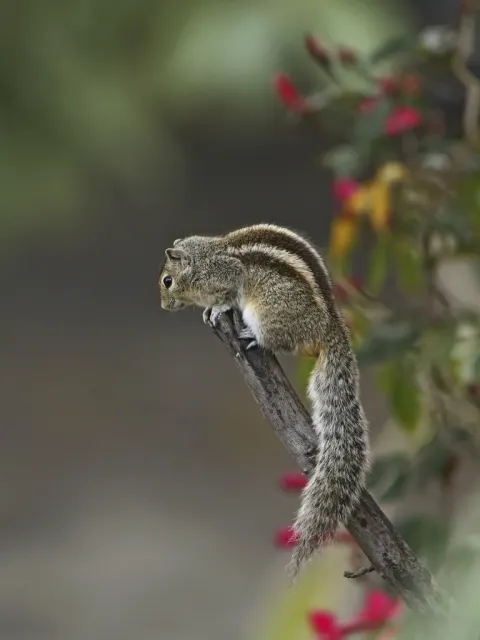
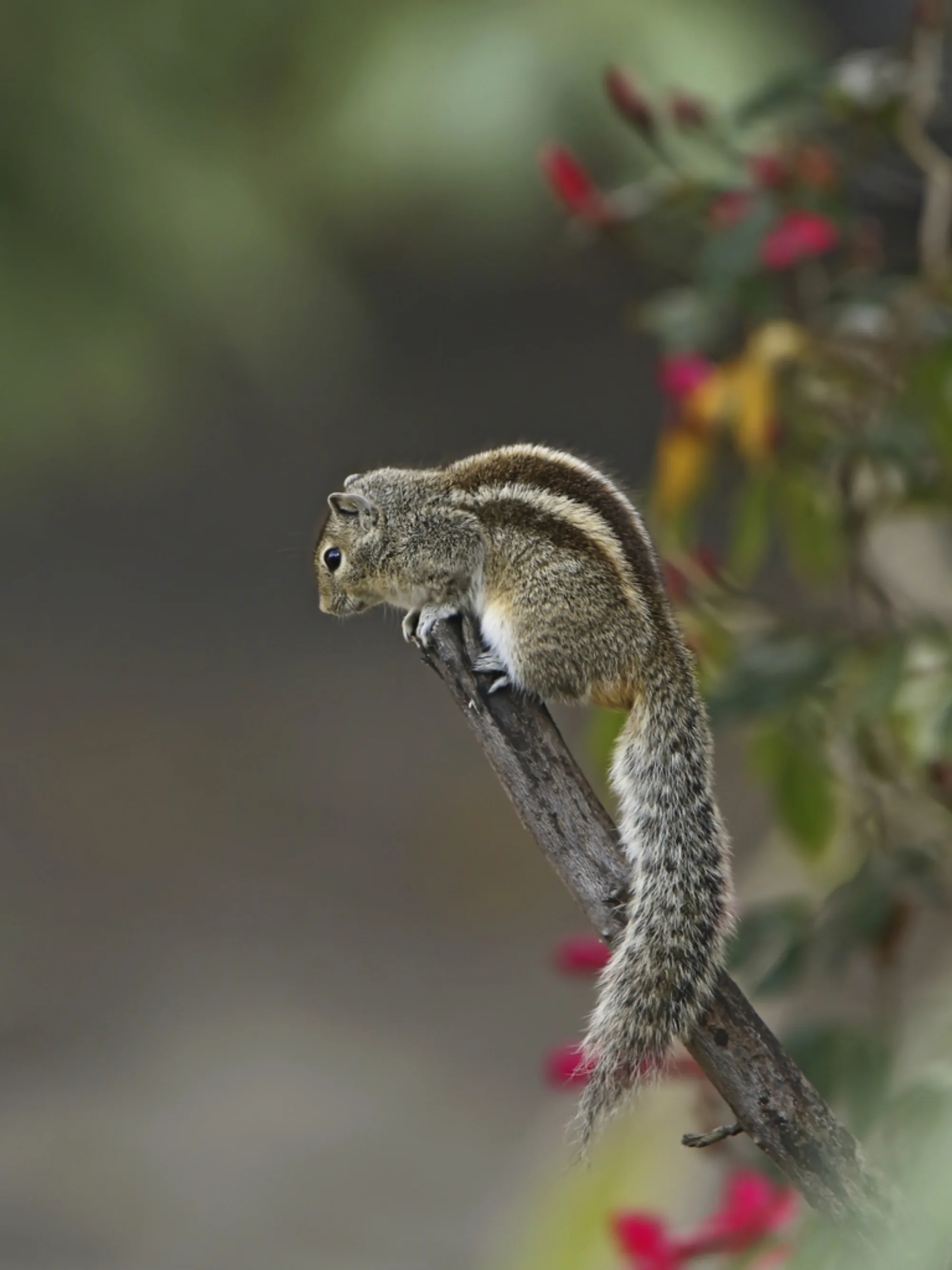
Look for three conspicuous white stripes against the grizzled grey-brown back of the Indian Palm Squirrel (Funambulus palmarum), a rodent about the size of a large chipmunk. The central stripe runs from head to tail, while the two outer stripes extend only from the forelegs to the hind legs. Its belly is creamy white, its ears are small and triangular, and its bushy tail is slightly shorter than its body. Long black and white hairs are interspersed across the tail, while young squirrels are noticeably lighter in colour and darken as they age.
The species occurs naturally in India south of the Vindhyas, the eastern districts of Karachi in Pakistan, Bangladesh and Sri Lanka. It was also introduced to Madagascar, Réunion, Mayotte, the Comoro Islands, Mauritius and Seychelles in the late 19th century. In urban areas, these squirrels are opportunists and can be tamed to accept food from people. Nuts and fruits make up most of their diet, though they also eat insects, smaller mammals and reptiles. They defend food sources from birds and other squirrels, and sound a repeated chip call to warn of danger.
Indian Palm Squirrels spend most of their lives alone, apart from mating and raising young, and do not hibernate. Breeding takes place in grass nests during autumn, after a gestation period of 34 days, and litters of two or three are common. The young are weaned at about 10 weeks and reach sexual maturity at 9 months.
Written from the English Wikipedia article Indian palm squirrel (CC BY-SA 4.0).
- Records
- 493
- Countries
- 2
- Atlas places
- 11
- Yala National Park· Sri Lanka
- Udawalawe National Park· Sri Lanka
- Bandipur National Park· India
- Minneriya National Park· Sri Lanka
- Wasgamuwa National Park· Sri Lanka
- Eravikulam National Park· India
- Kumana National Park· Sri Lanka
- Nagarhole National Park· India
- Pench National Park· India
- Periyar National Park· India
- Wilpattu National Park· Sri Lanka
These are open occurrence records, so they show where people looked for and recorded the Indian Palm Squirrel as much as where it lives. Cells are up to 25 km across, and every location is generalised to its cell.
Generalised encounter areas, not exact locations. Each shape is a grid cell coloured by how likely the species is there.
- Very likelyIndia25 km zone · medium confidence · 305 records · updated 80 days ago
- Very likelySri Lanka25 km zone · medium confidence · 188 records · updated 80 days ago
Conservation status not assessed here yet, so every location is generalised to its grid cell.