Northern Fulmar
Fulmarus glacialis
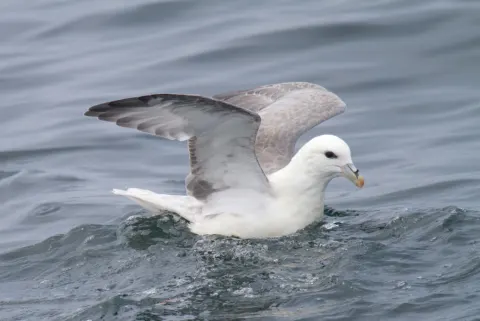
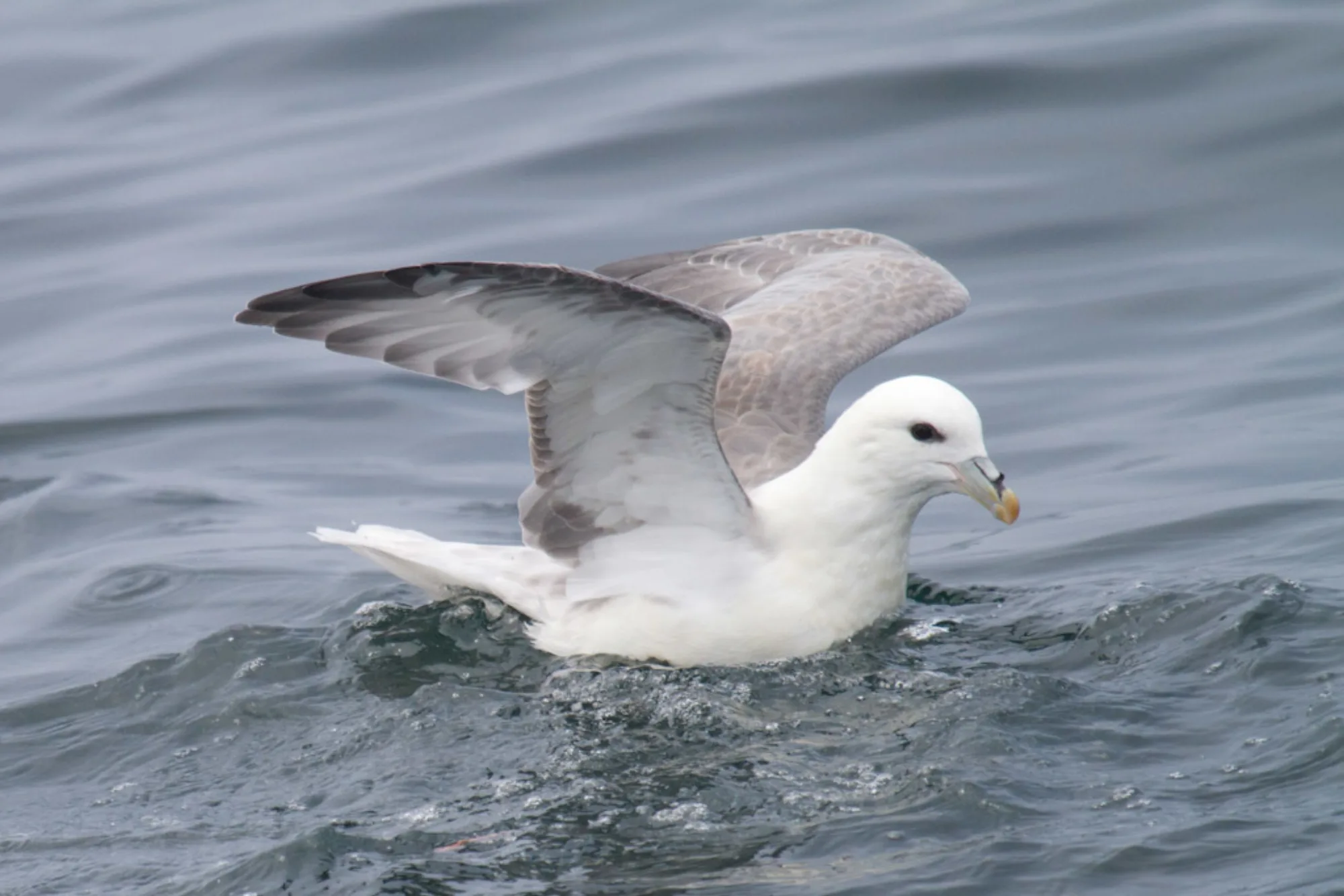
With its thick pale yellow bill and stiff-winged flight, the Northern Fulmar can look much like a gull, but it belongs to the same family as petrels and shearwaters. It has a stocky-looking neck, bluish legs and a wingspan of 102 to 112 cm. Light birds have white heads and bodies with grey wings and tails, while dark birds are grey throughout; many fall between these colour forms.
Fulmars live mainly in subarctic parts of the North Atlantic and North Pacific, spending long periods at sea. Breeding sites range from the high Arctic to temperate coasts, including Newfoundland and Brittany in the Atlantic and Alaska and eastern Siberia in the Pacific. They are strong fliers but walk with difficulty, and can dive up to 4 metres for fish. Their varied diet also includes squid, shrimps, plankton, jellyfish, carrion and refuse. They make grunting and chuckling sounds while feeding, and guttural calls during the breeding season.
Large nesting colonies gather on grassy ledges or on the ground, and some birds now nest on buildings and rooftops. Pairs form long-term bonds and return to the same nest site each year. Both parents build the nest, incubate a single white egg and care for the chick, which fledges after 70 to 75 days. During that period, the parents are active at night and may remain inactive on well-lit nights. A reduction in food from commercial fishing fleets and climatic change may shrink the fulmar's range. Plastic pollution is another concern: a study found microplastics in the digestive tracts of 89.5% of 143 northern fulmars examined.
Written from the English Wikipedia article Northern fulmar (CC BY-SA 4.0).
- Records
- 262,802
- Countries
- 14
- Atlas places
- 1
These are open occurrence records, so they show where people looked for and recorded the Northern Fulmar as much as where it lives. Cells are up to 25 km across, and every location is generalised to its cell.
Generalised encounter areas, not exact locations. Each shape is a grid cell coloured by how likely the species is there.
- Very likelyUnited Kingdom25 km zone · high confidence · 138957 records · updated 80 days ago
- Very likelyUnited States25 km zone · high confidence · 68894 records · updated 80 days ago
- Very likelyIceland25 km zone · high confidence · 24414 records · updated 80 days ago
- Very likelyNorway25 km zone · high confidence · 9208 records · updated 80 days ago
- Very likelyFaroe Islands25 km zone · high confidence · 4392 records · updated 80 days ago
- Very likelyIreland25 km zone · high confidence · 3783 records · updated 80 days ago
- Very likelyIsle of Man25 km zone · high confidence · 2934 records · updated 80 days ago
- Very likelyFrance25 km zone · high confidence · 2652 records · updated 80 days ago
- Very likelyNetherlands25 km zone · high confidence · 2091 records · updated 80 days ago
- Very likelySvalbard & Jan Mayen25 km zone · high confidence · 1749 records · updated 80 days ago
Conservation status not assessed here yet, so every location is generalised to its grid cell.