Eurasian Coot
Fulica atra
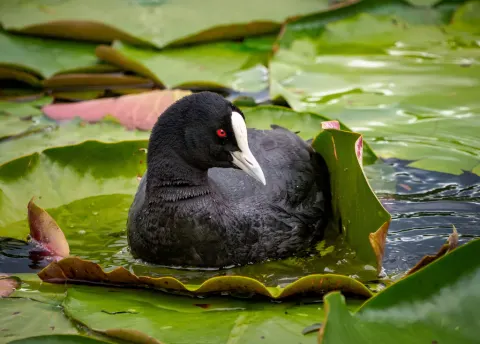
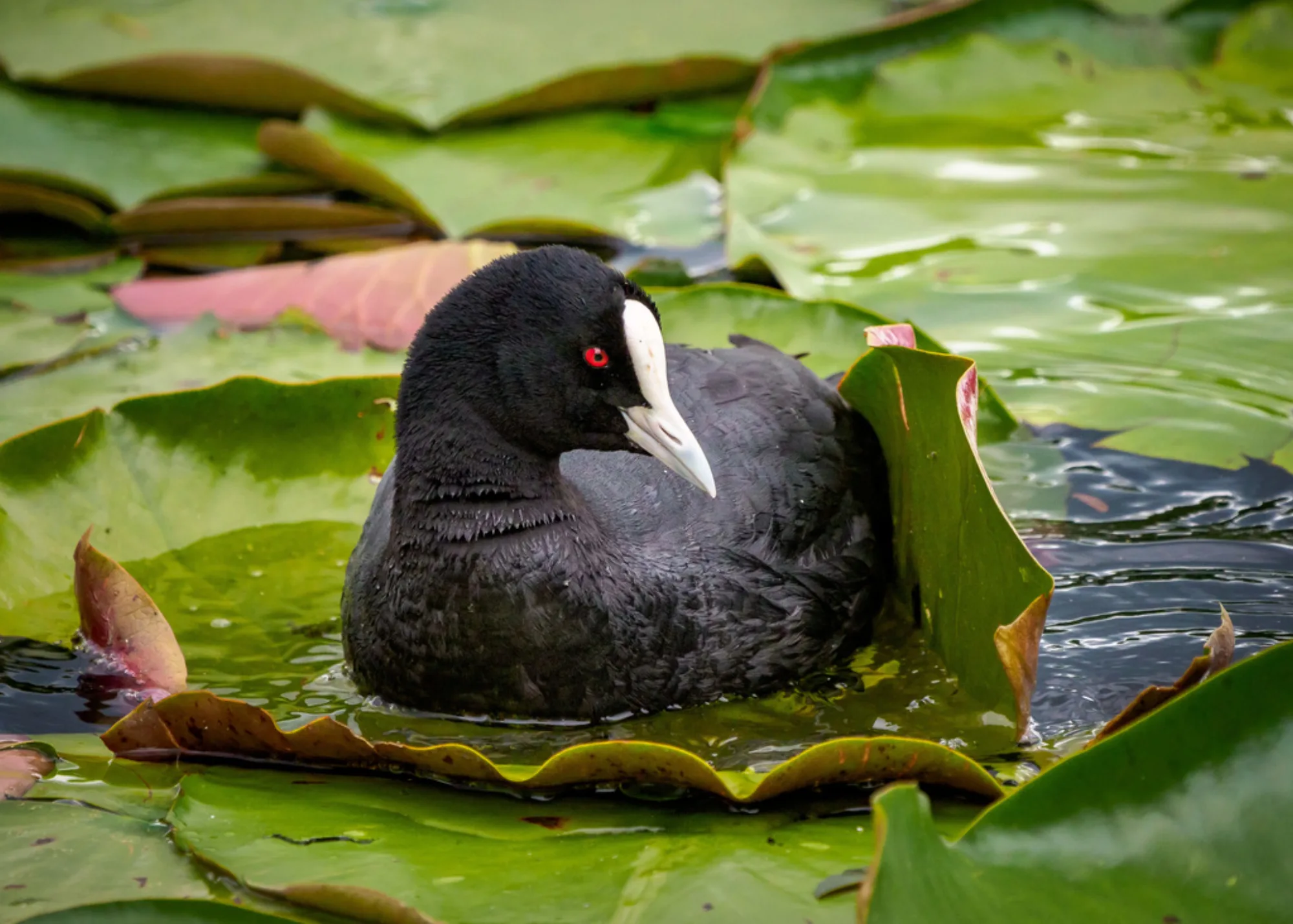
A white bill and white shield above it stand out against the Eurasian Coot's slaty-black body and glossy black head. This member of the rail and crake family measures 36 to 38 cm in length, and males and females look alike. Young birds are paler, with whitish breasts, and lack the facial shield. Listen for its varied crackling, explosive or trumpeting calls, which are often heard at night. It swims in open water and walks across grassland beside the water, making it less secretive than most of its relatives.
The coot's range extends from Europe and North Africa across Asia to Australia and New Zealand. It breeds on freshwater lakes and ponds and has adapted to urban surroundings, including parks and gardens with access to water. Birds remain year-round in milder parts of the range, while many from Asia move south and west in winter as waters freeze. A swimming coot moves its head up and down, and gives a little jump before diving briefly. Reluctant to fly, it splashes across the surface when taking off, though migrating birds can cover large distances, usually at night. It eats algae, plants, seeds and fruit as well as small live prey and the eggs of other waterbirds, feeding by grazing, upending or diving.
During the breeding season, coots defend territories aggressively, with both parents taking part. They build a bulky nest of stems and leaves, usually hidden among vegetation, either floating or resting in shallow water. A clutch usually holds six to ten eggs, and both parents incubate them. Outside the breeding season, coots may gather in large flocks. For chicks, starvation is a greater cause of death than predation, and most deaths occur within the first 10 days after hatching.
Written from the English Wikipedia article Eurasian coot (CC BY-SA 4.0).
- Records
- 1,487,964
- Countries
- 108
- Atlas places
- 6
These are open occurrence records, so they show where people looked for and recorded the Eurasian Coot as much as where it lives. Cells are up to 25 km across, and every location is generalised to its cell.
Generalised encounter areas, not exact locations. Each shape is a grid cell coloured by how likely the species is there.
- Very likelyUnited Kingdom25 km zone · high confidence · 356816 records · updated 86 days ago
- Very likelyAustralia25 km zone · high confidence · 263846 records · updated 86 days ago
- Very likelyBelgium25 km zone · high confidence · 220584 records · updated 86 days ago
- Very likelyFrance25 km zone · high confidence · 100131 records · updated 86 days ago
- Very likelySpain25 km zone · high confidence · 81831 records · updated 86 days ago
- Very likelyNetherlands25 km zone · high confidence · 56663 records · updated 86 days ago
- Very likelyIndia25 km zone · high confidence · 51602 records · updated 86 days ago
- Very likelyNorway25 km zone · high confidence · 50302 records · updated 86 days ago
- Very likelyTaiwan25 km zone · high confidence · 25036 records · updated 86 days ago
- Very likelyGermany25 km zone · high confidence · 24825 records · updated 86 days ago
Conservation status not assessed here yet, so every location is generalised to its grid cell.