Damara Mole Rat
Fukomys damarensis
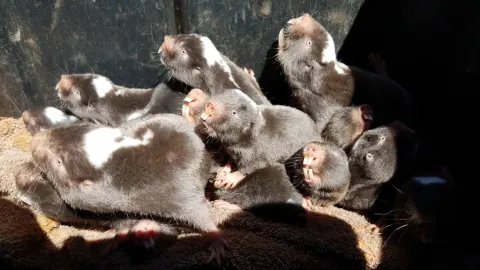
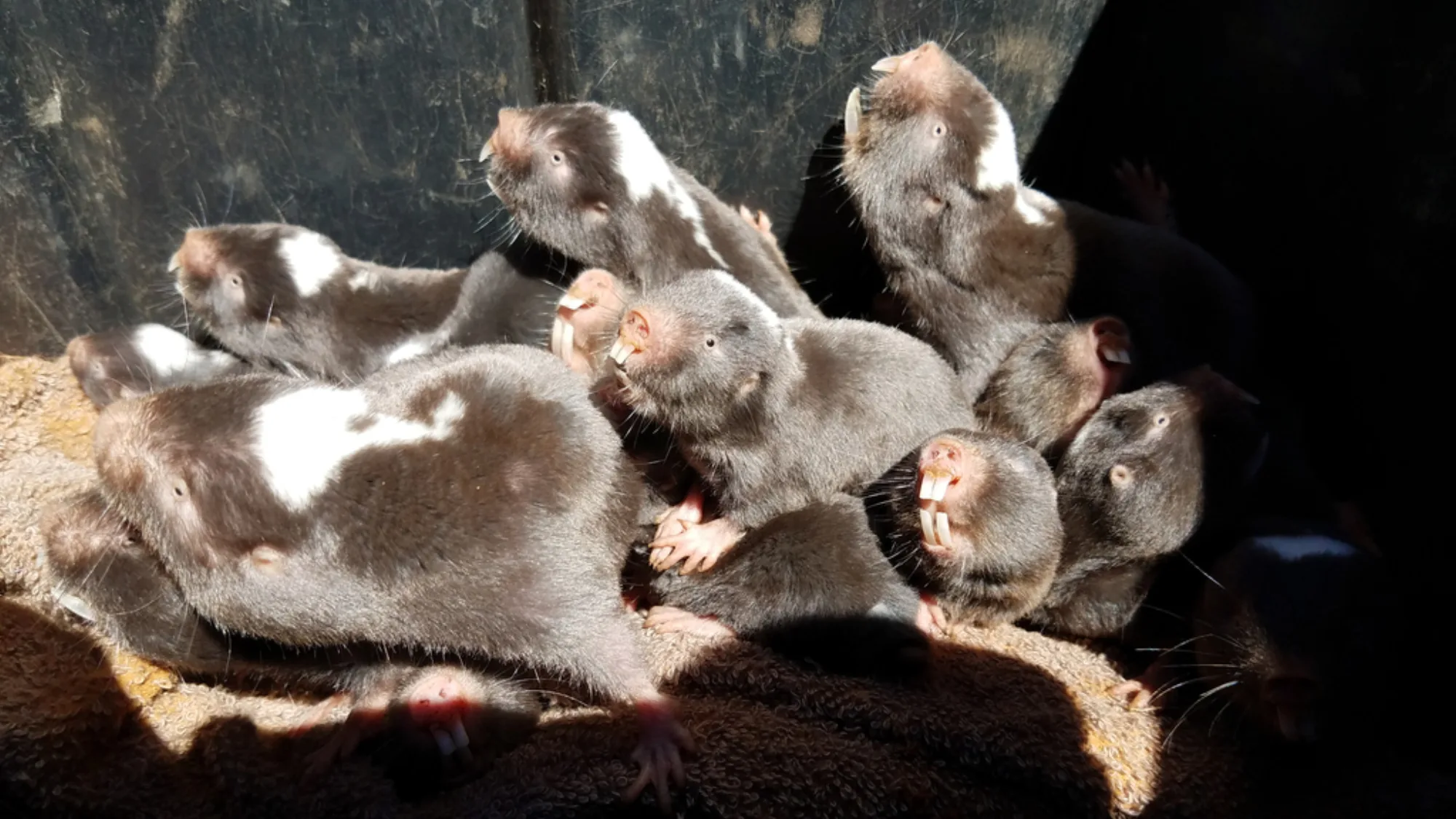
Across the warm, semi-arid landscapes of southern Africa, the Damara Mole Rat spends its life underground. This burrowing rodent has a cylindrical body, short, stout limbs and a conical head, with tiny blue eyes and no external ears. Its short, thick fur ranges from fawn to almost black, most often brown, and a white patch always marks the top of its head. The head and body measure 14 to 20 cm, with a tail of 2 to 3 cm. It occurs in Botswana, Namibia, South Africa, Zambia and Zimbabwe, favouring savannah scrubland and sandy grasslands where suitable underground plant foods are available.
Colonies occupy networks of tunnels that can extend up to 1 km, with dome-shaped mounds of excavated soil revealing their presence above ground. Most digging takes place after rain, when the soil is easier to excavate. The animals use their front teeth to dig, seeking tubers, corms and bulbs, which provide all their water as well as food. Smaller finds are carried to storage chambers, while particularly large ones may be eaten where they grow. A colony typically has about twelve members, comprising one breeding pair and their non-breeding offspring. The other colony members forage, maintain tunnels and close any breaches. Although they live entirely underground, these mole rats are mainly active during the day. The breeding female can produce up to three litters a year, each with one to six pups. Mole snakes and sometimes cobras prey on them, while individuals travelling above ground to establish new colonies are vulnerable to a wider range of predators.
Written from the English Wikipedia article Damaraland mole-rat (CC BY-SA 4.0).
- Records
- 3
- Countries
- 1
No atlas park has a record of the Damara Mole Rat in or around it yet.
These are open occurrence records, so they show where people looked for and recorded the Damara Mole Rat as much as where it lives. Cells are up to 25 km across, and every location is generalised to its cell.
Generalised encounter areas, not exact locations. Each shape is a grid cell coloured by how likely the species is there.
- Very likelySouth Africa25 km zone · medium confidence · 3 records · updated 80 days ago
Conservation status not assessed here yet, so every location is generalised to its grid cell.