Brambling
Fringilla montifringilla
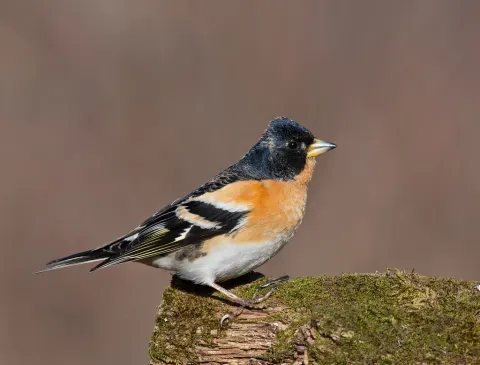
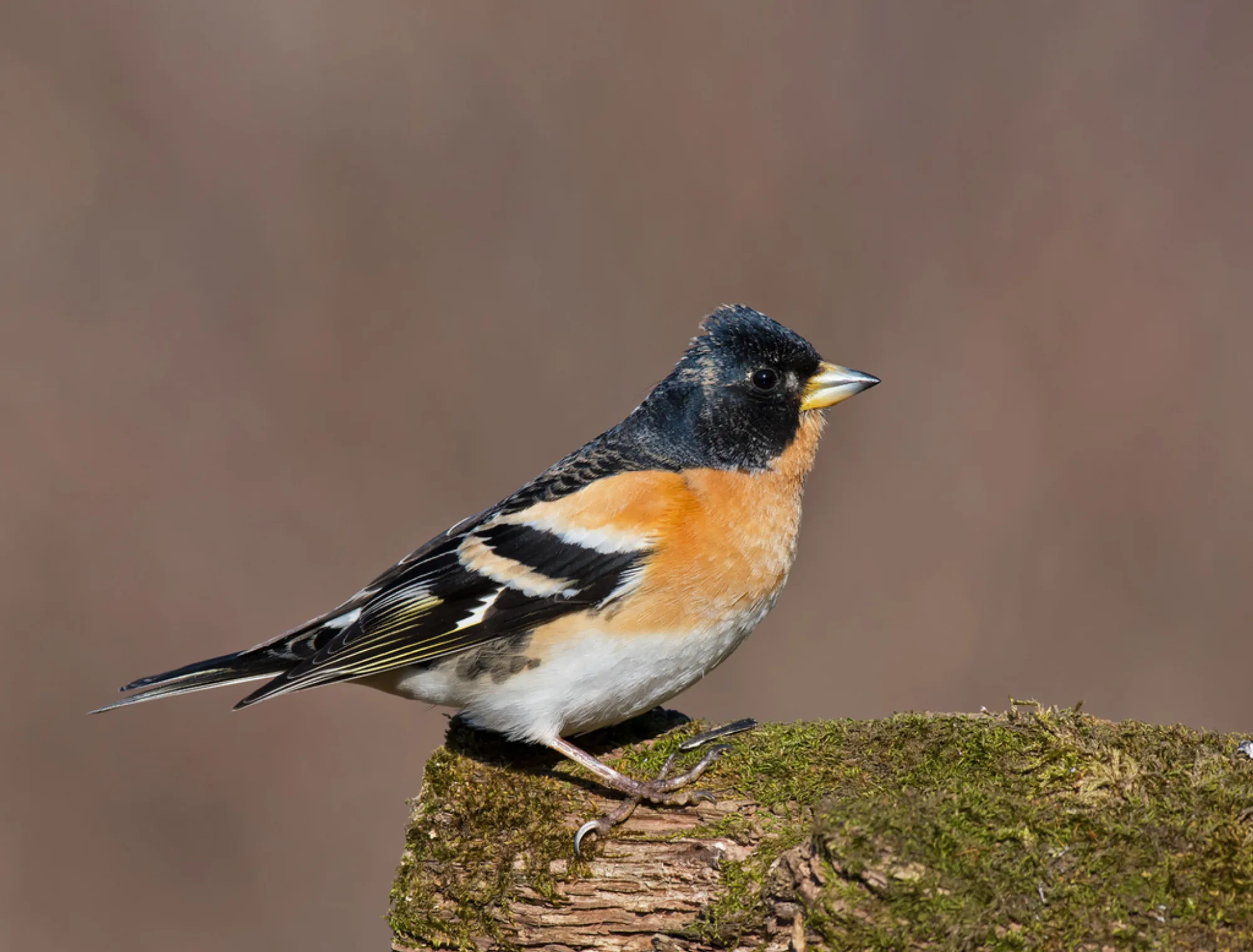
In breeding plumage, a male Brambling has a black head, dark upperparts, an orange breast and a white belly. This small finch resembles a common chaffinch in size and shape, while females and young birds can look particularly alike. Look for the white rump, orange breast and dark spots on the flanks to help distinguish a Brambling from a chaffinch. Most have a yellow bill, though breeding males have black bills. The bird measures 16 cm in length and weighs 23 to 29 g.
Bramblings breed in northern European forests and range east through the Palearctic, favouring open coniferous or birch woodland. Almost all migrate, wintering in China, Japan, northern India, northern Pakistan, North Africa and southern Europe. During migration, some stray into Alaska, with scattered records farther south in Canada and the northern United States. In European winters, flocks can gather in their thousands or even millions, particularly where beech mast is plentiful. Winter flocks move in search of this food, although the birds can manage without it. Their diet is mostly seeds in winter and insects in summer.
A female usually builds her nest high against a tree trunk, using materials such as lichen, grass, cobwebs and strips of bark, with a softer lining. She normally lays 5 to 7 eggs and incubates them; both parents feed and care for the young. Nest predators include carrion crows and Siberian jays, while common cuckoos often parasitise the nests. The global population is decreasing.
Written from the English Wikipedia article Brambling (CC BY-SA 4.0).
- Records
- 427,884
- Countries
- 80
No atlas park has a record of the Brambling in or around it yet.
These are open occurrence records, so they show where people looked for and recorded the Brambling as much as where it lives. Cells are up to 25 km across, and every location is generalised to its cell.
Generalised encounter areas, not exact locations. Each shape is a grid cell coloured by how likely the species is there.
- Very likelyNorway25 km zone · high confidence · 123760 records · updated 86 days ago
- Very likelySweden25 km zone · high confidence · 99923 records · updated 86 days ago
- Very likelyFinland25 km zone · high confidence · 77506 records · updated 86 days ago
- Very likelyBelgium25 km zone · high confidence · 36540 records · updated 86 days ago
- Very likelyFrance25 km zone · high confidence · 13974 records · updated 86 days ago
- Very likelyUnited Kingdom25 km zone · high confidence · 8510 records · updated 86 days ago
- Very likelyChina25 km zone · high confidence · 6293 records · updated 86 days ago
- Very likelyDenmark25 km zone · high confidence · 5813 records · updated 86 days ago
- Very likelyNetherlands25 km zone · high confidence · 5155 records · updated 86 days ago
- Very likelyIsrael25 km zone · high confidence · 4516 records · updated 86 days ago
Conservation status not assessed here yet, so every location is generalised to its grid cell.