Great Frigatebird
Fregata minor
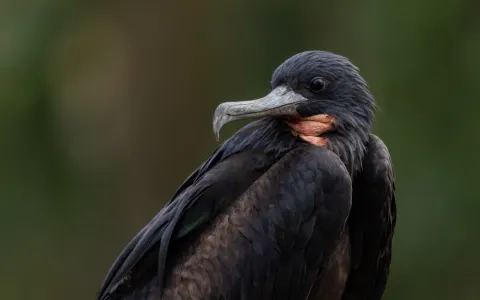
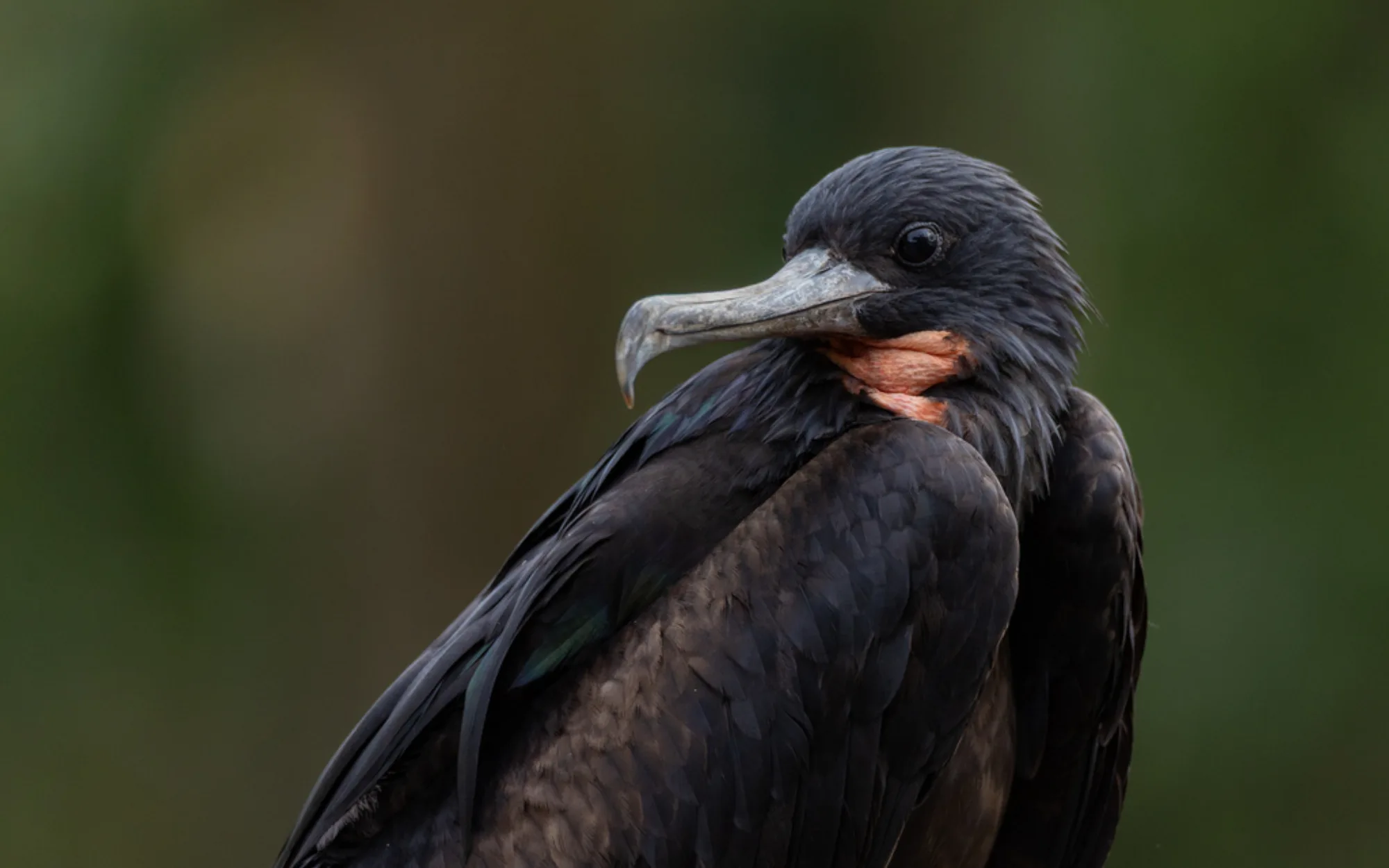
With long, pointed wings and a deeply forked tail, the Great Frigatebird cuts a distinctive shape above tropical seas. This large, lightly built seabird measures 85 to 105 cm long and is mostly black. Females are larger than males, with a white throat and breast and a red ring around the eye. Males have a green sheen on their feathers, while young birds have a white face, head and throat tinged with rust. During the breeding season, males can inflate a striking red throat pouch.
Major nesting populations live in the tropical Pacific, including Hawaii and the Galápagos Islands, while Indian Ocean colonies occur in the Seychelles and Mauritius. In the Atlantic, a much smaller population lives around Ascension Island and St. Helena, as well as Trindade and Martin Vaz off Brazil. Birds travel widely but may return to the colony where they hatched to breed. Over open water, they snatch prey in flight, most often flying fish, and sometimes feed in large flocks alongside other seabirds. They also chase seabirds to steal food, though this supplements what they catch themselves.
Great Frigatebirds nest in colonies in bushes and trees, or on the ground where vegetation is absent, sometimes alongside red-footed boobies. Both parents incubate the single egg, and care continues long after the chick has fledged. On Trindade, the bird has disappeared as a breeding species from the main island, though small numbers remain elsewhere in the archipelago. Forest destruction and overgrazing by introduced goats prevented the forest from recovering there, while feral cats seriously depleted ground-nesting birds before they were eradicated.
Written from the English Wikipedia article Great frigatebird (CC BY-SA 4.0).
- Records
- 45,927
- Countries
- 53
- Atlas places
- 5
These are open occurrence records, so they show where people looked for and recorded the Great Frigatebird as much as where it lives. Cells are up to 25 km across, and every location is generalised to its cell.
Generalised encounter areas, not exact locations. Each shape is a grid cell coloured by how likely the species is there.
- Very likelyUnited States25 km zone · high confidence · 20567 records · updated 86 days ago
- Very likelyEcuador25 km zone · high confidence · 11669 records · updated 86 days ago
- Very likelyAustralia25 km zone · high confidence · 2748 records · updated 86 days ago
- Very likelyU.S. Outlying Islands25 km zone · high confidence · 2282 records · updated 86 days ago
- Very likelyChristmas Island25 km zone · high confidence · 1064 records · updated 86 days ago
- Very likelyFrench Polynesia25 km zone · high confidence · 1013 records · updated 86 days ago
- Very likelySeychelles25 km zone · high confidence · 925 records · updated 86 days ago
- Very likelyCosta Rica25 km zone · high confidence · 918 records · updated 86 days ago
- Very likelyChile25 km zone · high confidence · 768 records · updated 86 days ago
- Very likelyIndonesia25 km zone · high confidence · 672 records · updated 86 days ago
Conservation status not assessed here yet, so every location is generalised to its grid cell.