Atlantic Puffin
Fratercula arctica
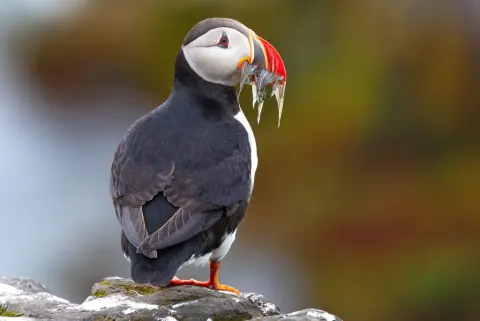
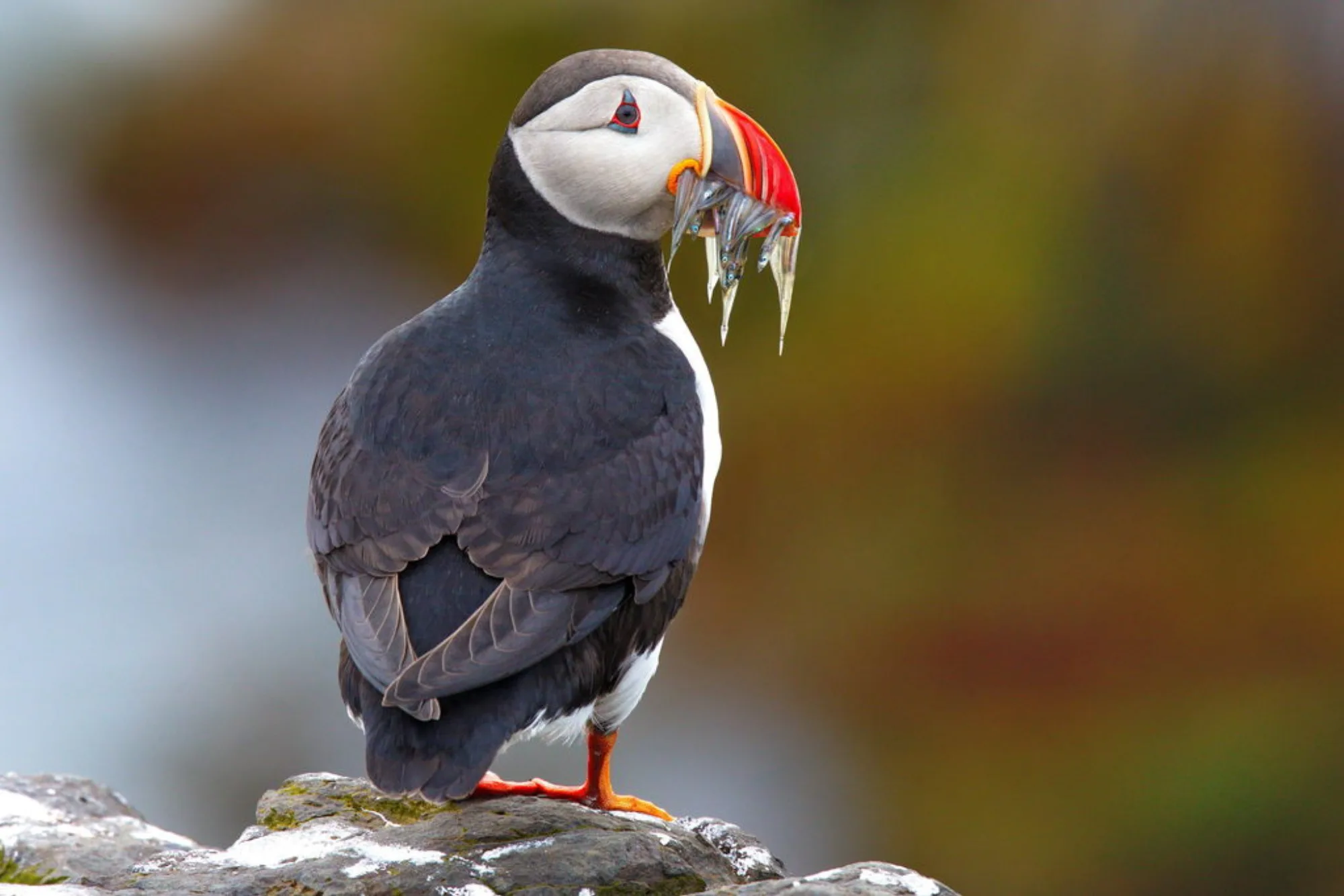
With its upright stance, orange legs and broad red-and-black bill, the Atlantic Puffin is a distinctive seabird of the auk family. Its crown and back are black, its cheeks light grey and its underparts white. The bright facial colours return in spring after fading during a winter moult at sea; young birds are duller, with darker faces and narrower bills.
Puffins spend autumn and winter far out in cold northern waters, returning to coasts in late spring to breed. They nest in colonies on grassy clifftops, often on islands, across a range that includes Iceland, Norway, Britain, Greenland and eastern North America. The Westman Islands in Iceland are a particularly common place to find them. At sea, puffins swim at the surface and dive for food, using their wings to propel themselves underwater. Fish make up almost all their diet, including sand eels, herring, capelin and sprats, though they also eat some crustaceans and other marine animals. Around breeding colonies, birds may circle several times before landing, and the slopes are busiest in the evening, when puffins rest or gather outside their burrows.
A pair lays a single white egg in a burrow, and both parents help care for the chick. The young bird feeds mostly on whole fish, then leaves for the sea at night after about 6 weeks and stays away from land for several years. Gulls and skuas prey on puffins and their young, while introduced rats and other mammals threaten nesting colonies. Declining food supplies, fishing nets, oil spills and climate change are among the other pressures facing the species.
Written from the English Wikipedia article Atlantic puffin (CC BY-SA 4.0).
- Records
- 119,467
- Countries
- 13
- Atlas places
- 1
These are open occurrence records, so they show where people looked for and recorded the Atlantic Puffin as much as where it lives. Cells are up to 25 km across, and every location is generalised to its cell.
Generalised encounter areas, not exact locations. Each shape is a grid cell coloured by how likely the species is there.
- Very likelyUnited Kingdom25 km zone · high confidence · 45428 records · updated 81 days ago
- Very likelyUnited States25 km zone · high confidence · 29764 records · updated 81 days ago
- Very likelyCanada25 km zone · high confidence · 15973 records · updated 81 days ago
- Very likelyIceland25 km zone · high confidence · 9633 records · updated 81 days ago
- Very likelyNorway25 km zone · high confidence · 8709 records · updated 81 days ago
- Very likelyFaroe Islands25 km zone · high confidence · 4895 records · updated 81 days ago
- Very likelySvalbard & Jan Mayen25 km zone · high confidence · 1822 records · updated 81 days ago
- Very likelyIreland25 km zone · high confidence · 1748 records · updated 81 days ago
- Very likelySpain25 km zone · high confidence · 648 records · updated 81 days ago
- Very likelyFrance25 km zone · high confidence · 569 records · updated 81 days ago
Conservation status not assessed here yet, so every location is generalised to its grid cell.