Malagasy Civet
Fossa fossana
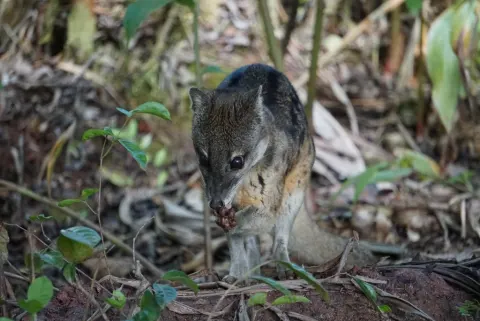
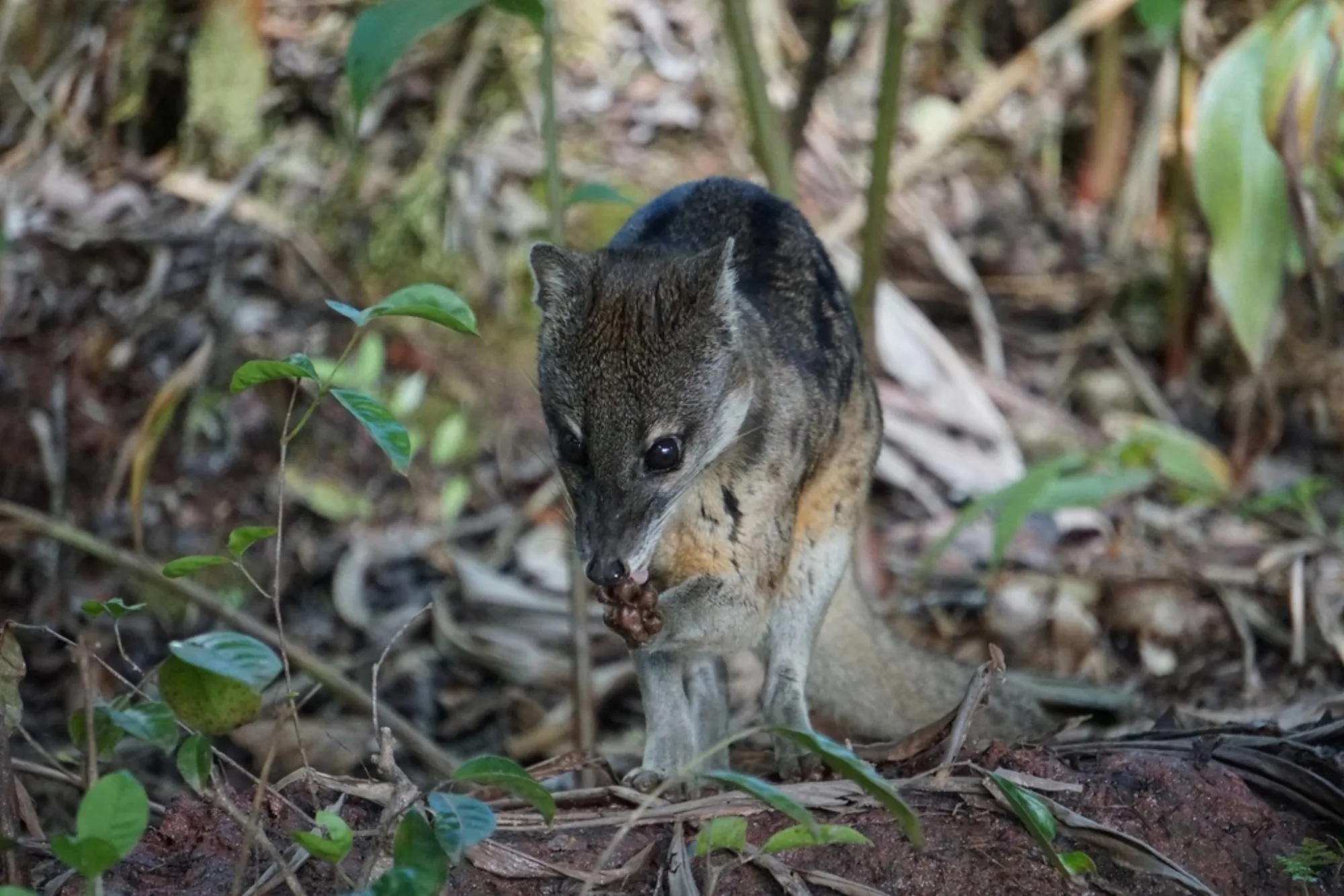
A shy, secretive night wanderer, the Malagasy Civet is a small mammal found only in Madagascar. Its short coat is greyish beige or brown, marked with dark stripes that run along the body and become spots near the belly. On its bushier tail, the stripes wrap around vertically. Short, very thin legs support a body about 47 centimetres long, with a tail of about 20 centimetres.
Look for its habitat in the tropical forests of eastern and northern Madagascar, including lowland and rainforest areas. It also lives in the humid, isolated forests of Amber Mountain National Park and the less humid forests of Ankarana Reserve farther north. Its range extends from sea level to 1,600 metres, although it is common only up to 1,000 metres. It frequents ravines and is not a good climber. Sources disagree on whether it lives alone or in pairs, but male and female pairs defend territories of around 50 hectares.
Its food includes small mammals, birds, reptiles and amphibians, as well as insects, aquatic animals and eggs taken from birds' nests. Its calls resemble crying and groaning, with another sound like coq-coq. Breeding takes place from August to September, and after a pregnancy of around three months, a single offspring is born. It is weaned in two to three months and leaves its parents at around one year old. Forest loss, logging and charcoal production threaten the civet, along with hunting and competition from introduced dogs, cats and small Indian civets. Dogs may also prey on it, and its range has been reduced to isolated patches.
Written from the English Wikipedia article Malagasy civet (CC BY-SA 4.0).
- Records
- 6
- Countries
- 1
No atlas park has a record of the Malagasy Civet in or around it yet.
These are open occurrence records, so they show where people looked for and recorded the Malagasy Civet as much as where it lives. Cells are up to 25 km across, and every location is generalised to its cell.
Generalised encounter areas, not exact locations. Each shape is a grid cell coloured by how likely the species is there.
- Very likelyMadagascar25 km zone · medium confidence · 6 records · updated 80 days ago
Conservation status not assessed here yet, so every location is generalised to its grid cell.