Pygmy Killer Whale
Feresa attenuata
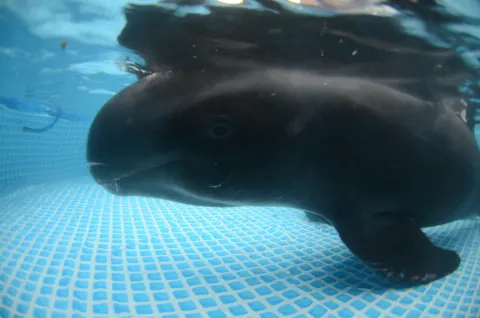
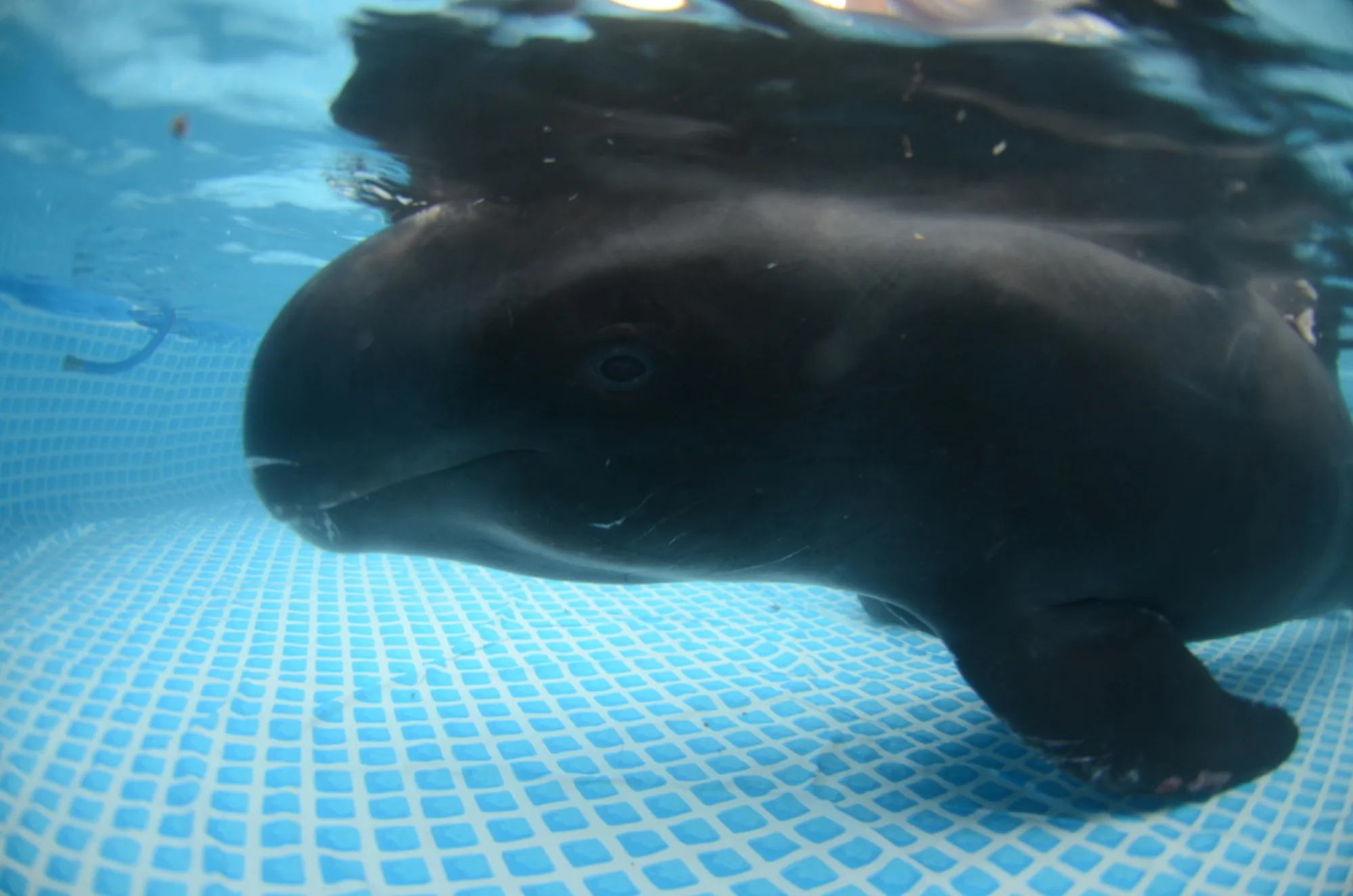
Rarely seen and poorly known, the Pygmy Killer Whale is an oceanic dolphin with an average length of just over two metres. Its dark grey to black back changes sharply to lighter grey sides, and white around the mouth extends onto the face. A rounded tip to the dorsal fin is another useful clue, though melon-headed and false killer whales can look similar. At the surface, it usually moves slowly and rarely rides the bow waves of boats.
The species ranges through tropical and subtropical waters worldwide, mostly in deep water from 500 m to 2000 m. It is sighted regularly off Hawaii and Japan, though sightings remain rare even around the resident Hawaiian population. Animals have been seen in groups of 4 to 30 or more, and they use echolocation. Around Hawaii, the dolphins have a closely connected social structure, with some associations lasting up to 15 years. There, they have also been seen alongside bottlenose dolphins, short-finned pilot whales and false killer whales. The species is known to breed in spring in the Gulf of Mexico.
Fishing gear poses a threat: pygmy killer whales are caught incidentally, including in commercial drift gill nets off Sri Lanka. They are also vulnerable to parasites and attacks by cookie cutter sharks, and occasionally become involved in mass strandings. In some strandings, healthy animals repeatedly return to shore and stay with a sick or injured individual until it dies. The species has been aggressive in captivity, but such behaviour has not been observed in the wild.
Written from the English Wikipedia article Pygmy killer whale (CC BY-SA 4.0).
- Records
- 152
- Countries
- 8
- Atlas places
- 2
These are open occurrence records, so they show where people looked for and recorded the Pygmy Killer Whale as much as where it lives. Cells are up to 25 km across, and every location is generalised to its cell.
Generalised encounter areas, not exact locations. Each shape is a grid cell coloured by how likely the species is there.
- Very likelyGuadeloupe25 km zone · medium confidence · 54 records · updated 80 days ago
- Very likelyUnited States25 km zone · medium confidence · 36 records · updated 80 days ago
- Very likelyAustralia25 km zone · medium confidence · 28 records · updated 80 days ago
- Very likelyTaiwan25 km zone · medium confidence · 13 records · updated 80 days ago
- PossibleFrench Guiana25 km zone · medium confidence · 15 records · updated 80 days ago
- PossibleMartinique25 km zone · medium confidence · 4 records · updated 80 days ago
- UncommonRéunion25 km zone · medium confidence · 2 records · updated 80 days ago
- RareMadagascar25 km zone · low confidence · 0 records · updated 80 days ago
Conservation status not assessed here yet, so every location is generalised to its grid cell.