Wildcat
Felis silvestris
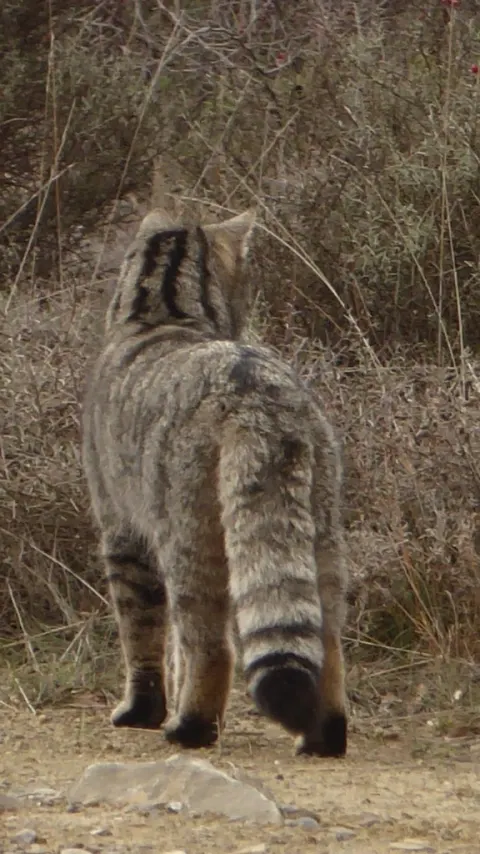
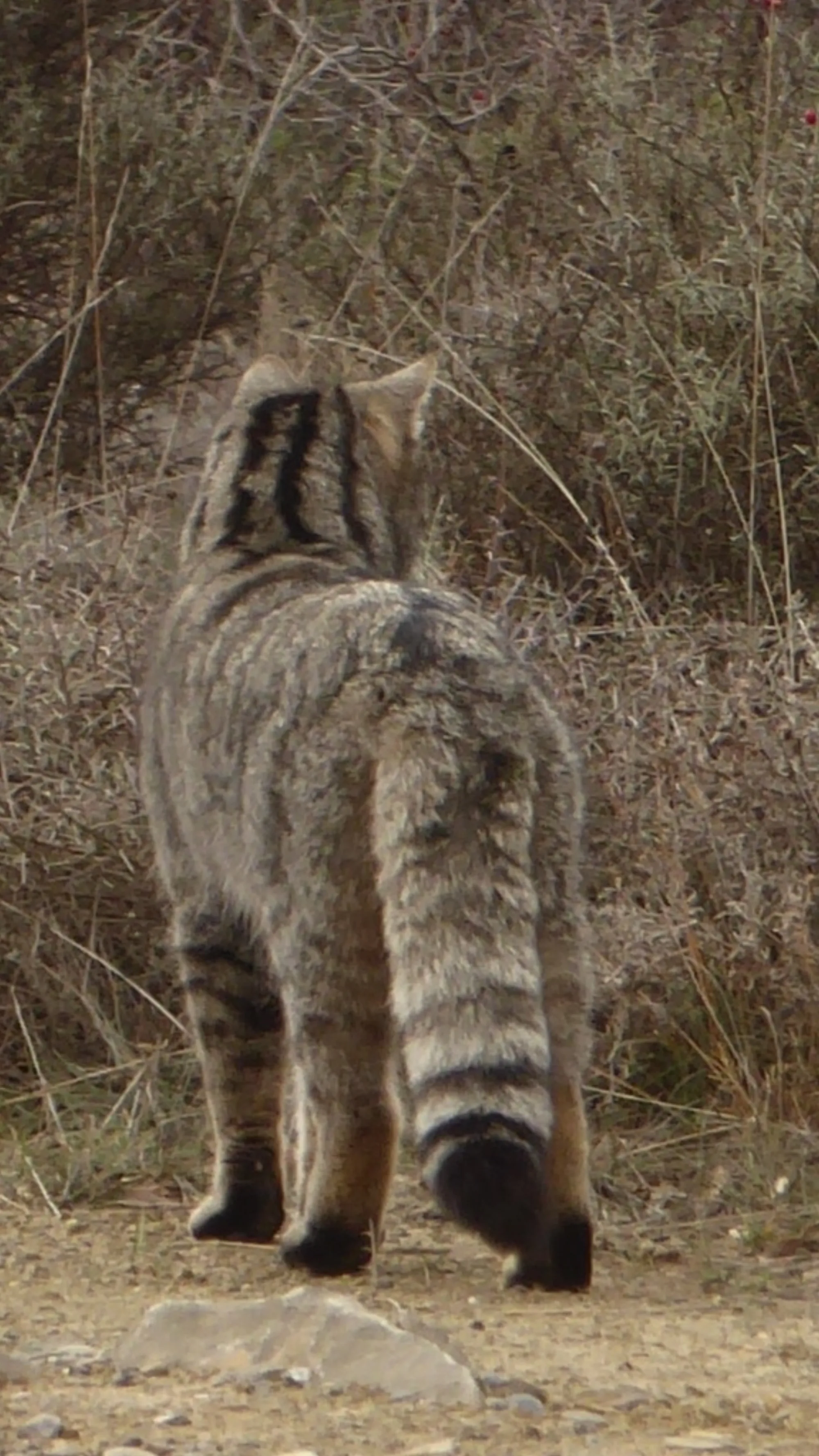
Brownish to grey fur, dark stripes and a bushy, black-tipped tail help identify the European Wildcat, a small wild cat native to parts of Europe and beyond. Its forehead is striped, while irregular dark markings on its sides break into a blotched pattern on the hind legs. The tail has two to three black rings and a rounded tip. On average, it is bigger and stouter than a domestic cat, with longer fur and a shorter, bushier tail. Looks alone can be misleading, though, because wildcats and domestic cats interbreed and their striped hybrids can be difficult to distinguish.
Across its native range in continental Europe, Scotland, Turkey and the Caucasus, the Wildcat favours woodland with broad-leaved trees or a mixture of tree types. It steers clear of settlements and heavily farmed areas, and has disappeared from England and Wales. In France and Italy it is most active at night, although it also moves about by day where human activity does not disturb it. Small mammals are its main prey, including rodents and rabbits, but it also takes ground-dwelling birds. Its diet varies by region: in Moldavia, for example, it eats mainly rodents in winter and takes birds, fish and crayfish in summer.
Interbreeding with feral cats threatens the distinctiveness of the wild population in the Scottish Highlands and is also a threat in Portugal and Spain. Habitat loss threatens the population in Portugal and Spain, while the destruction of broad-leaved forests has reduced the range of eastern populations. Although protected by law, wildcats are still sometimes shot by people who mistake them for feral cats. In Scotland, some wildcats released in 2023 gave birth to kittens the following spring.
Written from the English Wikipedia article European wildcat (CC BY-SA 4.0).
- Records
- 25,552
- Countries
- 10
No atlas park has a record of the Wildcat in or around it yet.
These are open occurrence records, so they show where people looked for and recorded the Wildcat as much as where it lives. Cells are up to 25 km across, and every location is generalised to its cell.
Generalised encounter areas, not exact locations. Each shape is a grid cell coloured by how likely the species is there.
- Very likelyFrance25 km zone · high confidence · 12337 records · updated 80 days ago
- Very likelySwitzerland25 km zone · high confidence · 5527 records · updated 80 days ago
- Very likelyLuxembourg25 km zone · high confidence · 3541 records · updated 80 days ago
- Very likelyGermany25 km zone · high confidence · 3332 records · updated 80 days ago
- Very likelyIsrael25 km zone · high confidence · 418 records · updated 80 days ago
- Very likelyUkraine25 km zone · high confidence · 202 records · updated 80 days ago
- LikelyUnited Kingdom25 km zone · medium confidence · 87 records · updated 80 days ago
- LikelySenegal25 km zone · medium confidence · 43 records · updated 80 days ago
- LikelyBelgium25 km zone · medium confidence · 39 records · updated 80 days ago
- LikelyLebanon25 km zone · medium confidence · 26 records · updated 80 days ago
Conservation status not assessed here yet, so every location is generalised to its grid cell.