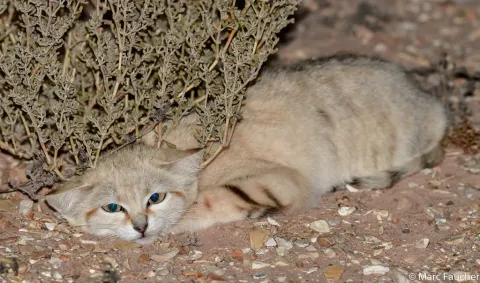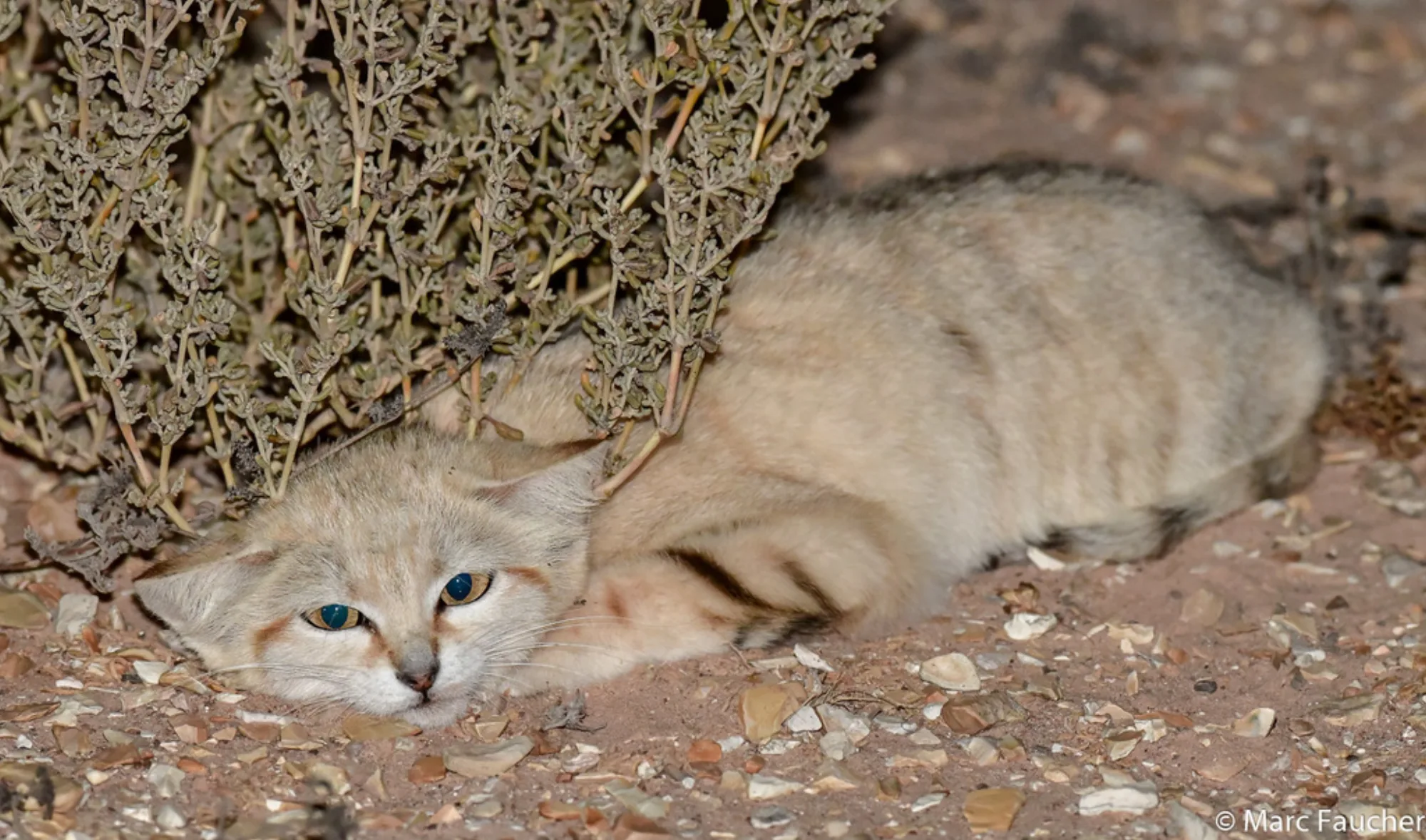
Sand Cat
Felis margarita
At home in sandy and stony deserts, the Sand Cat is a small wild cat whose pale sandy to light grey coat blends into its surroundings. Its broad, flat head has short ears set low on either side, while its short legs and relatively long tail give it a distinctive outline. A faint reddish line crosses each cheek from the eye, and dark bars mark the legs. Its fur-covered paws are insulated against extreme temperatures, but also leave tracks that are difficult to identify and follow.
Its scattered range stretches across North Africa and into Southwest and Central Asia, often in deserts far from water. It favours flat or gently rolling ground with sparse grasses or small bushes, although it has also been recorded among dunes in parts of its range. Usually solitary, it rests underground by day and hunts at night, travelling an average of 5.4 km on its nightly search for food. Small rodents and birds are on the menu, along with reptiles, including venomous snakes. In the Ténéré, cats have been observed burying leftover prey for later and obtaining the moisture they need from their food. Females give birth to two to three kittens in spring; the young can fend for themselves by the close of their first year.
Habitat degradation and the loss of sand dunes threaten populations in Western Asia, while drought, desertification and the loss of natural vegetation can reduce the vegetation needed by their small-mammal prey. Sand cats have also been caught in fences and traps, killed by domestic dogs and taken for the pet trade.
Written from the English Wikipedia article Sand cat (CC BY-SA 4.0).
- Records
- 3
- Countries
- 1
No atlas park has a record of the Sand Cat in or around it yet.
These are open occurrence records, so they show where people looked for and recorded the Sand Cat as much as where it lives. Cells are up to 25 km across, and every location is generalised to its cell.
Generalised encounter areas, not exact locations. Each shape is a grid cell coloured by how likely the species is there.
- Very likelyUnited States25 km zone · medium confidence · 3 records · updated 80 days ago
Conservation status not assessed here yet, so every location is generalised to its grid cell.