African Wildcat
Felis lybica
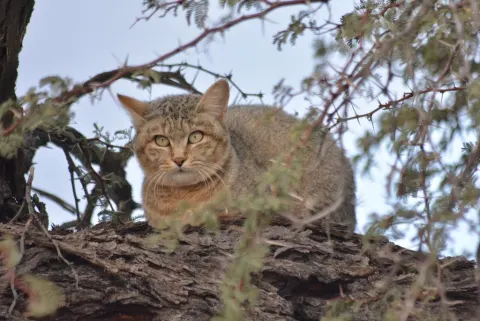
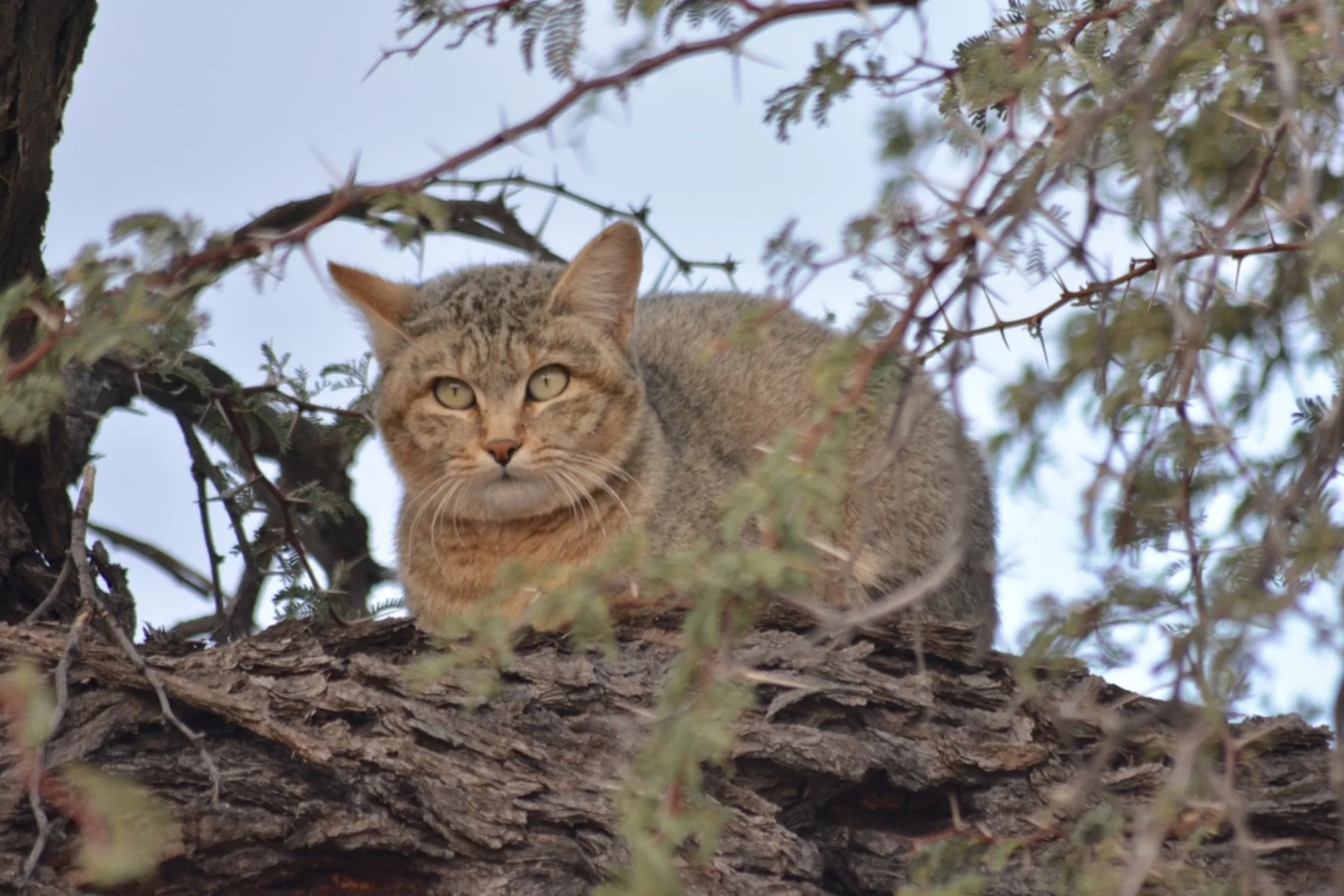
Sandy grey fur and a slender, black-tipped tail give the African Wildcat the look of a small, lightly marked cat. Its coat can have a pale yellow or reddish tint, while the throat and belly are almost white. Dark lines cross the face, and the faint vertical stripes on its sides often break into spots. Its ears usually carry small tufts, and the tail has two to three rings near its tip.
The cat ranges across Africa and the Middle East, through Central Asia to Xinjiang in China, and into parts of India. It occupies deserts, grasslands, savannas and shrublands, but does not live in the Congo Basin's dense tropical rainforests. Across the Sahara, wildcats are much scarcer and favour rugged terrain such as the Hoggar Mountains. By day it usually shelters in bushes, although it may emerge on dark, cloudy days. At night it searches for prey, creeping forward patiently under the cover of vegetation.
Mice, rats, birds, reptiles and insects are among its principal prey, and it rarely drinks water. Farther south in Africa, its prey also includes antelope fawns and livestock such as lambs and young goats. In Botswana, females usually give birth during the warm wet season, often in a sheltered den among dense grass, in a burrow or in a hollow tree. Kittens begin learning to hunt from their mother at around three months and become independent at around six months. Where wildcats and domestic cats share their range, hybrids are common; in Asia, their similarity can make wildcats difficult to distinguish from free-living domestic cats.
Written from the English Wikipedia article African wildcat (CC BY-SA 4.0).
- Records
- 5
- Countries
- 2
- Atlas places
- 2
These are open occurrence records, so they show where people looked for and recorded the African Wildcat as much as where it lives. Cells are up to 25 km across, and every location is generalised to its cell.
Generalised encounter areas, not exact locations. Each shape is a grid cell coloured by how likely the species is there.
- Very likelySouth Africa25 km zone · medium confidence · 3 records · updated 80 days ago
- Very likelyKenya25 km zone · medium confidence · 2 records · updated 80 days ago
Conservation status not assessed here yet, so every location is generalised to its grid cell.