Common Kestrel
Falco tinnunculus
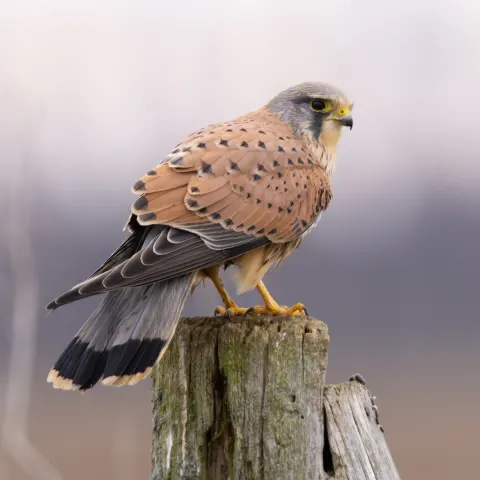
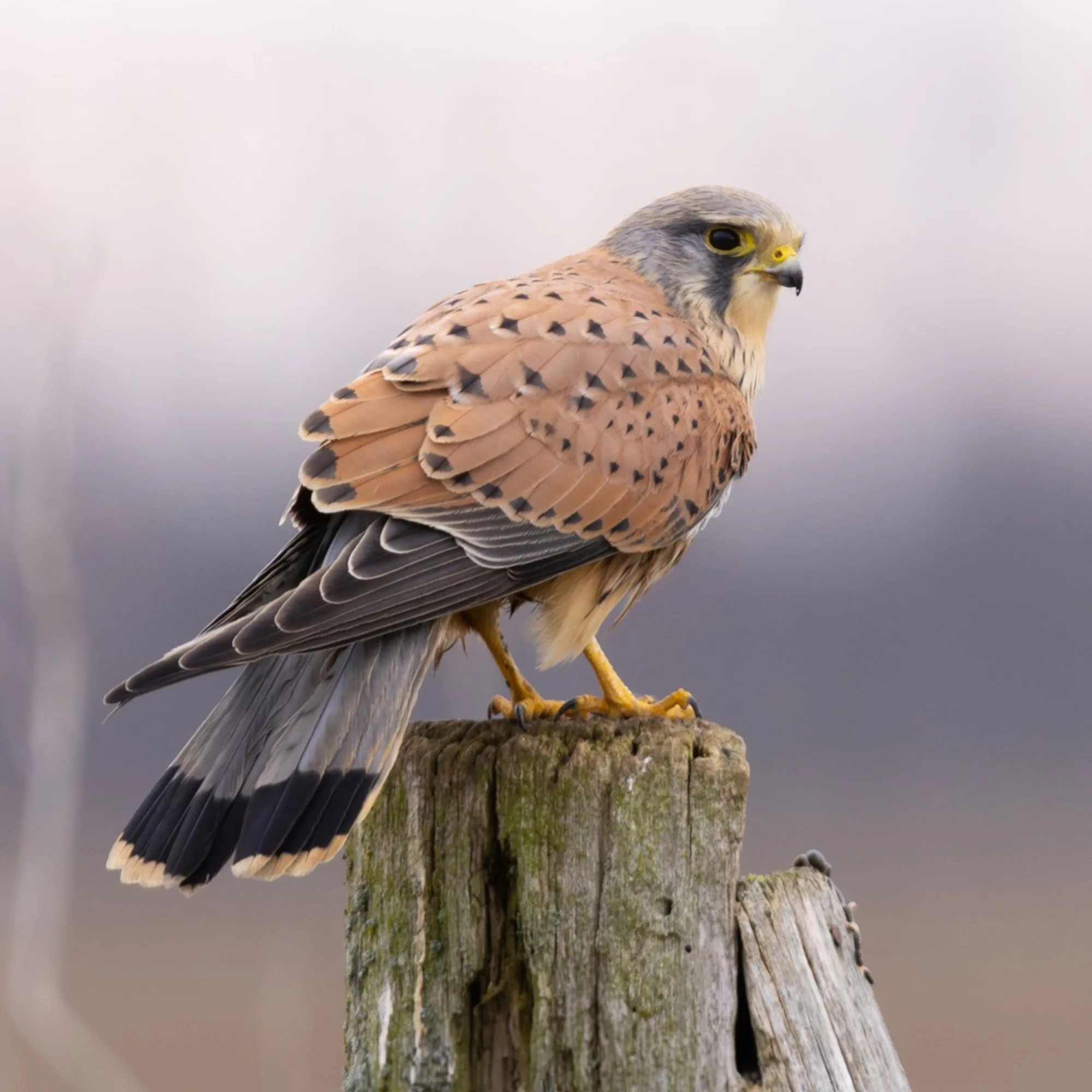
Watch for a Common Kestrel hovering above open ground, its long wings and tail held against the wind as it searches for prey. This small falcon has mainly light chestnut-brown upperparts with dark spots and a buff underside marked by narrow dark streaks. Males have fewer markings than females, along with a blue-grey cap and tail; both sexes have a black tail tip edged narrowly in white. The feet and the ring around each eye are bright yellow.
Common Kestrels are widespread across Europe, Asia and Africa, and have colonised a few oceanic islands. They favour open lowland habitats, including fields, heaths, shrubland and marshland, but also use places near human settlement where enough vegetation remains. Rocks or buildings can provide perches and nest sites where there are no trees. Birds from cool temperate areas migrate south for winter, while others remain in place, although young birds may wander before settling.
A hunting kestrel may hover 10 to 20 m above the ground before diving steeply, or watch from a perch and pounce on moving prey. Voles, shrews and mice make up much of its diet, while small birds can be especially important on oceanic islands. Insects are also eaten, and kestrels sometimes store captured voles for later. Breeding begins in spring in temperate Eurasia, with nests in holes in cliffs, trees or buildings, or in old corvid nests. Both parents incubate the eggs, and the young fledge after 4 to 5 weeks. Pesticide use affected populations in the mid-20th century, and recent declines have been reported in parts of Western Europe, including Ireland.
Written from the English Wikipedia article Common kestrel (CC BY-SA 4.0).
- Records
- 1,039,059
- Countries
- 136
- Atlas places
- 16
- Serengeti National Park· Tanzania
- Ngorongoro Conservation Area· Tanzania
- Annapurna Conservation Area· Nepal
- Koshi Tappu Wildlife Reserve· Nepal
- Maasai Mara National Reserve· Kenya
- Yala National Park· Sri Lanka
- Akagera National Park· Rwanda
- Kinabalu Park· Malaysia
- Lake Mburo National Park· Uganda
- Lake Nakuru National Park· Kenya
- Murchison Falls National Park· Uganda
- Nairobi National Park· Kenya
- Nyungwe National Park· Rwanda
- Queen Elizabeth National Park· Uganda
- Rwenzori Mountains National Park· Uganda
- Volcanoes National Park· Rwanda
These are open occurrence records, so they show where people looked for and recorded the Common Kestrel as much as where it lives. Cells are up to 25 km across, and every location is generalised to its cell.
Generalised encounter areas, not exact locations. Each shape is a grid cell coloured by how likely the species is there.
- Very likelyUnited Kingdom25 km zone · high confidence · 183325 records · updated 86 days ago
- Very likelyFinland25 km zone · high confidence · 141681 records · updated 86 days ago
- Very likelyBelgium25 km zone · high confidence · 114391 records · updated 86 days ago
- Very likelySpain25 km zone · high confidence · 113852 records · updated 86 days ago
- Very likelyFrance25 km zone · high confidence · 66930 records · updated 86 days ago
- Very likelyPortugal25 km zone · high confidence · 51992 records · updated 86 days ago
- Very likelyNetherlands25 km zone · high confidence · 44954 records · updated 86 days ago
- Very likelyPalestinian Territories25 km zone · high confidence · 28285 records · updated 86 days ago
- Very likelyIsrael25 km zone · high confidence · 26582 records · updated 86 days ago
- Very likelyNorway25 km zone · high confidence · 21394 records · updated 86 days ago
Conservation status not assessed here yet, so every location is generalised to its grid cell.