Eurasian Hobby
Falco subbuteo
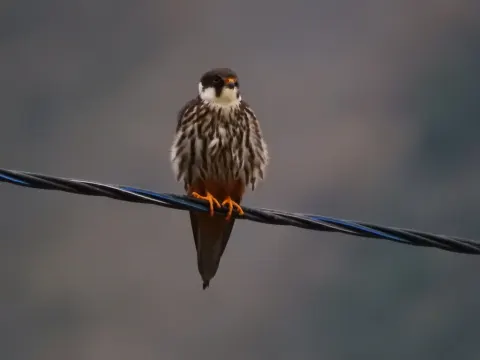
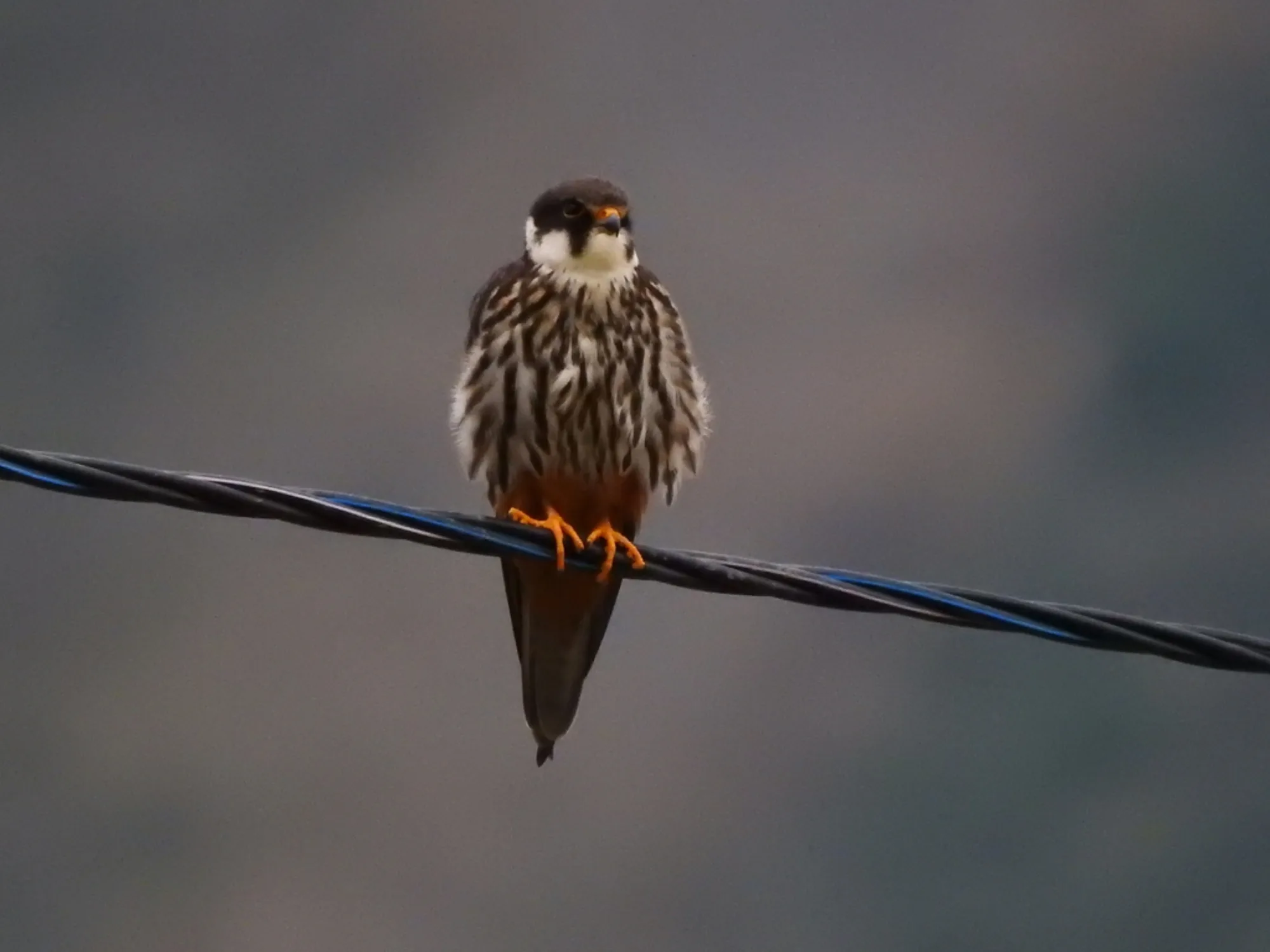
With long, pointed wings and a square tail, the Eurasian Hobby cuts a sickle-like shape across the sky and can resemble a swift when it glides. This small, slim falcon measures 29 to 36 cm in length, with a wingspan of 74 to 84 cm. An adult has slate-grey upperparts, a dark crown, short black moustache stripes and a white throat. Their pale underparts carry black streaks, while a close view can reveal reddish thighs. Young birds are generally browner, with scaled upperparts and streaked, buff-coloured thighs.
The hobby breeds across the Palearctic and inhabits open country, including farmland, marshes, taiga and savannah. It is widespread in lowlands where small woods are scattered across the landscape. One subspecies makes long-distance journeys to spend the winter in Africa, while another is mainly resident. Migrating birds may travel in small groups. Outside the breeding season, hobbies hunt mainly in the morning and evening.
Fast and powerful in flight, the hobby catches large insects such as dragonflies, which it can eat while circling slowly. It also takes small bats and birds in the air, using its speed and agility to catch swallows and even swifts. Swallows and house martins have a distinctive alarm call for the hobby, which also harasses swallows at their roosts. For nesting, hobbies often take over old nests made by birds such as crows and rooks. The chosen tree is usually in a hedge or at the edge of a small wood, giving the bird a distant view of intruders. Hobbies generally raise a single brood, laying 2 to 3 eggs from June to August; both parents incubate them, although the female does more.
Written from the English Wikipedia article Eurasian hobby (CC BY-SA 4.0).
- Records
- 155,830
- Countries
- 32
- Atlas places
- 1
These are open occurrence records, so they show where people looked for and recorded the Eurasian Hobby as much as where it lives. Cells are up to 25 km across, and every location is generalised to its cell.
Generalised encounter areas, not exact locations. Each shape is a grid cell coloured by how likely the species is there.
- Very likelyBelgium25 km zone · high confidence · 39852 records · updated 80 days ago
- Very likelyUnited Kingdom25 km zone · high confidence · 39651 records · updated 80 days ago
- Very likelyFrance25 km zone · high confidence · 19858 records · updated 80 days ago
- Very likelyNorway25 km zone · high confidence · 11835 records · updated 80 days ago
- Very likelyNetherlands25 km zone · high confidence · 10244 records · updated 80 days ago
- Very likelySpain25 km zone · high confidence · 5282 records · updated 80 days ago
- Very likelyFinland25 km zone · high confidence · 4826 records · updated 80 days ago
- Very likelyIsrael25 km zone · high confidence · 4045 records · updated 80 days ago
- Very likelyTürkiye25 km zone · high confidence · 3400 records · updated 80 days ago
- Very likelyChina25 km zone · high confidence · 1913 records · updated 80 days ago
Conservation status not assessed here yet, so every location is generalised to its grid cell.