American Kestrel
Falco sparverius
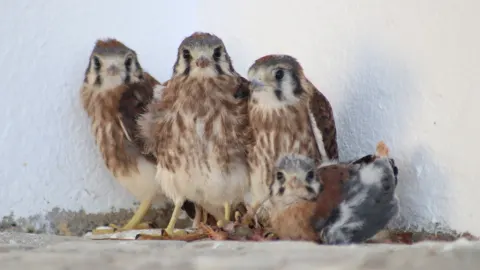
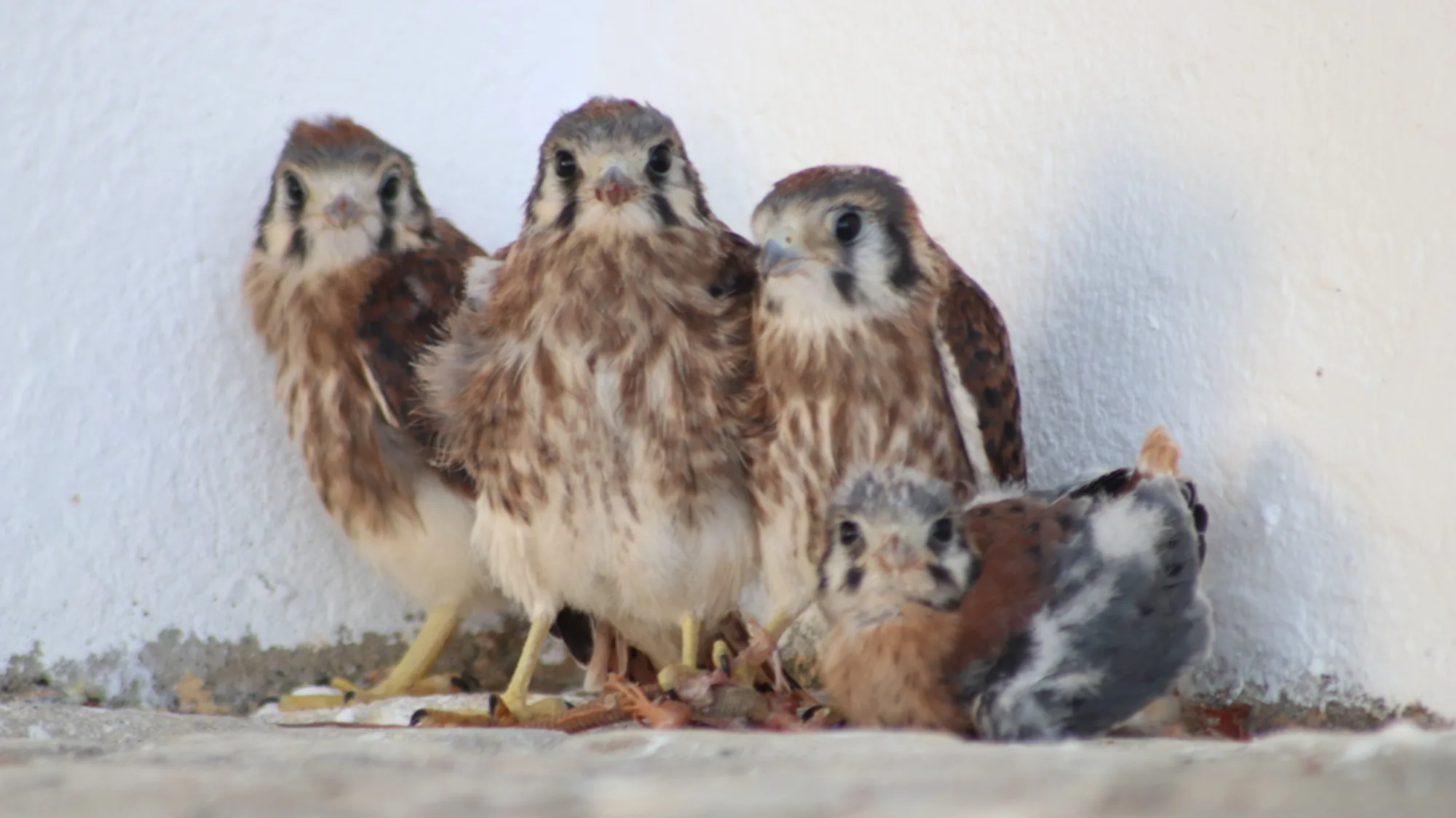
Small enough to be compared in weight with a blue jay or a mourning dove, the American Kestrel (Falco sparverius) is the smallest falcon in the Americas. It measures 22 to 31 cm long, and females are moderately larger than males. Both sexes have a barred rufous back and a pale head with a bluish-grey crown and two narrow black marks on each side of the face. Males have blue-grey wings with black spots, while females have rufous wings with dark brown bars. Young birds resemble adults in their colouring.
American Kestrels range from Alaska and northern Canada to Tierra del Fuego, at the southern tip of South America. They inhabit grasslands, meadows, deserts and other open or partly open country, as well as towns and suburbs. Look for them beside roads or fields, perched on trees, overhead power lines or fence posts as they watch for prey. They also hover on rapidly beating wings or fly low over fields, hunting insects, lizards, mice and small birds. In winter, most kestrels that breed in Canada or the northern United States head south, while many farther south remain year-round.
Pairs often return to the same nesting site in successive years, choosing cavities in trees, cliffs or buildings. A clutch contains three to seven eggs, which both parents help to incubate. North American breeding populations have undergone a gradual, sustained decline, with faster falls in some regions. Loss of nesting sites, road deaths and direct killing pose threats, while traffic and development around nests have been linked to breeding failure. Chemicals are another concern: kestrels can be poisoned through their prey, and exposure to industrial pollutants can affect their immune response and reproduction.
Written from the English Wikipedia article American kestrel (CC BY-SA 4.0).
- Records
- 1,561,165
- Countries
- 4
- Atlas places
- 2
These are open occurrence records, so they show where people looked for and recorded the American Kestrel as much as where it lives. Cells are up to 25 km across, and every location is generalised to its cell.
Generalised encounter areas, not exact locations. Each shape is a grid cell coloured by how likely the species is there.
- Very likelyUnited States25 km zone · high confidence · 1459429 records · updated 80 days ago
- Very likelyCanada25 km zone · high confidence · 56553 records · updated 80 days ago
- Very likelyMexico25 km zone · high confidence · 40539 records · updated 80 days ago
- Very likelyEcuador25 km zone · high confidence · 4644 records · updated 80 days ago
Conservation status not assessed here yet, so every location is generalised to its grid cell.