Gyrfalcon
Falco rusticolus
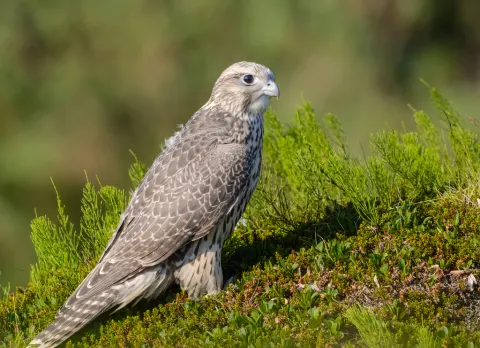
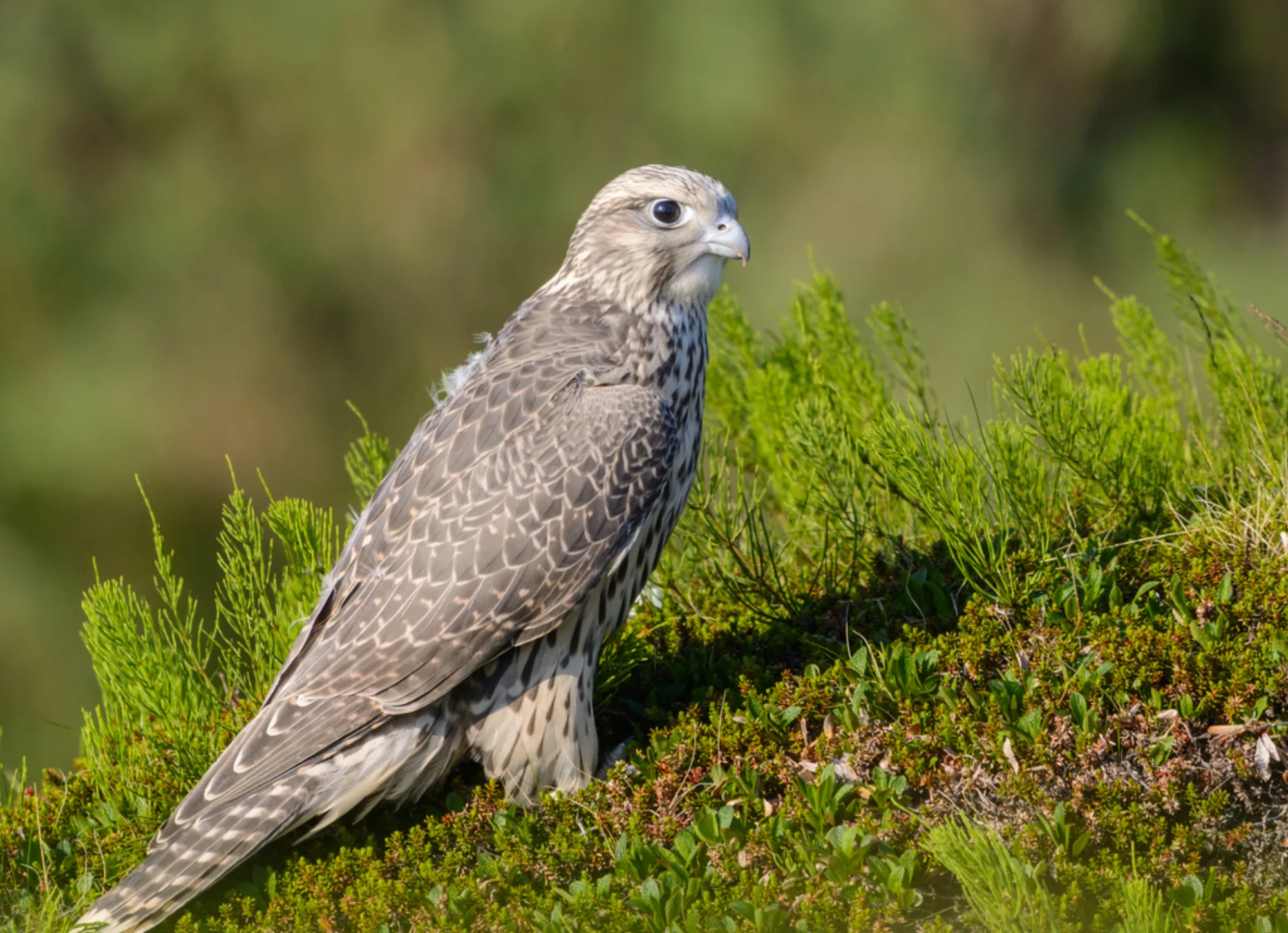
Largest of the falcons, the Gyrfalcon is a powerful bird of prey of the far north. Females are much larger than males, and the species has broader wings and a longer tail than the peregrine falcon. Its pointed wings and variable plumage are useful features to look for: birds range from all-white to dark grey-brown. Greenland birds are often white with grey flecks on the back and wings, while Icelandic birds tend to be pale and Eurasian populations are generally darker. Young birds are darker and browner than adults.
Gyrfalcons breed on Arctic coasts and tundra and on northern islands of North America and Siberia. Most remain in their northern range, although some travel more widely after breeding or during winter. In winter, they can spend considerable time on sea ice far from land. They usually hunt in a horizontal pursuit, and most prey is killed on the ground. Ptarmigan are often a main food in the tundra, while coastal birds may feed chiefly on auks, gulls and sea ducks. Arctic ground squirrels and Arctic hares can also be important prey locally.
Breeding pairs usually nest on cliffs, using a bare ledge or an old nest made by another bird, often a golden eagle or common raven. A clutch usually contains 2 to 4 eggs, and the young depart the nest when they are 7 to 8 weeks old. Parents aggressively harass animals near the nest, but ravens have been known to take eggs and hatchlings. Human causes are the leading source of mortality, including hunting, vehicle collisions and poisoning from carrion. Pollution, including pesticides, depressed numbers in the mid-20th century, while northward expansion of peregrine falcons has brought competition in parts of Greenland.
Written from the English Wikipedia article Gyrfalcon (CC BY-SA 4.0).
- Records
- 4,406
- Countries
- 9
- Atlas places
- 3
These are open occurrence records, so they show where people looked for and recorded the Gyrfalcon as much as where it lives. Cells are up to 25 km across, and every location is generalised to its cell.
Generalised encounter areas, not exact locations. Each shape is a grid cell coloured by how likely the species is there.
- Very likelyNorway25 km zone · medium confidence · 4142 records · updated 80 days ago
- Very likelyBelgium25 km zone · medium confidence · 41 records · updated 80 days ago
- Very likelyNetherlands25 km zone · medium confidence · 39 records · updated 80 days ago
- Very likelySweden25 km zone · medium confidence · 31 records · updated 80 days ago
- LikelyUnited States25 km zone · medium confidence · 115 records · updated 80 days ago
- LikelySvalbard & Jan Mayen25 km zone · medium confidence · 15 records · updated 80 days ago
- PossibleCanada25 km zone · medium confidence · 20 records · updated 80 days ago
- UncommonIceland25 km zone · medium confidence · 2 records · updated 80 days ago
- UncommonDenmark25 km zone · medium confidence · 1 record · updated 80 days ago
Conservation status not assessed here yet, so every location is generalised to its grid cell.