Eleonora's Falcon
Falco eleonorae
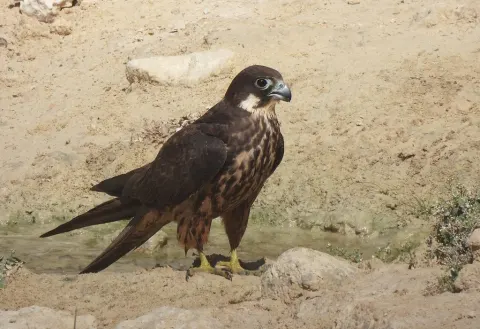
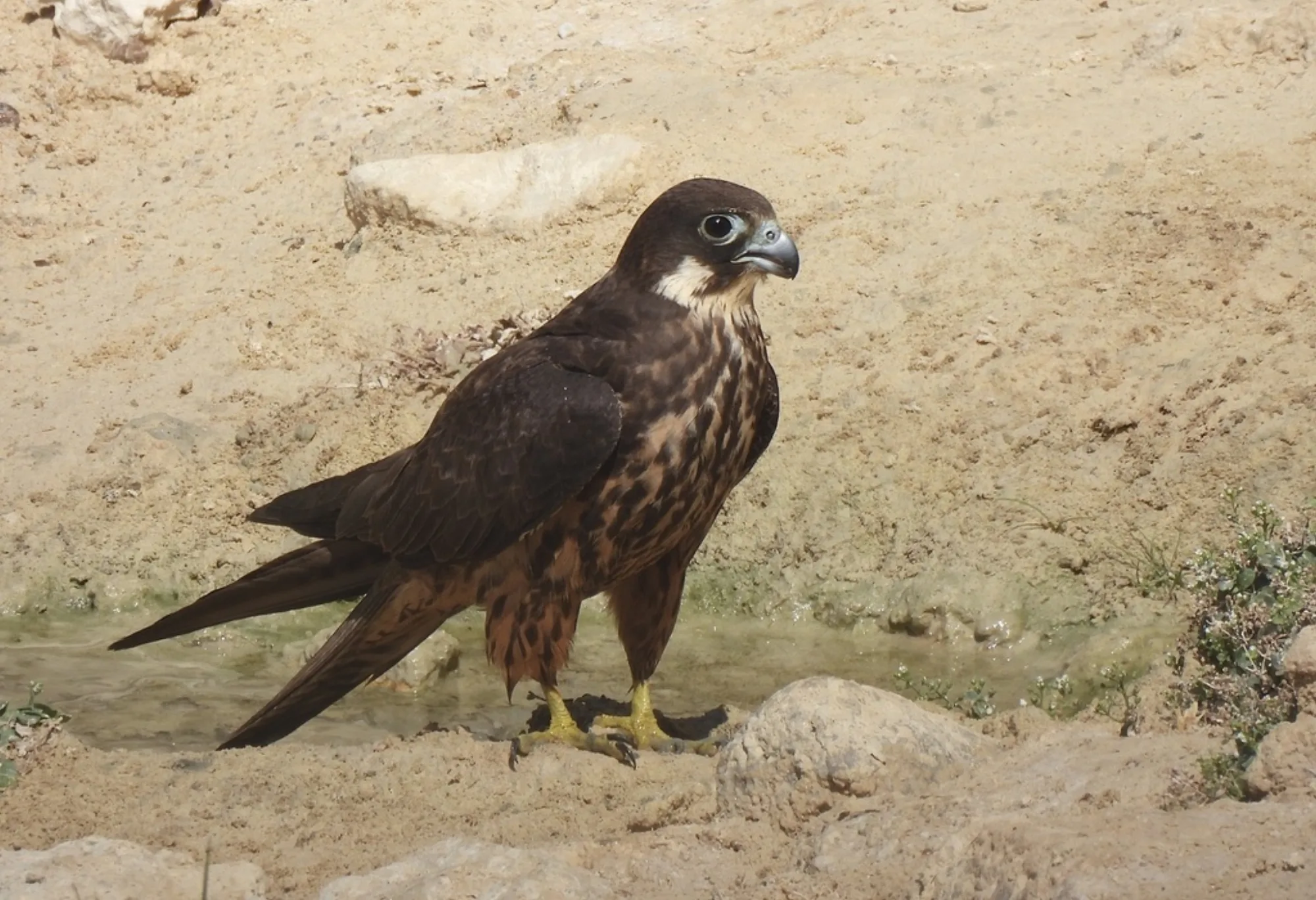
Long pointed wings, a long tail and a slim body give Eleonora's Falcon a distinctive silhouette. This medium-sized bird of prey measures 36 to 42 cm in length, with a wingspan of 87 to 104 cm. Adults come in two colour forms: dark birds are sooty brown, while light birds have buff underparts and a contrast between dark wing coverts and paler flight feathers. Young birds have pale underparts that stand out against darker wingtips and wing coverts. Listen, too, for its kek-kek-kek call.
Eleonora's Falcon breeds on Mediterranean islands, particularly off Greece, as well as in the Canary Islands and around several other parts of the Mediterranean. Two-thirds of the world's population breeds off Greece, and Tilos alone holds 10% of the world population during the breeding season. The falcon also lives on the coasts of Madagascar and Mozambique and spends the winter in Madagascar. Its migration crosses inland Africa, passing through the Sahara and equatorial rainforests before reaching Kenya and Mozambique. A one-way journey can cover up to 9,000 km.
Along coastal cliffs, the falcons cruise on steady wingbeats, watching for tired migrating birds. They catch small birds in flight and also eat large insects, sometimes taking them on the wing, as well as bats occasionally. On Mogador Island in Morocco, researchers found live prey held in rock crevices for later consumption. Breeding comes late, when migrating birds pass through the Mediterranean islands and provide food for chicks. The falcons breed in colonies, placing their nests on sea cliffs and producing as many as four eggs.
Written from the English Wikipedia article Eleonora's falcon (CC BY-SA 4.0).
- Records
- 15,792
- Countries
- 17
No atlas park has a record of the Eleonora's Falcon in or around it yet.
These are open occurrence records, so they show where people looked for and recorded the Eleonora's Falcon as much as where it lives. Cells are up to 25 km across, and every location is generalised to its cell.
Generalised encounter areas, not exact locations. Each shape is a grid cell coloured by how likely the species is there.
- Very likelySpain25 km zone · high confidence · 5323 records · updated 80 days ago
- Very likelyGreece25 km zone · high confidence · 4264 records · updated 80 days ago
- Very likelyFrance25 km zone · high confidence · 1621 records · updated 80 days ago
- Very likelyCyprus25 km zone · medium confidence · 1224 records · updated 80 days ago
- Very likelyIsrael25 km zone · high confidence · 707 records · updated 80 days ago
- Very likelyTürkiye25 km zone · medium confidence · 679 records · updated 80 days ago
- Very likelyItaly25 km zone · high confidence · 670 records · updated 80 days ago
- Very likelyPortugal25 km zone · high confidence · 320 records · updated 80 days ago
- Very likelyMorocco25 km zone · high confidence · 313 records · updated 80 days ago
- Very likelyUnited Kingdom25 km zone · high confidence · 212 records · updated 80 days ago
Conservation status not assessed here yet, so every location is generalised to its grid cell.