Saker Falcon
Falco cherrug
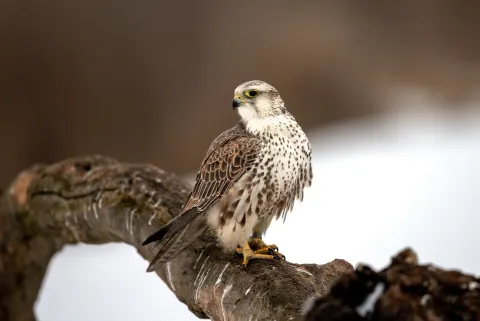
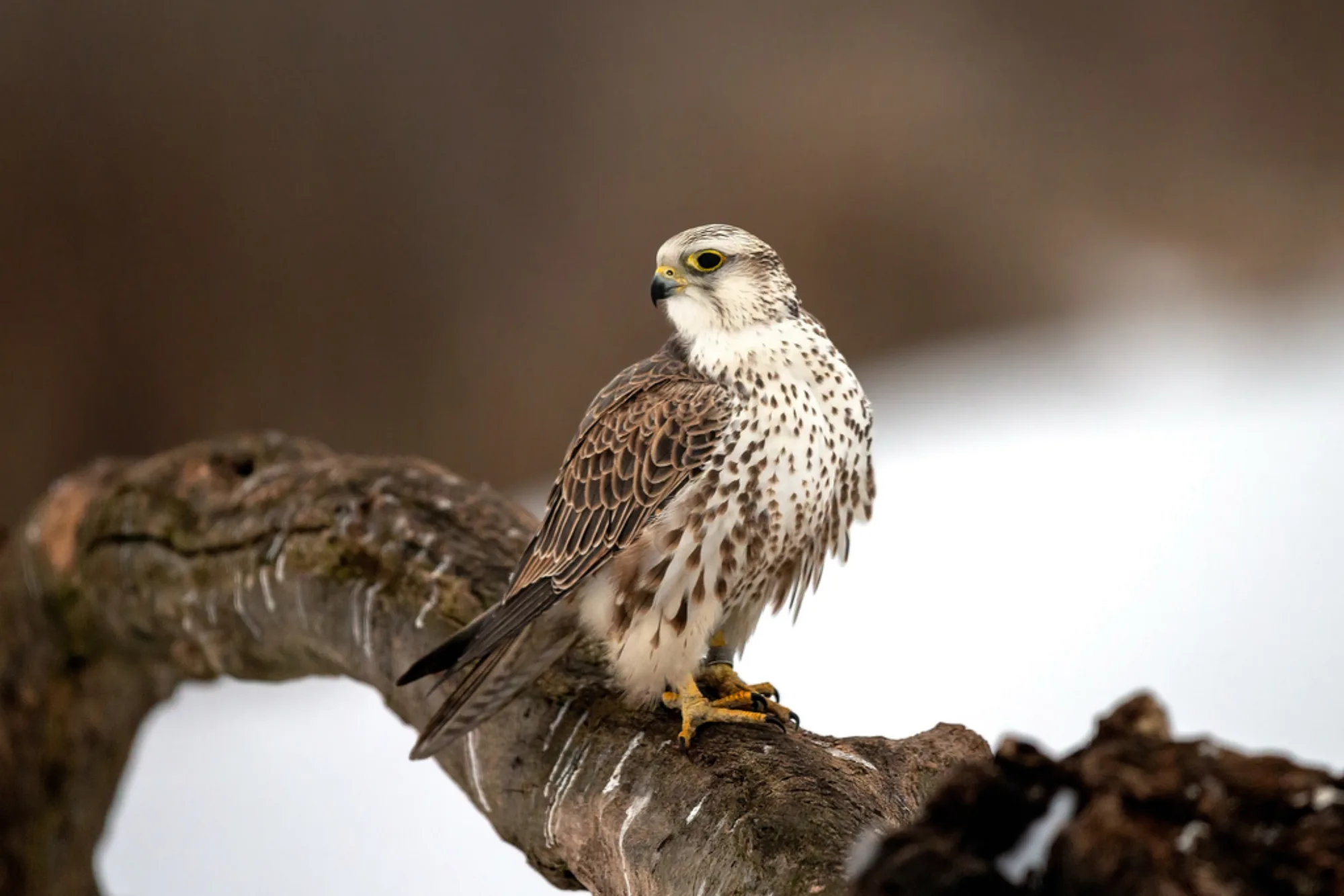
Across open grasslands from Central Europe to Manchuria, the Saker Falcon cuts a powerful figure, favouring places with trees or cliffs. This large falcon measures 45 to 57 cm in length, with a wingspan of 97 to 126 cm. Its plumage varies, but it is generally brown, while young birds are usually darker, with heavier streaking. Males and females look much alike apart from their size; listen for a sharp kiy-ee call or a series of kyak notes.
Not all Sakers migrate: in Europe, some juveniles move south while adults mostly remain resident. Migrants from Europe and West Asia winter in the Sahel, crossing the Middle East, Arabian Peninsula and Pakistan on their journeys. Birds migrating from east of the Altai Mountains spend the winter on the Qinghai-Tibet Plateau. The falcon often chases prey in horizontal flight, taking mostly birds and rodents. In Europe, its common catches include feral pigeons and ground squirrels. It usually takes over an old stick nest in a tree, previously used by birds such as ravens, storks or buzzards, and lays 3 to 6 eggs there. Cliffs are also frequent nesting sites.
Sakers have declined rapidly, particularly on their Central Asian breeding grounds, with especially steep losses in Kazakhstan and Uzbekistan. Habitat loss and destruction add to the pressure, while migrating birds risk illegal trapping as they pass through Pakistan, the Arabian Peninsula and the Middle East. Thousands of falcons have been caught and sold illegally, with the United Arab Emirates becoming the main destination after the Soviet Union collapsed. The birds can also be difficult to survey because they occur at low densities across extensive, remote ranges.
Written from the English Wikipedia article Saker falcon (CC BY-SA 4.0).
- Records
- 191
- Countries
- 15
No atlas park has a record of the Saker Falcon in or around it yet.
These are open occurrence records, so they show where people looked for and recorded the Saker Falcon as much as where it lives. Cells are up to 25 km across, and every location is generalised to its cell.
Generalised encounter areas, not exact locations. Each shape is a grid cell coloured by how likely the species is there.
- Very likelyRussia25 km zone · medium confidence · 51 records · updated 80 days ago
- Very likelyUkraine25 km zone · medium confidence · 37 records · updated 80 days ago
- Very likelyAustria25 km zone · medium confidence · 27 records · updated 80 days ago
- Very likelyGeorgia25 km zone · medium confidence · 18 records · updated 80 days ago
- Very likelyChina25 km zone · medium confidence · 15 records · updated 80 days ago
- Very likelyMongolia25 km zone · medium confidence · 15 records · updated 80 days ago
- Very likelyQatar25 km zone · medium confidence · 12 records · updated 80 days ago
- Very likelyTürkiye25 km zone · medium confidence · 5 records · updated 80 days ago
- Very likelyBelgium25 km zone · medium confidence · 4 records · updated 80 days ago
- Very likelyFrance25 km zone · medium confidence · 3 records · updated 80 days ago
Conservation status not assessed here yet, so every location is generalised to its grid cell.