Lanner Falcon
Falco biarmicus
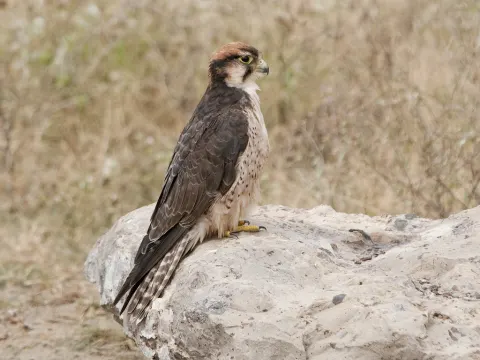
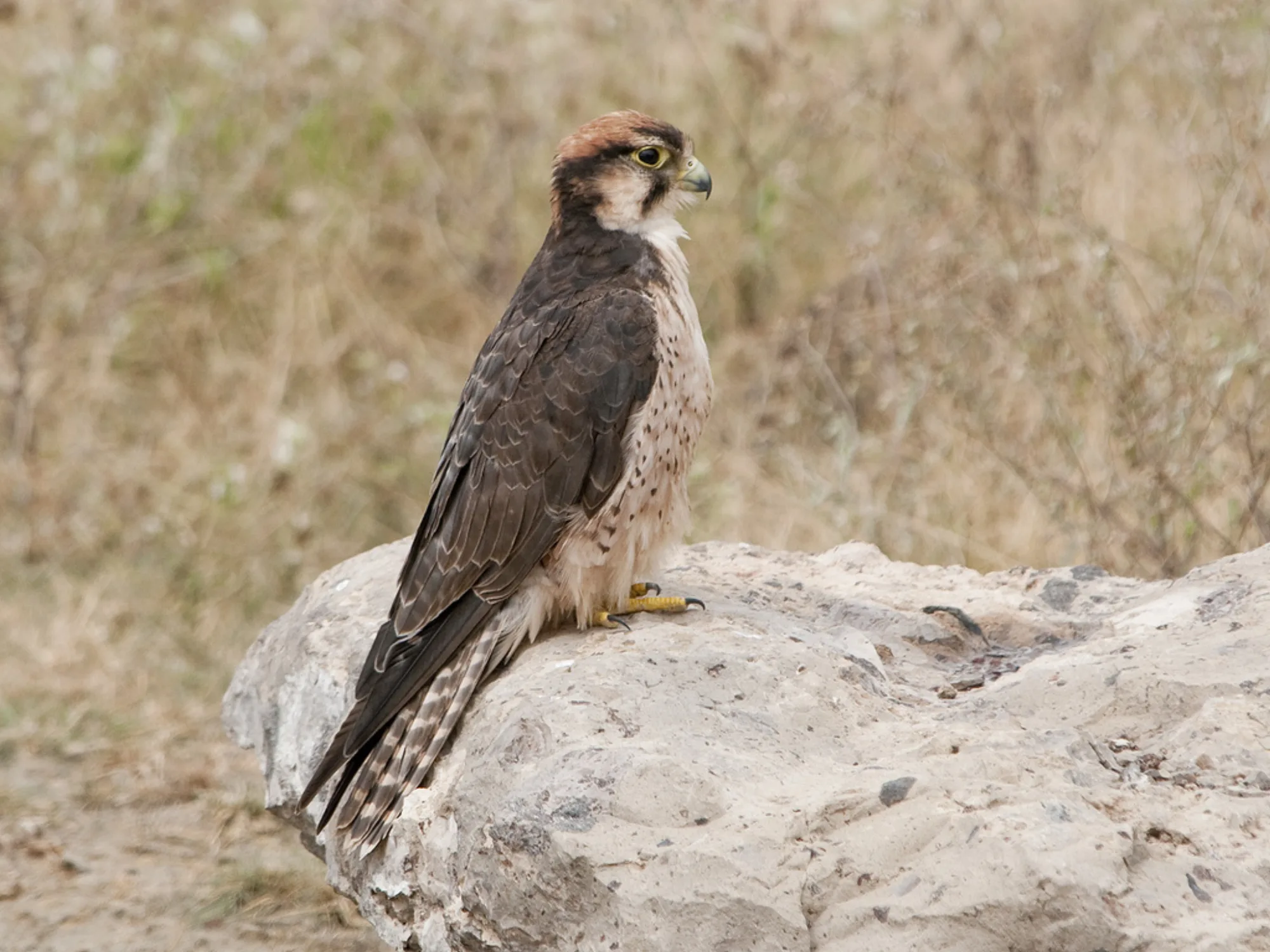
Across open country from Africa to southeast Europe and just into Asia, the Lanner Falcon hunts birds in flight. This large falcon measures 43 to 50 cm long, with a wingspan of 95 to 105 cm. Eurasian birds have slate-grey or brown-grey upperparts, while most African subspecies are paler blue-grey above. Look for the reddish back of the head; northern birds also have streaked breasts. Young birds are browner, and the call is a harsh “wray-e”.
Lanner Falcons favour open savannah and sour grasslands, though they can be found anywhere from forest edges to desert. They are mainly resident, with local movements that may follow seasonal rains and changes in altitude. A hunting bird often pursues its prey horizontally, taking birds in flight, but it can also attack from a perch or a fast, low flight. Doves, pigeons and domestic chickens are among its prey; it also takes bats, small mammals, reptiles and invertebrates. Falcons have been observed hunting jackdaws together, using visual contact to coordinate the chase.
Pairs usually nest on sheer cliffs and lay three or four eggs, but they also use old crow nests, trees, pylons and less steep cliffs. The female mainly stays with and feeds the young, while the male takes over when she needs to hunt. Wild numbers are declining steadily in Europe and across North Africa, although the falcon remains relatively common in parts of Africa. Threats include nest robbery, capture for falconry, persecution, vehicle collisions and electrocution on power lines. Human expansion removes suitable habitat, while intensive agricultural pesticide use poses another threat.
Written from the English Wikipedia article Lanner falcon (CC BY-SA 4.0).
- Records
- 23,541
- Countries
- 18
- Atlas places
- 30
- uKhahlamba-Drakensberg Park· South Africa
- Kgalagadi Transfrontier Park· South Africa
- Kruger National Park· South Africa
- Addo Elephant National Park· South Africa
- Etosha National Park· Namibia
- Golden Gate Highlands National Park· South Africa
- Samburu National Reserve· Kenya
- Table Mountain National Park· South Africa
- iSimangaliso Wetland Park· South Africa
- Madikwe Game Reserve· South Africa
- West Coast National Park· South Africa
- Aberdare National Park· Kenya
- Amboseli National Park· Kenya
- Arusha National Park· Tanzania
- Augrabies Falls National Park· South Africa
- Bwabwata National Park· Namibia
- Chobe National Park· Botswana
- Hell's Gate National Park· Kenya
- Hluhluwe-iMfolozi Park· South Africa
- Karoo National Park· South Africa
- Lake Manyara National Park· Tanzania
- Lake Nakuru National Park· Kenya
- Mapungubwe National Park· South Africa
- Nairobi National Park· Kenya
- Ngorongoro Conservation Area· Tanzania
- Okavango Delta· Botswana
- Tsavo East National Park· Kenya
- Tsavo West National Park· Kenya
- Volcanoes National Park· Rwanda
- Zambezi National Park· Zimbabwe
These are open occurrence records, so they show where people looked for and recorded the Lanner Falcon as much as where it lives. Cells are up to 25 km across, and every location is generalised to its cell.
Generalised encounter areas, not exact locations. Each shape is a grid cell coloured by how likely the species is there.
- Very likelySouth Africa25 km zone · high confidence · 15731 records · updated 80 days ago
- Very likelyKenya25 km zone · high confidence · 1303 records · updated 80 days ago
- Very likelyBotswana25 km zone · high confidence · 1171 records · updated 80 days ago
- Very likelyGambia25 km zone · medium confidence · 901 records · updated 80 days ago
- Very likelyTanzania25 km zone · high confidence · 834 records · updated 80 days ago
- Very likelyNigeria25 km zone · high confidence · 706 records · updated 80 days ago
- Very likelyGhana25 km zone · medium confidence · 700 records · updated 80 days ago
- Very likelyEthiopia25 km zone · high confidence · 634 records · updated 80 days ago
- Very likelyNamibia25 km zone · medium confidence · 480 records · updated 80 days ago
- Very likelyZimbabwe25 km zone · high confidence · 369 records · updated 80 days ago
Conservation status not assessed here yet, so every location is generalised to its grid cell.