Amur Falcon
Falco amurensis
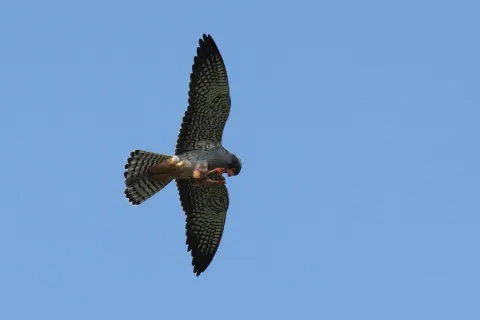
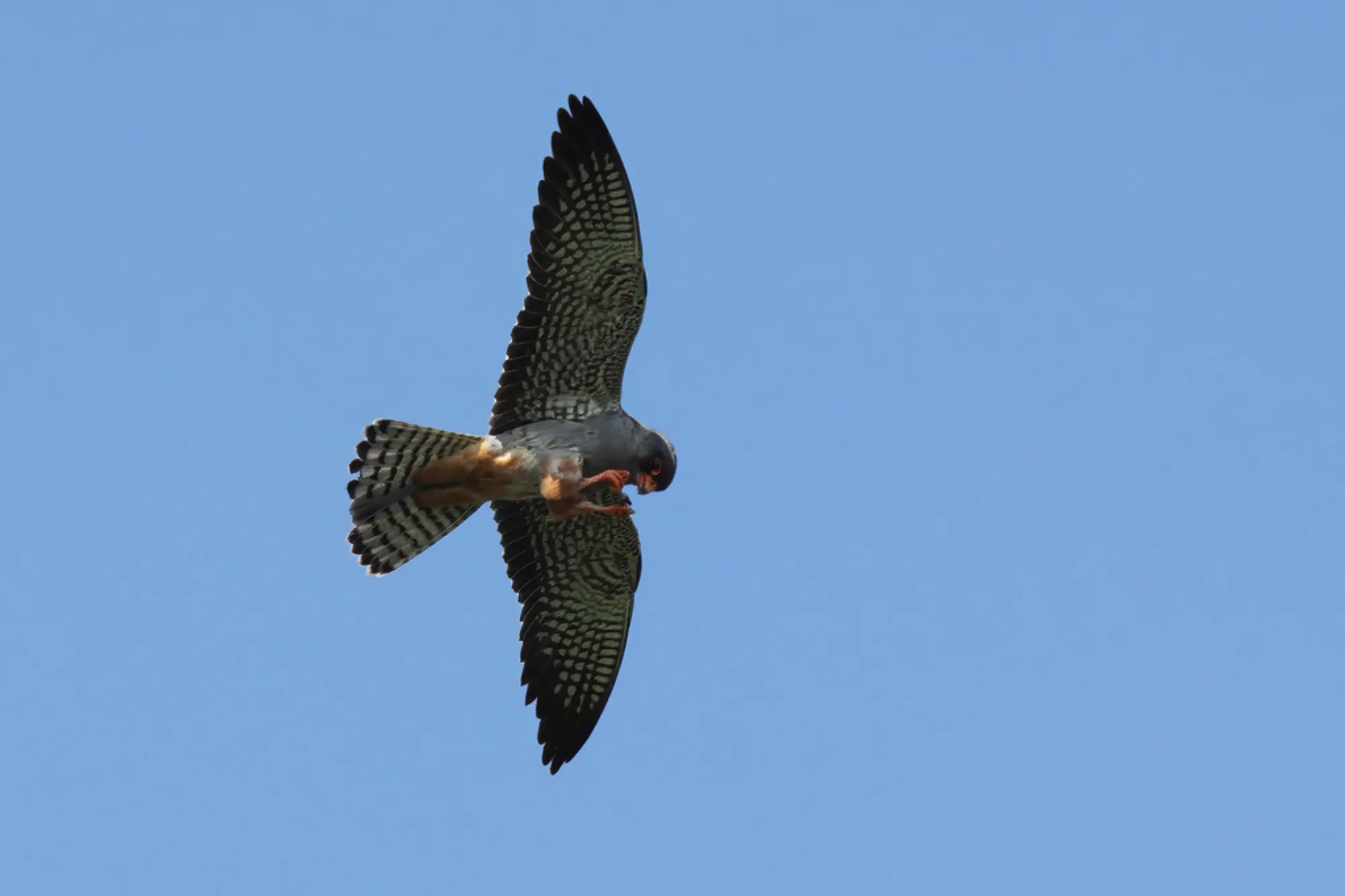
Small and long-winged, the Amur Falcon travels in large flocks between its East Asian breeding grounds and southern and eastern Africa. Males are dark sooty grey above, with reddish-brown thighs and a white wing lining that stands out against the darker flight feathers. Females can be harder to identify, but their orange eye-rings and reddish-orange feet offer useful clues. At rest, the long wing tips reach the tail tip or extend just beyond it.
The breeding range stretches from Transbaikalia, Amurland and northern Mongolia to parts of North Korea, in open wooded country with marshes. On migration, the falcons cross India and the Arabian Sea, stopping in open forest or grassland and gathering to roost on exposed perches or wires. They usually hunt in the early morning or late evening, taking insects in flight or from the ground. African rains bring swarms of termites, locusts, ants and beetles, while small birds, mammals and amphibians are also brought to young in the breeding range. Breeding takes place from May to June, sometimes with several pairs nesting close together. The birds reuse abandoned nests or tree hollows, and both parents incubate the eggs and feed the chicks.
Large migrating flocks are exposed to hunting, including for food in parts of northeastern India and eastern Africa. At Pangti in Nagaland, mass trapping was reported in 2012, prompting a successful campaign to prevent the birds being killed. Local leadership and shared responsibility helped turn hunters into protectors, while tourism contributed to community pride in conservation.
Written from the English Wikipedia article Amur falcon (CC BY-SA 4.0).
- Records
- 31,000
- Countries
- 14
- Atlas places
- 11
- Kruger National Park· South Africa
- uKhahlamba-Drakensberg Park· South Africa
- Addo Elephant National Park· South Africa
- Golden Gate Highlands National Park· South Africa
- Garden Route National Park· South Africa
- Hwange National Park· Zimbabwe
- iSimangaliso Wetland Park· South Africa
- Mapungubwe National Park· South Africa
- Tsavo East National Park· Kenya
- Tsavo West National Park· Kenya
- Zambezi National Park· Zimbabwe
These are open occurrence records, so they show where people looked for and recorded the Amur Falcon as much as where it lives. Cells are up to 25 km across, and every location is generalised to its cell.
Generalised encounter areas, not exact locations. Each shape is a grid cell coloured by how likely the species is there.
- Very likelySouth Africa25 km zone · high confidence · 22820 records · updated 80 days ago
- Very likelyChina25 km zone · high confidence · 3665 records · updated 80 days ago
- Very likelyIndia25 km zone · high confidence · 1732 records · updated 80 days ago
- Very likelyMongolia25 km zone · high confidence · 881 records · updated 80 days ago
- Very likelyZimbabwe25 km zone · high confidence · 757 records · updated 80 days ago
- Very likelyRussia25 km zone · high confidence · 406 records · updated 80 days ago
- Very likelySouth Korea25 km zone · high confidence · 157 records · updated 80 days ago
- Very likelyUnited Arab Emirates25 km zone · high confidence · 151 records · updated 80 days ago
- Very likelyKenya25 km zone · high confidence · 96 records · updated 80 days ago
- Very likelyLesotho25 km zone · high confidence · 96 records · updated 80 days ago
Conservation status not assessed here yet, so every location is generalised to its grid cell.