Sunbittern
Eurypyga helias
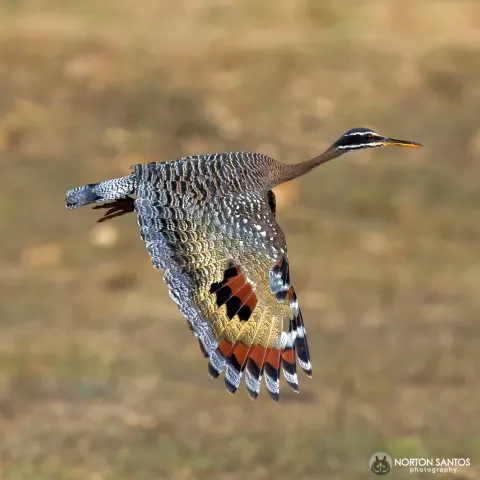
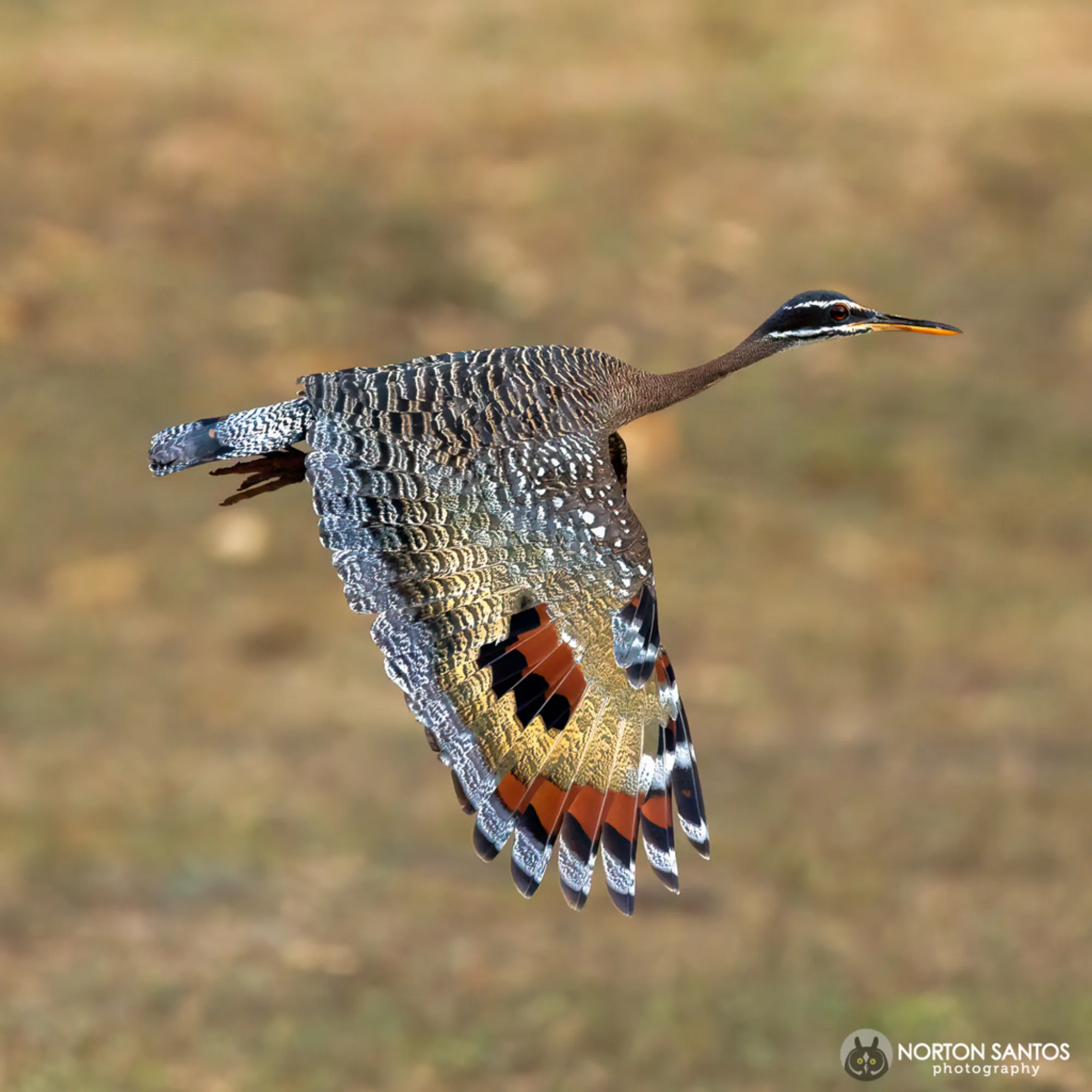
With its finely patterned plumage and long, pointed bill, the Sunbittern can blend into the humid forests of Central and South America. Its usual colours are subdued, with fine lines of black, grey and brown. When it spreads its large wings, bright red, yellow and black eyespots appear. It shows these patterns to other Sunbitterns during courtship or threats, and may also use them to startle potential predators. Birds in the lowlands east of the Andes are mainly brown above, with orange-yellow legs and lower bills, while the other forms are greyer above and sometimes redder on the legs and bill.
The species ranges from Guatemala to Brazil, living in humid forest, generally where the understorey is open and water is nearby. Look for its habitat near rivers, streams, ponds or lagoons. East of the Andes, it occurs in lowland tropical South America, across the Orinoco and Amazon basins and the Pantanal. Another form lives along the eastern Andean slope in south-central Peru, at altitudes of 800 to 1,830 m. A third occurs in southern Guatemala, across Central America and the Chocó, reaching western Ecuador.
Sunbitterns take a wide variety of animal prey, with insects forming an important part of their diet. Their menu also includes crabs, spiders, shrimps, earthworms, fish, tadpoles, frogs, toads, eels and lizards. Captive birds have been observed using bait or lures to bring prey within striking distance. Before nesting begins in the early wet season, they display in flight among the forest canopy, 10 to 15 m above the ground. Their open nests are built in trees, where they lay two eggs marked with blotches. After hatching, the young stay in their nest for several weeks.
Written from the English Wikipedia article Sunbittern (CC BY-SA 4.0).
- Records
- 36,931
- Countries
- 10
- Atlas places
- 9
These are open occurrence records, so they show where people looked for and recorded the Sunbittern as much as where it lives. Cells are up to 25 km across, and every location is generalised to its cell.
Generalised encounter areas, not exact locations. Each shape is a grid cell coloured by how likely the species is there.
- Very likelyCosta Rica25 km zone · high confidence · 10559 records · updated 80 days ago
- Very likelyBrazil25 km zone · high confidence · 9028 records · updated 80 days ago
- Very likelyColombia25 km zone · high confidence · 6340 records · updated 80 days ago
- Very likelyPeru25 km zone · high confidence · 4352 records · updated 80 days ago
- Very likelyEcuador25 km zone · high confidence · 3169 records · updated 80 days ago
- Very likelyPanama25 km zone · high confidence · 1308 records · updated 80 days ago
- Very likelyVenezuela25 km zone · medium confidence · 1141 records · updated 80 days ago
- Very likelyBolivia25 km zone · high confidence · 584 records · updated 80 days ago
- Very likelyGuyana25 km zone · high confidence · 393 records · updated 80 days ago
- Very likelyHonduras25 km zone · medium confidence · 57 records · updated 80 days ago
Conservation status not assessed here yet, so every location is generalised to its grid cell.