Pelican Eel
Eurypharynx pelecanoides
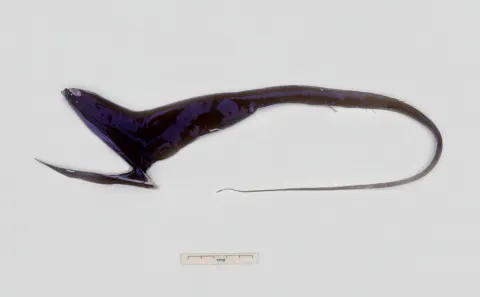
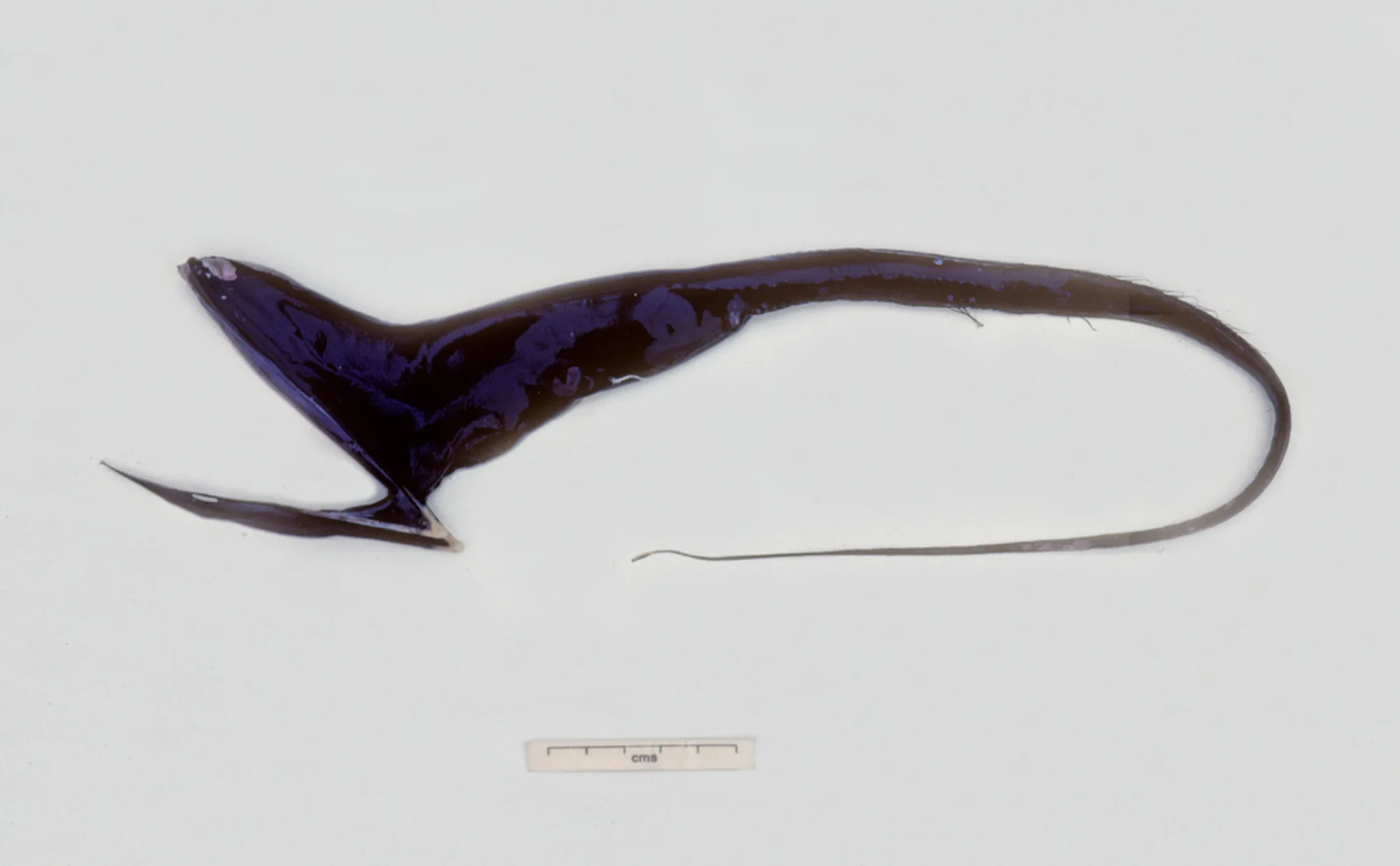
A huge mouth gives the Pelican Eel its distinctive outline, dwarfing its slender body and making its head look disproportionately large. Usually folded, the mouth can spread and inflate as the eel hunts. The eel grows to about 0.75 m, although lengths of 1 m are plausible. It has very small eyes and a long, whip-like tail used for movement and communication. The tail tip glows pink and sometimes flashes red, perhaps attracting prey. Its black or olive colouring includes ultra-black camouflage that helps it hide from predators and prey in the dim deep sea.
Pelican eels live in temperate and tropical waters across all oceans. In the North Atlantic, they appear to range from 500 to 3,000 m deep. They have also been seen off Portugal and near the Hawaiian islands. These depths make encounters difficult: much of what is known comes from eels accidentally caught in deep-sea fishing nets. Researchers near the Azores observed one moving constantly through the water column in search of prey.
The eel actively pursues food, approaching clusters of shrimp and other crustaceans with a closed mouth, then opening wide to scoop them up. Its stomach can stretch around a large meal, though stomach contents suggest that small crustaceans make up most of its diet. It also eats squid and other small invertebrates, while lancetfish and other deep-sea predators hunt it. Little is known about its breeding, but many researchers believe the eels die soon after reproducing. Newly born eels are extremely thin and transparent, and their larvae feed on marine snow.
Written from the English Wikipedia article Pelican eel (CC BY-SA 4.0).
- Records
- 303
- Countries
- 9
No atlas park has a record of the Pelican Eel in or around it yet.
These are open occurrence records, so they show where people looked for and recorded the Pelican Eel as much as where it lives. Cells are up to 25 km across, and every location is generalised to its cell.
Generalised encounter areas, not exact locations. Each shape is a grid cell coloured by how likely the species is there.
- Very likelyUnnamed area25 km zone · medium confidence · 147 records · updated 80 days ago
- Very likelyUnited States25 km zone · medium confidence · 85 records · updated 80 days ago
- Very likelyTaiwan25 km zone · medium confidence · 10 records · updated 80 days ago
- LikelyCanada25 km zone · medium confidence · 23 records · updated 80 days ago
- LikelyAustralia25 km zone · medium confidence · 20 records · updated 80 days ago
- PossibleNew Zealand25 km zone · medium confidence · 5 records · updated 80 days ago
- PossibleNorfolk Island25 km zone · medium confidence · 4 records · updated 80 days ago
- PossibleGreenland25 km zone · medium confidence · 3 records · updated 80 days ago
- PossibleSt. Helena25 km zone · medium confidence · 3 records · updated 80 days ago
- UncommonPalau25 km zone · medium confidence · 3 records · updated 80 days ago
Conservation status not assessed here yet, so every location is generalised to its grid cell.