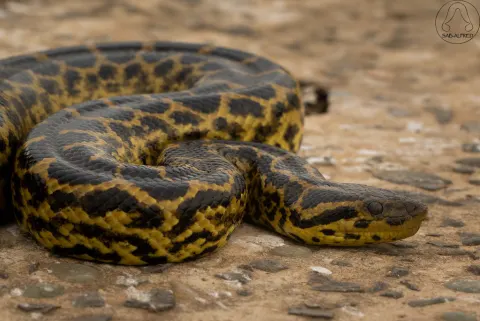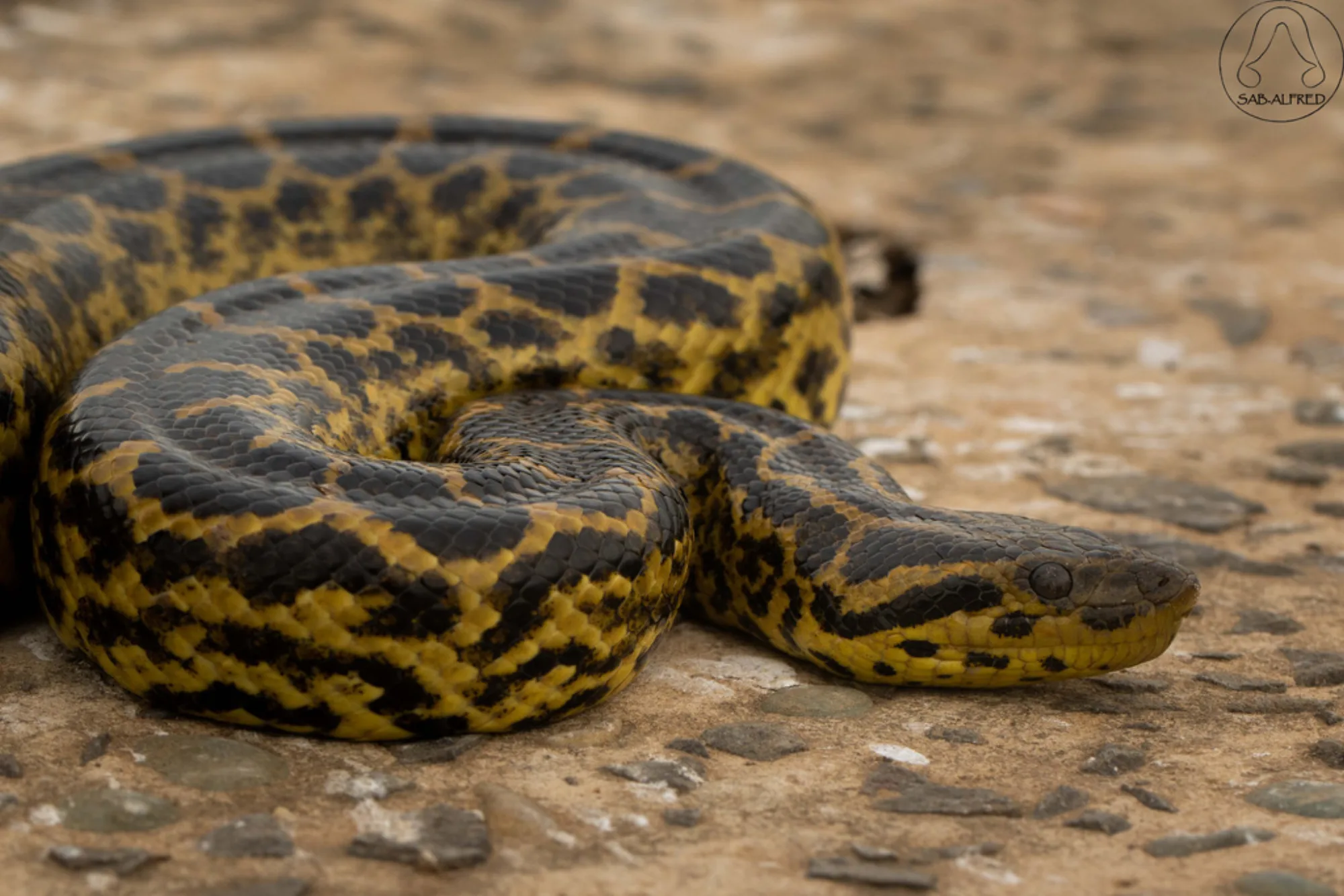
Yellow Anaconda
Eunectes notaeus
Patterned in yellow, golden-tan or greenish-yellow, the Yellow Anaconda carries dark saddles, blotches, spots and streaks along its body. This non-venomous boa is among the world's largest snakes, though it is smaller than the green anaconda. Adults average 3.7 m in length and commonly weigh 25 to 35 kg. Females are generally larger than males, with some reported reaching 4.6 m. Its South American range follows the Paraguay River drainage, extending from the Pantanal across parts of Bolivia, Paraguay and western Brazil, south to northern Uruguay and northeastern Argentina. It favours watery places, including swamps, marshes and brush-covered banks beside slow rivers and streams.
Usually solitary, yellow anacondas spend much of their time hunting in water, where they may float with their noses above the surface. They also venture onto land to hunt, move between water bodies or mate. In wetlands they forage mostly in shallow water, using both ambush and wide-ranging searches for food. Their varied prey includes snails, fish, birds, mammals, reptiles, eggs and carrion, with larger snakes able to take capybaras and other large animals. Hunting peaks from June to November, when floodwaters have receded somewhat and wading birds make up most of their prey. Breeding takes place each year between April and May, and females give birth to 4 to 82 live young after a 6-month gestation. The young are left to fend for themselves immediately after birth.
People hunt the species for its skin, although poaching has almost disappeared in Argentina following regulation and a sustainable use plan. Young snakes and occasional adults also face predators, including caimans, larger anacondas, herons and raptors.
Written from the English Wikipedia article Yellow anaconda (CC BY-SA 4.0).
- Records
- 41
- Countries
- 2
- Atlas places
- 2
These are open occurrence records, so they show where people looked for and recorded the Yellow Anaconda as much as where it lives. Cells are up to 25 km across, and every location is generalised to its cell.
Generalised encounter areas, not exact locations. Each shape is a grid cell coloured by how likely the species is there.
- Very likelyBrazil25 km zone · medium confidence · 23 records · updated 80 days ago
- Very likelyArgentina25 km zone · medium confidence · 18 records · updated 80 days ago
Conservation status not assessed here yet, so every location is generalised to its grid cell.