Anaconda
Eunectes murinus
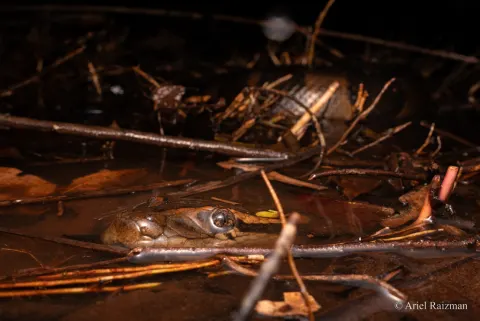
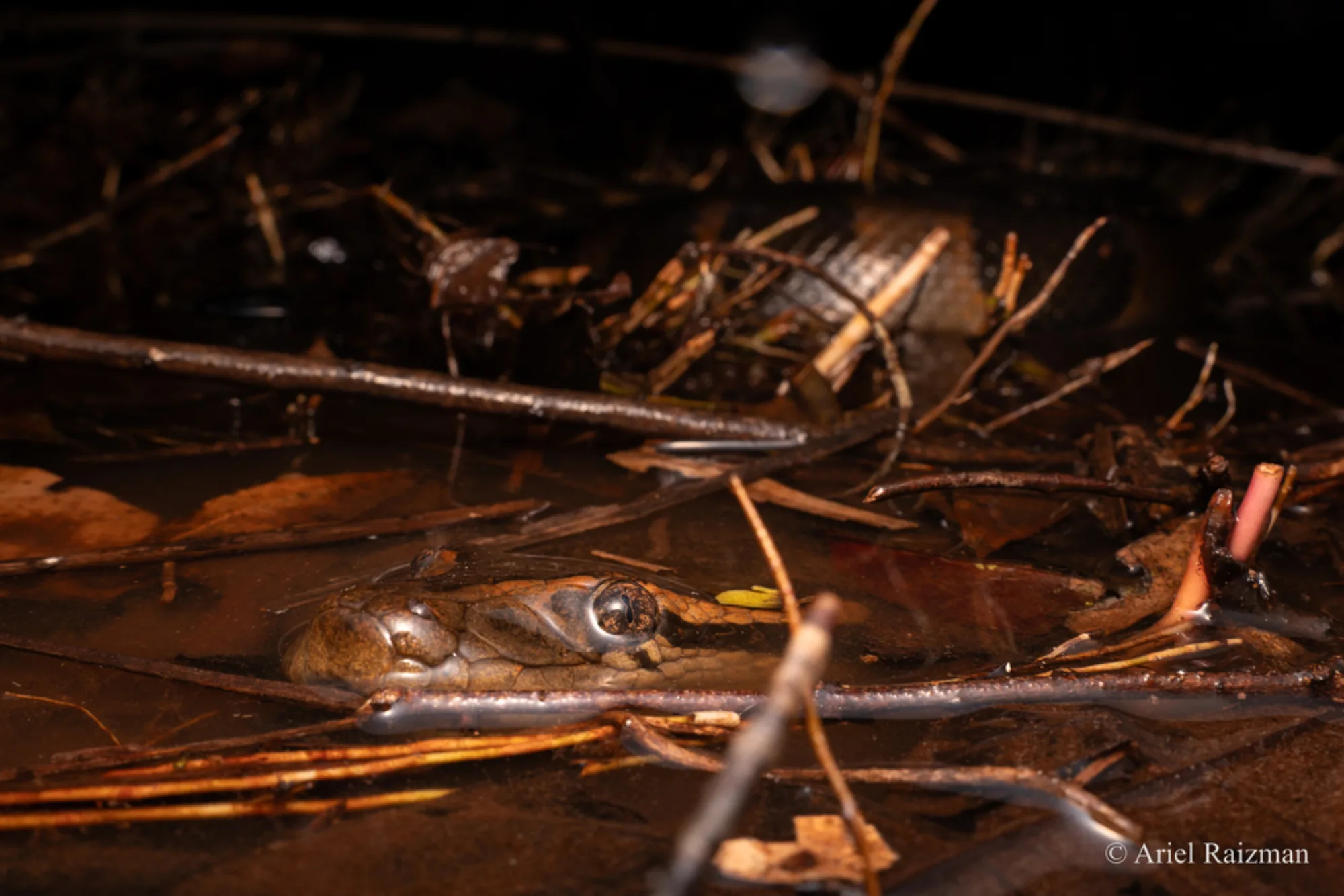
Heavy-bodied and olive green, the Anaconda is a non-venomous boa with black blotches running along its body. Its narrow head usually has orange-yellow stripes on either side, and its eyes sit high enough to watch above the water while its body stays hidden. Among the heaviest and longest living snakes, it can reach 6.32 m, although mature females average about 4.6 m and males around 3 m. Females are generally much larger than males.
The snake occurs east of the Andes in northern South America, from Trinidad south to northern Paraguay. In the Amazon and Orinoco basins, it favours rainforest and savanna that floods with the seasons, living in wetlands and waterways such as lagoons, marshes and gently flowing rivers. Mostly nocturnal and aquatic, it spends much of its time in water, though it can also be found on land among thick vegetation. It is awkward on land but moves stealthily in water, where it can lie almost completely submerged in wait for prey. After striking, it coils around its catch, constricts it and swallows it whole. Its varied diet includes fish, birds, mammals and other reptiles, with capybaras among its common prey; very large meals, such as tapirs or caimans, are rare.
Anacondas live alone until the rainy-season mating period, and females give birth to live young after a gestation of six to seven months. A litter usually contains 20 to 40 young, which receive no parental care and often fall prey to other animals. Even large adults can be eaten by jaguars, black caimans and Orinoco crocodiles, while large prey can sometimes seriously injure or kill an anaconda.
Written from the English Wikipedia article Green anaconda (CC BY-SA 4.0).
- Records
- 56
- Countries
- 9
- Atlas places
- 7
These are open occurrence records, so they show where people looked for and recorded the Anaconda as much as where it lives. Cells are up to 25 km across, and every location is generalised to its cell.
Generalised encounter areas, not exact locations. Each shape is a grid cell coloured by how likely the species is there.
- Very likelyEcuador25 km zone · medium confidence · 28 records · updated 80 days ago
- Very likelyColombia25 km zone · medium confidence · 8 records · updated 80 days ago
- Very likelyBolivia25 km zone · medium confidence · 6 records · updated 80 days ago
- Very likelyGuyana25 km zone · medium confidence · 2 records · updated 80 days ago
- Very likelyVenezuela25 km zone · medium confidence · 2 records · updated 80 days ago
- LikelyPeru25 km zone · medium confidence · 4 records · updated 80 days ago
- LikelyFrench Guiana25 km zone · medium confidence · 3 records · updated 80 days ago
- LikelyBrazil25 km zone · medium confidence · 2 records · updated 80 days ago
- LikelySuriname25 km zone · medium confidence · 1 record · updated 80 days ago
Conservation status not assessed here yet, so every location is generalised to its grid cell.