Steller Sea Lion
Eumetopias jubatus
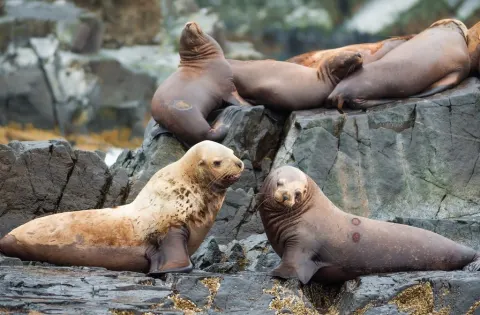
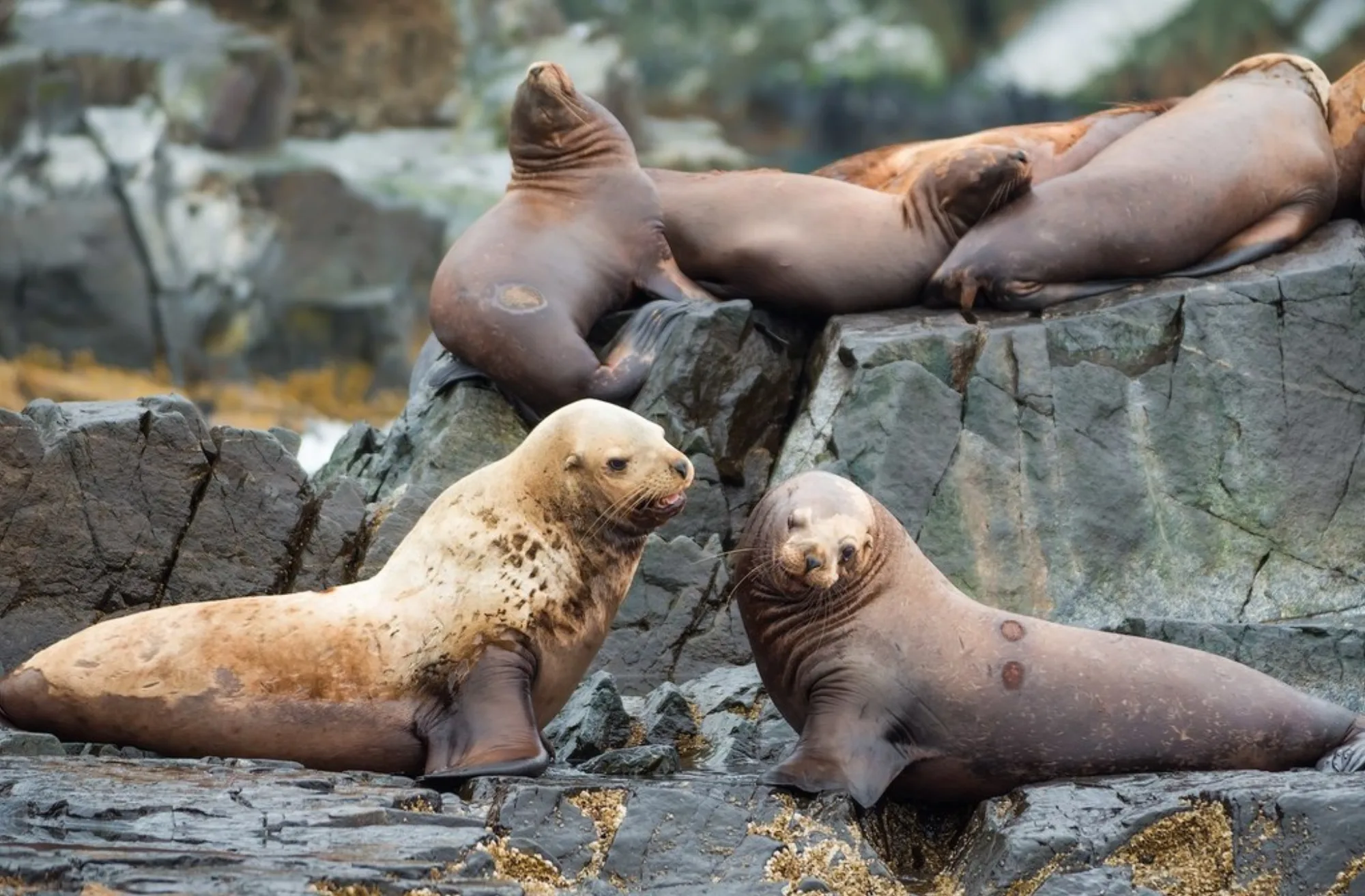
Pale yellow to tawny, and occasionally reddish, adult Steller Sea Lions are lighter in colour than most sea lions. They are the largest of the eared seals, with males growing larger than females and carrying thick manes around their necks. Newborn pups are almost black and stay dark for several months.
The species lives mainly in coastal waters around the northern Pacific, from central California north to Alaska and west through the Aleutian Islands to Russia and northern Japan. It favours the cool coastal waters of the subarctic, feeding at sea and coming ashore to rest, moult, breed and raise pups. Isolated islands are favoured gathering places, offering access to offshore prey as well as shelter from land predators. Sea lions also gather around fishing vessels to eat discarded bycatch, and may forage in groups where prey is plentiful. Their varied diet includes fish such as herring, salmon and pollock, as well as squid and octopus. They sometimes enter estuaries to feed on fish in brackish water.
In mid-spring, mature males gather at traditional breeding sites, usually on beaches on isolated islands, where older, larger males defend territories. Females arrive about a week later and give birth soon after reaching the rookery. Mothers initially nurse their pups ashore, then make increasingly long and frequent trips to find food. Distinctive calls help mothers and pups find one another among the crowd. Killer whales prey on Steller Sea Lions, and sharks may take juveniles. People sometimes kill them because they are viewed as competitors for fish. A sharp decline in the western population has several proposed causes, including changes in prey, fishing, predators, disease and contaminants.
Written from the English Wikipedia article Steller sea lion (CC BY-SA 4.0).
- Records
- 1,412
- Countries
- 3
- Atlas places
- 7
These are open occurrence records, so they show where people looked for and recorded the Steller Sea Lion as much as where it lives. Cells are up to 25 km across, and every location is generalised to its cell.
Generalised encounter areas, not exact locations. Each shape is a grid cell coloured by how likely the species is there.
- Very likelyUnited States25 km zone · medium confidence · 948 records · updated 80 days ago
- Very likelyCanada25 km zone · medium confidence · 445 records · updated 80 days ago
- LikelyRussia25 km zone · medium confidence · 19 records · updated 80 days ago
Conservation status not assessed here yet, so every location is generalised to its grid cell.