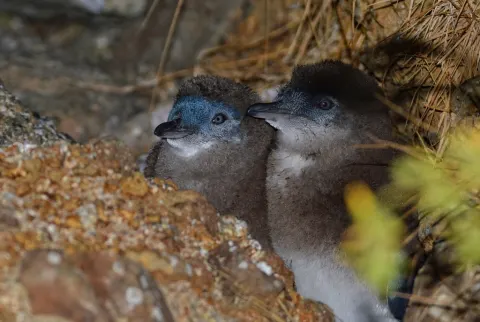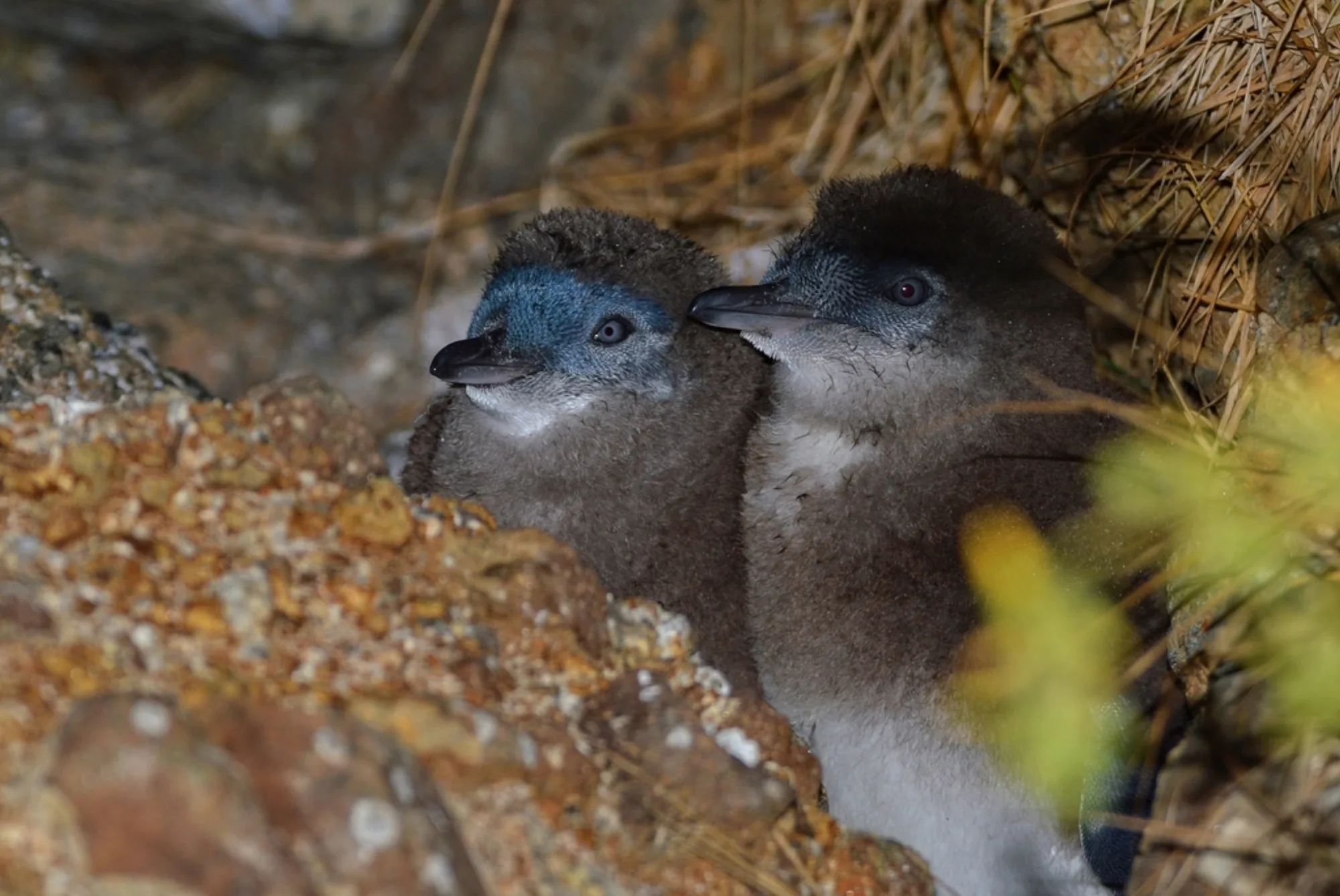
Little Penguin
Eudyptula minor
Small enough to stand just 30 to 33 cm tall, the Little Penguin has blue upperparts and flippers, a pale underside and a dark bill. It is the world's smallest penguin and is also known as the little blue penguin or kororā.
Eudyptula minor is native to New Zealand, while the Australian little penguin occurs across southern Australia and in Otago, on New Zealand's South Island. Colonies of the Australian bird are found mainly on offshore islands, where they have some protection from introduced land predators and human disturbance. Penguins nest close to the sea, using sandy burrows, caves and rock crevices, as well as sheltered spaces under logs or human-made structures. At Phillip Island in Victoria, visitors can watch penguins cross Summerland Beach in their nightly parade.
Little penguins dive for food during the day and return to shore at dusk. They generally feed inshore, hunting small fish, squid and crustaceans, sometimes diving as far as the sea floor. They may hunt together when pursuing small schooling prey, while larger prey is more often taken by birds hunting alone. Breeding takes place in spring and summer, although its timing varies with location and year. Both parents share incubation and chick-rearing duties, taking turns to forage and attend the nest. Introduced predators, including dogs, cats, rats and foxes, pose a serious threat on land, and a single uncontrolled dog or feral cat can kill many birds. Food shortages can also cause starvation and breeding failure, while rising ocean temperatures can shift breeding earlier so that it no longer coincides with prey availability.
Written from the English Wikipedia article Little penguin (CC BY-SA 4.0).
- Records
- 238,144
- Countries
- 2
- Atlas places
- 8
These are open occurrence records, so they show where people looked for and recorded the Little Penguin as much as where it lives. Cells are up to 25 km across, and every location is generalised to its cell.
Generalised encounter areas, not exact locations. Each shape is a grid cell coloured by how likely the species is there.
- Very likelyAustralia25 km zone · high confidence · 222361 records · updated 80 days ago
- Very likelyNew Zealand25 km zone · high confidence · 15783 records · updated 80 days ago
Conservation status not assessed here yet, so every location is generalised to its grid cell.