Royal Penguin
Eudyptes schlegeli
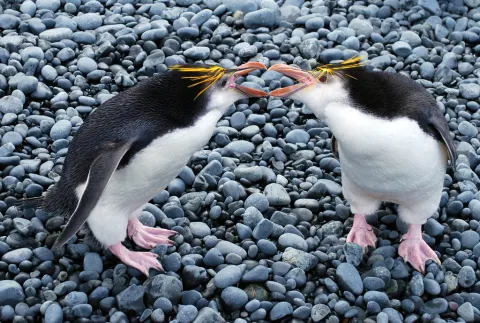
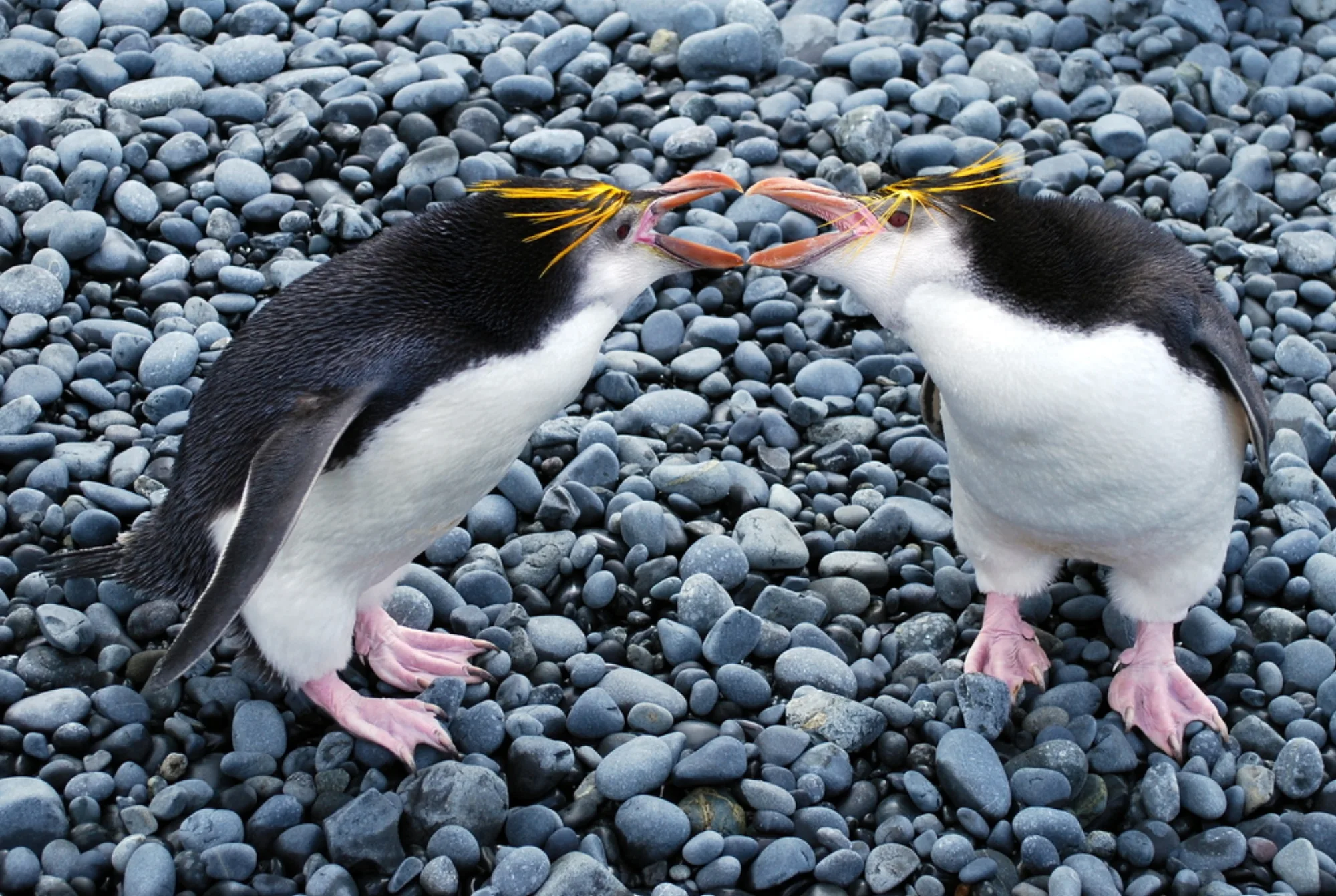
A pale face and chin distinguish the Royal Penguin from the similar macaroni penguin. Adults have black heads, backs and flippers, white underparts, and long yellow-orange crests that run from the forehead over the eyes. Their bills are orange-brown with dark tips, while their eyes are red-brown. Young birds resemble adults, though their feathers are less bright, their crests shorter and their faces darker.
Royal penguins occur only on Macquarie Island and the neighbouring Bishop and Clerk Islets, in the subantarctic Southern Ocean. Breeding colonies occupy beaches, coastal terraces and vegetated slopes, often near creeks or natural routes through dense vegetation that provide access to the sea. Beyond the breeding and moulting seasons, they live mostly offshore in the subantarctic waters surrounding Antarctica. They feed mainly on crustaceans, especially krill, as well as fish and cephalopods. Their diet changes with the season, becoming more varied during chick-rearing, when fish and cephalopods make up a greater share.
Adults return to breeding colonies from late September to October and make shallow nests in sandy or grassy ground, sometimes lining them with stones, grass or pebbles. Both parents share incubation; after hatching, males usually guard the chick while females forage and bring back food. Later, chicks gather in large crèches to keep warm and safe, and both parents carry on feeding them. Skuas and southern giant petrels prey on eggs and young chicks, and southern elephant seals can crush birds and eggs as they move through crowded nesting sites. Introduced rats, discarded plastic, pollution and reduced food supplies associated with commercial fishing also threaten royal penguins.
Written from the English Wikipedia article Royal penguin (CC BY-SA 4.0).
- Records
- 2,362
- Countries
- 5
- Atlas places
- 2
These are open occurrence records, so they show where people looked for and recorded the Royal Penguin as much as where it lives. Cells are up to 25 km across, and every location is generalised to its cell.
Generalised encounter areas, not exact locations. Each shape is a grid cell coloured by how likely the species is there.
- Very likelyAustralia25 km zone · medium confidence · 1850 records · updated 80 days ago
- Very likelyUnnamed area25 km zone · medium confidence · 431 records · updated 80 days ago
- LikelyAntarctica25 km zone · medium confidence · 56 records · updated 80 days ago
- PossibleNew Zealand25 km zone · medium confidence · 12 records · updated 80 days ago
- PossibleFalkland Islands25 km zone · medium confidence · 9 records · updated 80 days ago
- PossibleFrench Southern Territories25 km zone · medium confidence · 4 records · updated 80 days ago
Conservation status not assessed here yet, so every location is generalised to its grid cell.