Fiordland Penguin
Eudyptes pachyrhynchus
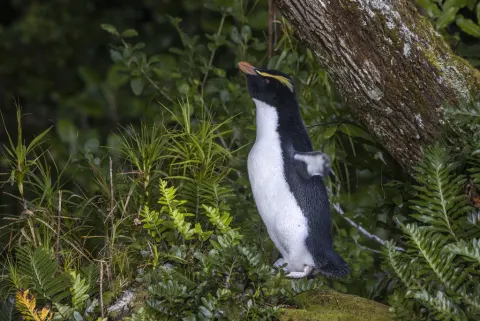
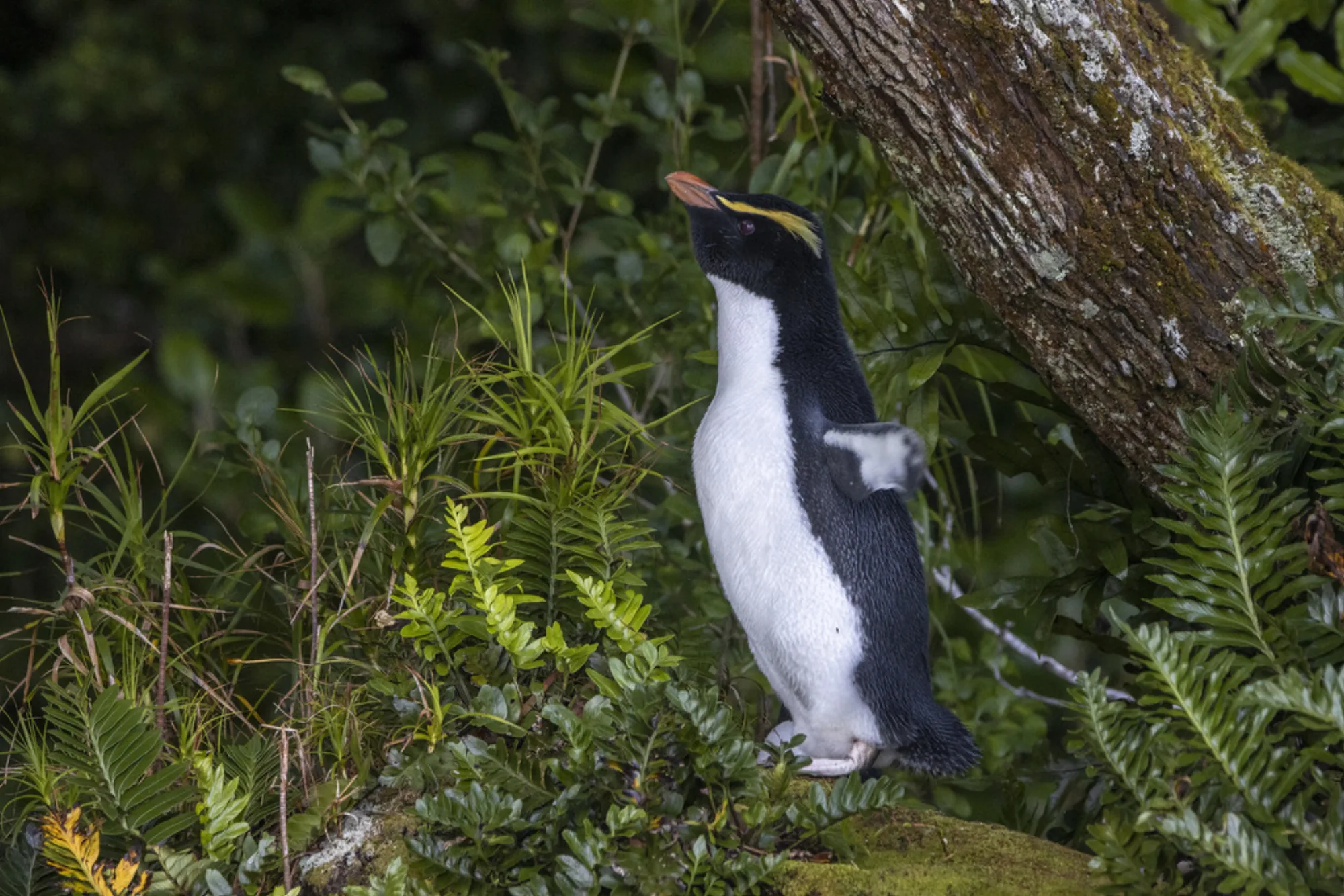
A broad yellow crest sweeps from the base of the beak, over the eye and down the neck of the Fiordland Penguin. This medium-sized, black-and-white penguin has a white front and white facial markings, and grows to approximately 55 cm long. Unlike the similar Snares and erect-crested penguins, its bill is surrounded by feathered skin.
Found only in New Zealand as a breeding species, it nests along the south-western coast of the South Island, as well as around Stewart Island/Rakiura and neighbouring islands. Colonies shelter among roots and rocks in dense coastal forest, while small groups also nest on steep rainforest slopes and at open coastal sites. Outside breeding and incubation, the birds tend to travel alone and are nocturnal. Their recorded prey consists mainly of cephalopods, particularly arrow squid, followed by crustaceans and fish, although the importance of cephalopods may be overstated. Birds in the outer fjord make long, deep dives, while those in the mid-fjord feed in the upper 20 metres of water.
After four months at sea, breeding birds gather in small groups during winter and come ashore for about 20 weeks. They breed annually from July to December, laying two eggs, with the second larger than the first. Both parents incubate the eggs and feed their chick after it joins a crèche, until it heads to sea at around 75 days old. Heavy rain and frequent storms can kill offspring, while introduced predators, especially stoats, also threaten the penguins. Dogs, cats and rats are threats too, as is human disturbance, which can drive adults from nests and expose chicks to predators.
Written from the English Wikipedia article Fiordland penguin (CC BY-SA 4.0).
- Records
- 3,345
- Countries
- 2
- Atlas places
- 5
These are open occurrence records, so they show where people looked for and recorded the Fiordland Penguin as much as where it lives. Cells are up to 25 km across, and every location is generalised to its cell.
Generalised encounter areas, not exact locations. Each shape is a grid cell coloured by how likely the species is there.
- Very likelyNew Zealand25 km zone · high confidence · 3252 records · updated 80 days ago
- LikelyAustralia25 km zone · medium confidence · 93 records · updated 80 days ago
Conservation status not assessed here yet, so every location is generalised to its grid cell.