Macaroni Penguin
Eudyptes chrysolophus
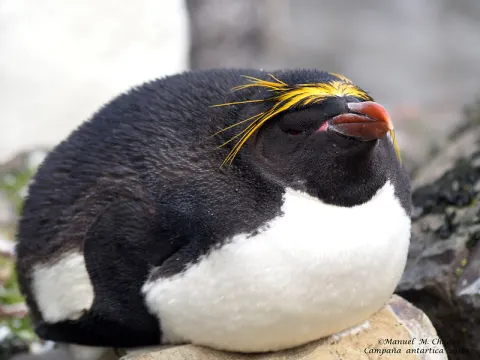
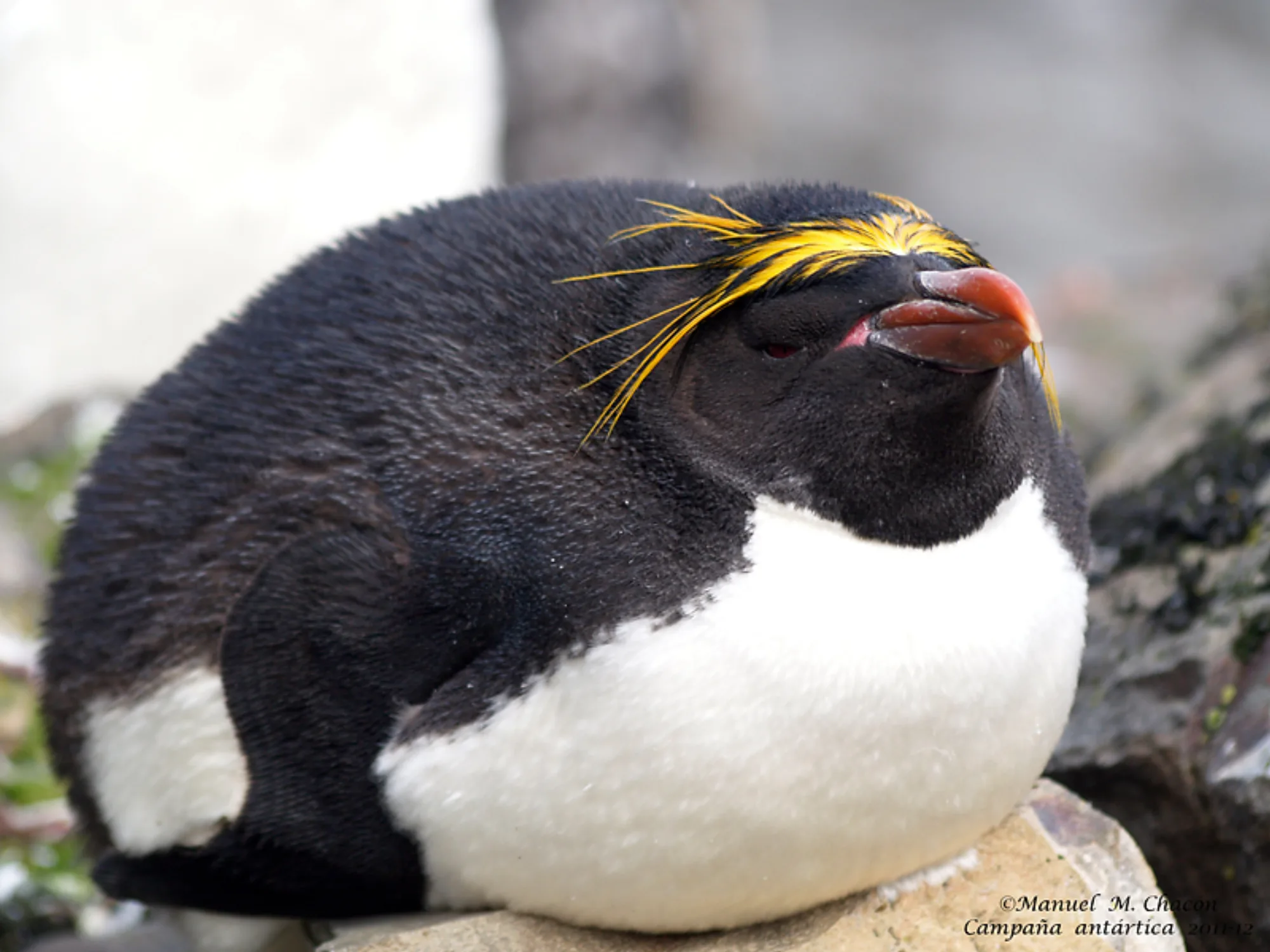
A sweep of yellow feathers across the forehead gives the Macaroni Penguin its distinctive look. Its black face and upperparts contrast sharply with its white underside, while its large bill is orange-brown. Adults average 70 cm in length, and males and females look similar, although males tend to be slightly larger.
These flightless birds live across the Subantarctic and as far south as the Antarctic Peninsula. Their breeding sites include South Georgia and the Falkland Islands, as well as Kerguelen, Heard and McDonald Islands. They gather in densely packed colonies that can hold up to 100,000 birds, nesting in shallow scrapes sometimes lined with pebbles, stones or grass. On South Georgia, a nest may also lie in a clump of tussock grass. Adults begin breeding in late October, and the female usually lays two eggs. After hatching, the male keeps the chick warm and protected while the female brings it food. Young birds form groups called crèches when they are no longer guarded by the males, before heading out to sea on their own.
Macaroni Penguins feed on crustaceans, squid and fish, with krill making up most of their food during the breeding season. When feeding chicks, they generally forage daily from dawn to dusk, sometimes staying out overnight as the chicks grow older. After breeding, they disperse into the ocean, and they also spend three to four weeks ashore each year while moulting. Seals and killer whales hunt adults in the water, while seabirds take eggs and chicks. Numbers have fallen substantially in several places, and commercial fishing and marine pollution may be affecting the species. Reductions in krill linked to climate and fishing may also make it harder for females to reproduce.
Written from the English Wikipedia article Macaroni penguin (CC BY-SA 4.0).
- Records
- 28,426
- Countries
- 6
- Atlas places
- 1
These are open occurrence records, so they show where people looked for and recorded the Macaroni Penguin as much as where it lives. Cells are up to 25 km across, and every location is generalised to its cell.
Generalised encounter areas, not exact locations. Each shape is a grid cell coloured by how likely the species is there.
- Very likelyHeard & McDonald Islands25 km zone · medium confidence · 14997 records · updated 80 days ago
- Very likelySouth Georgia & South Sandwich Islands25 km zone · high confidence · 9643 records · updated 80 days ago
- Very likelyUnnamed area25 km zone · medium confidence · 1356 records · updated 80 days ago
- Very likelySouth Africa25 km zone · high confidence · 1146 records · updated 80 days ago
- Very likelyChile25 km zone · high confidence · 519 records · updated 80 days ago
- Very likelyAntarctica25 km zone · high confidence · 410 records · updated 80 days ago
- Very likelyFalkland Islands25 km zone · high confidence · 355 records · updated 80 days ago
Conservation status not assessed here yet, so every location is generalised to its grid cell.