Asian Koel
Eudynamys scolopaceus
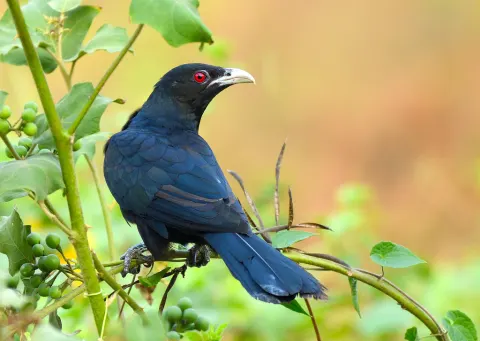
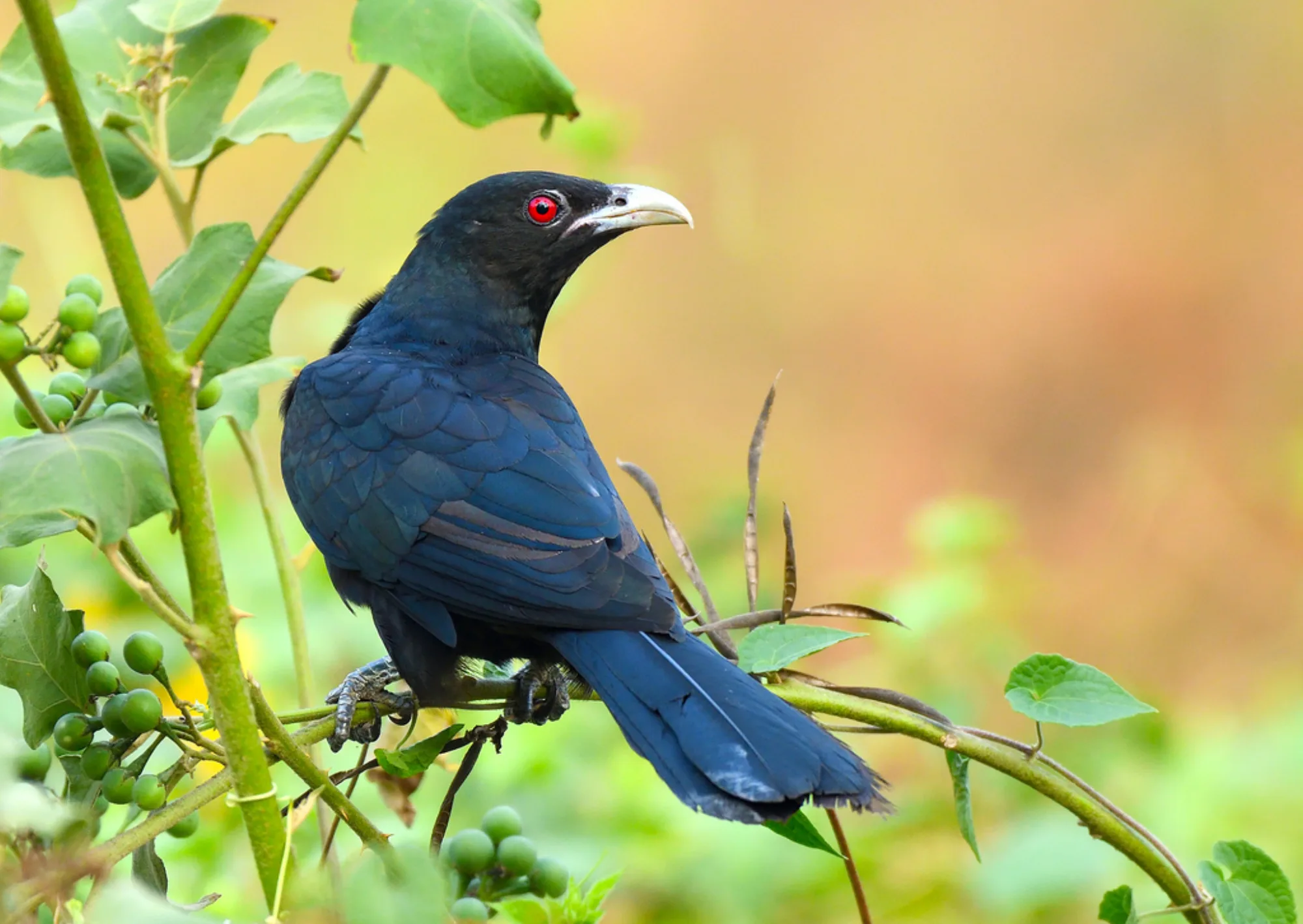
Listen for a repeated koo-Ooo in light woodland or cultivated land: it may lead you to the Asian Koel, a large, long-tailed cuckoo found across the Indian subcontinent, China and Southeast Asia. Measuring 39 to 46 cm and weighing 190 to 327 g, it varies in size and colour across its range. In the nominate form, males have crimson eyes, a pale greenish-grey bill and glossy, bluish-black plumage. The female has a brownish crown, reddish-brown streaks on her head, dark brown upperparts marked with pale spots, and heavily striped whitish underparts. Young birds have upper plumage more like the male's and a black beak. During the breeding season, koels are particularly vocal: alongside the male's repeated song, the female gives a shrill kik-kik-kik call, though calls vary between populations.
The species breeds mainly as a resident across tropical southern Asia, from Iran and Sri Lanka east to southern China and the Greater Sundas. It has colonised new places, including Krakatau and Singapore, while some populations may travel long distances. Adults eat mainly fruit, but the species also takes insects, caterpillars, eggs and small vertebrates. A bird may defend a fruiting tree and chase away other fruit-eaters, and koels help disperse sandalwood in India. For breeding, a female lays in another bird's nest, often choosing one low down and near fruit trees. Crows and mynas are among the hosts that raise young koels, although adult female koels have sometimes been seen feeding their own young in host nests. Parasites recorded in the species include lice, nematodes and malaria-like protozoa; koels were also once popular as cagebirds in India.
Written from the English Wikipedia article Asian koel (CC BY-SA 4.0).
- Records
- 761,481
- Countries
- 28
- Atlas places
- 11
- Bandipur National Park· India
- Annapurna Conservation Area· Nepal
- Kanha National Park· India
- Kaziranga National Park· India
- Komodo National Park· Indonesia
- Koshi Tappu Wildlife Reserve· Nepal
- Langtang National Park· Nepal
- Periyar National Park· India
- Ranthambore National Park· India
- Tadoba Andhari Tiger Reserve· India
- Yala National Park· Sri Lanka
These are open occurrence records, so they show where people looked for and recorded the Asian Koel as much as where it lives. Cells are up to 25 km across, and every location is generalised to its cell.
Generalised encounter areas, not exact locations. Each shape is a grid cell coloured by how likely the species is there.
- Very likelyIndia25 km zone · high confidence · 616106 records · updated 86 days ago
- Very likelyThailand25 km zone · high confidence · 42787 records · updated 86 days ago
- Very likelySri Lanka25 km zone · high confidence · 22175 records · updated 86 days ago
- Very likelySingapore25 km zone · high confidence · 17175 records · updated 86 days ago
- Very likelyHong Kong SAR China25 km zone · high confidence · 13575 records · updated 86 days ago
- Very likelyTaiwan25 km zone · high confidence · 10897 records · updated 86 days ago
- Very likelyMalaysia25 km zone · high confidence · 9527 records · updated 86 days ago
- Very likelyChina25 km zone · high confidence · 5982 records · updated 86 days ago
- Very likelyNepal25 km zone · high confidence · 5785 records · updated 86 days ago
- Very likelyBangladesh25 km zone · high confidence · 4643 records · updated 86 days ago
Conservation status not assessed here yet, so every location is generalised to its grid cell.