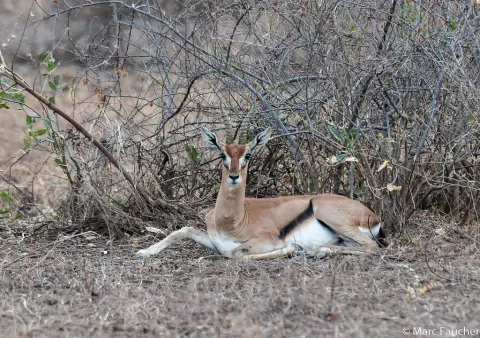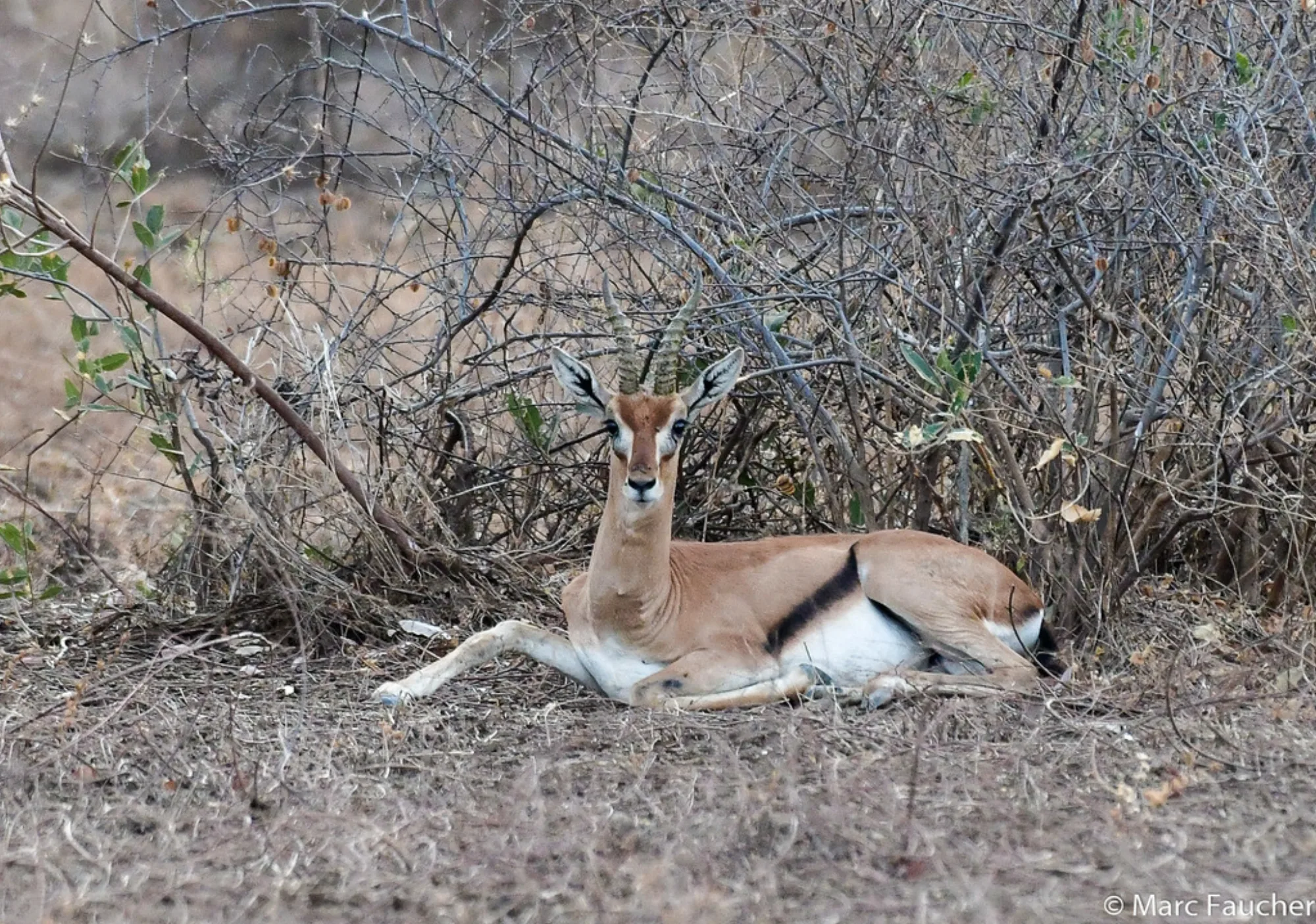
Red-fronted Gazelle
Eudorcas rufifrons
This medium-sized antelope is found in a thin corridor across Africa, stretching from Senegal to the highlands of Ethiopia. Primarily residing in the Sahel, the Red-fronted Gazelle wanders through dry grasslands, shrubby steppes and wooded savannas. It is a seasonal traveler, moving toward the southern fringes of the Sahara when the rains arrive but retreating south to find water during the dry months. While it can adapt to old farmland or pastures, it requires sufficient cover to survive.
To identify one, look for a light reddish-brown coat accented by a white belly and rump. A narrow black stripe, about 2 to 4 cm high, marks the flank between the front and back legs, while white stripes border the face from the eyes to the mouth. Both sexes carry horns with an S-shaped curve. These gazelles typically live in solitude, as a duo, or in clusters of six or fewer, though you might occasionally spot a herd of up to 15. They spend their time grazing on grass or browsing on the leaves of shrubs and trees.
Breeding happens for much of the year, with mothers hiding their single fawns and returning only to nurse them. The species faces a declining population, now estimated at 25,000 individuals. Their survival is pressured by illegal hunting and the loss of habitat to farming. Furthermore, domestic livestock often outcompete them for food, as overgrazing forces these gazelles to abandon their traditional ranges for new territory.
Written from the English Wikipedia article Red-fronted gazelle (CC BY-SA 4.0).
- Records
- 0
- Countries
- 2
- Atlas places
- 0
These are open occurrence records, so they show where people looked for and recorded the Red-fronted Gazelle as much as where it lives. Cells are up to 25 km across, and every location is generalised to its cell.
Generalised encounter areas, not exact locations. Each shape is a grid cell coloured by how likely the species is there.
- Very likelyNiger25 km zone · low confidence · 0 records · updated 4 days ago
- UncommonChad25 km zone · low confidence · 0 records · updated 4 days ago
Conservation status not assessed here yet, so every location is generalised to its grid cell.