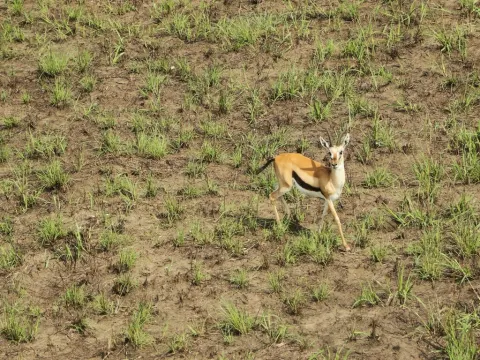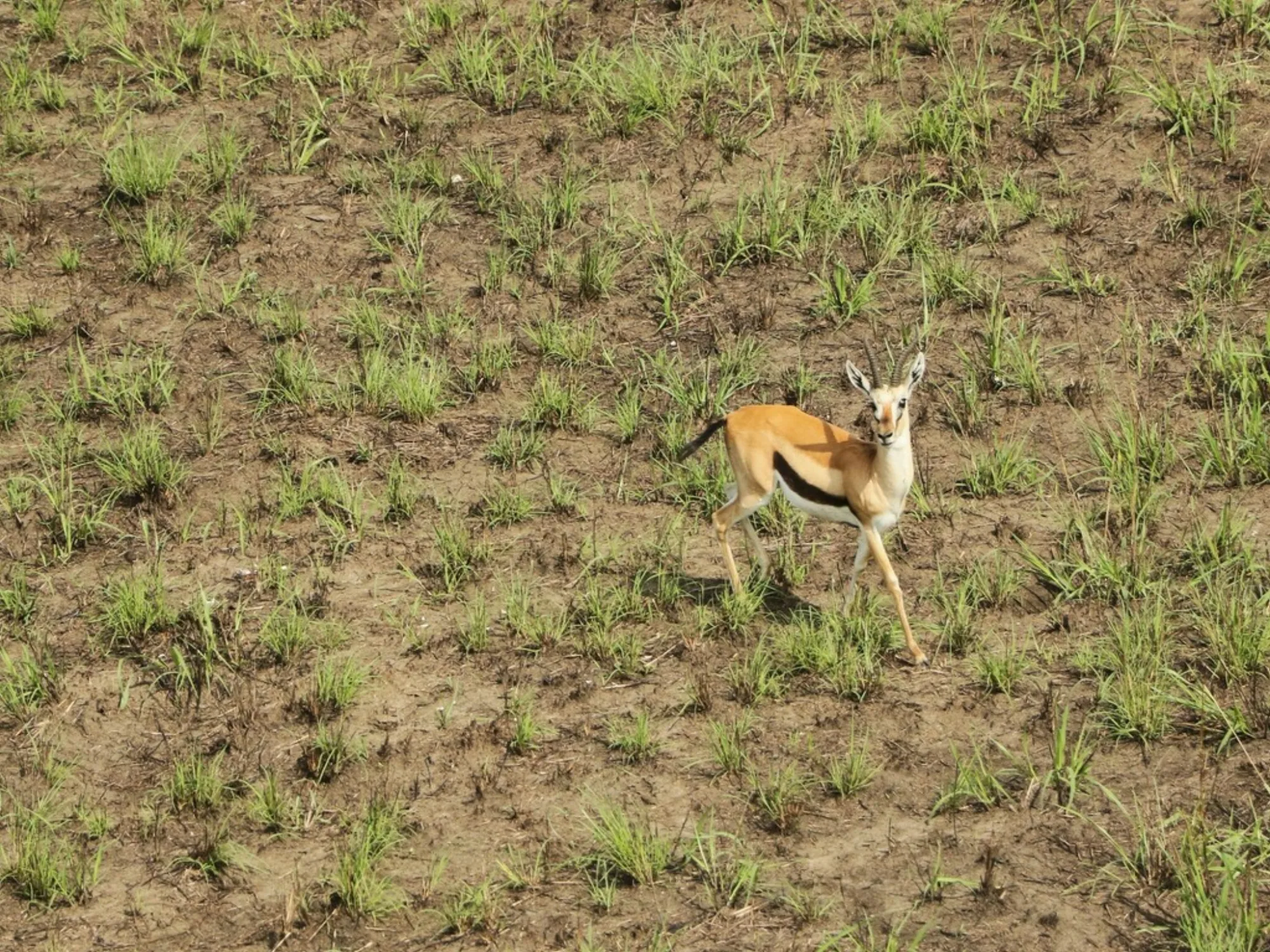
Mongalla Gazelle
Eudorcas albonotata
Travellers exploring the floodplains and flat savanna of South Sudan may encounter the Mongalla Gazelle, a medium-sized antelope found east of the Nile. This gazelle is distinguished by its brown coat and striking white patches on the forehead, underbelly, and buttocks. A white ring surrounds each eye, and the animal features a broad band across its flanks with a faint reddish stripe positioned just below it. Both sexes possess horns that curve backward then forward with inward-turning tips, though the horns on males are twice as long as those of the females. Male horns are also notable for their prominent rings and inward curvature.
These animals are highly mobile, following a nomadic migration cycle every year across the eastern Sudd floodplains. During the wet season, they gather in high densities alongside other migratory species like the tiang and white-eared kob. In fact, more than one million of these combined animals have maintained their migratory patterns despite decades of civil war in the region. In the Boma ecosystem, this gazelle has been recorded as the second-most numerous animal, with population estimates for the species reaching as high as 278,000 according to a 2007 aerial survey.
While the range of the Mongalla Gazelle does not extend as far as the borders of Uganda or Kenya, it remains well-established in its specific South Sudan habitat. At present, no major threats to the survival of the species have been identified. The population within the Boma ecosystem appears stable and is not considered to be under significant risk from hunting. Furthermore, certain areas of their range remain difficult for poachers to access because those locations are devoid of water.
Written from the English Wikipedia article Mongalla gazelle (CC BY-SA 4.0).
- Atlas places
- 0
These are open occurrence records, so they show where people looked for and recorded the Mongalla Gazelle as much as where it lives. Cells are up to 25 km across, and every location is generalised to its cell.
No encounter zones yet
Where and when you can expect to see Mongalla Gazelle is calculated from observation density. No zones have been computed for this species yet.
Conservation status not assessed here yet, so every location is generalised to its grid cell.