Tasselled Wobbegong
Eucrossorhinus dasypogon
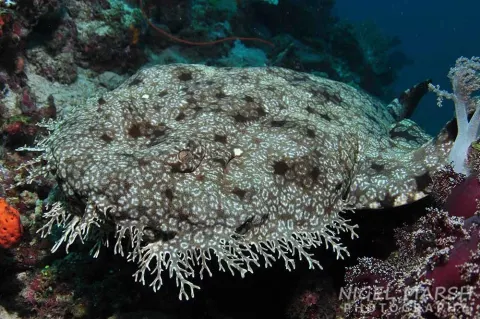
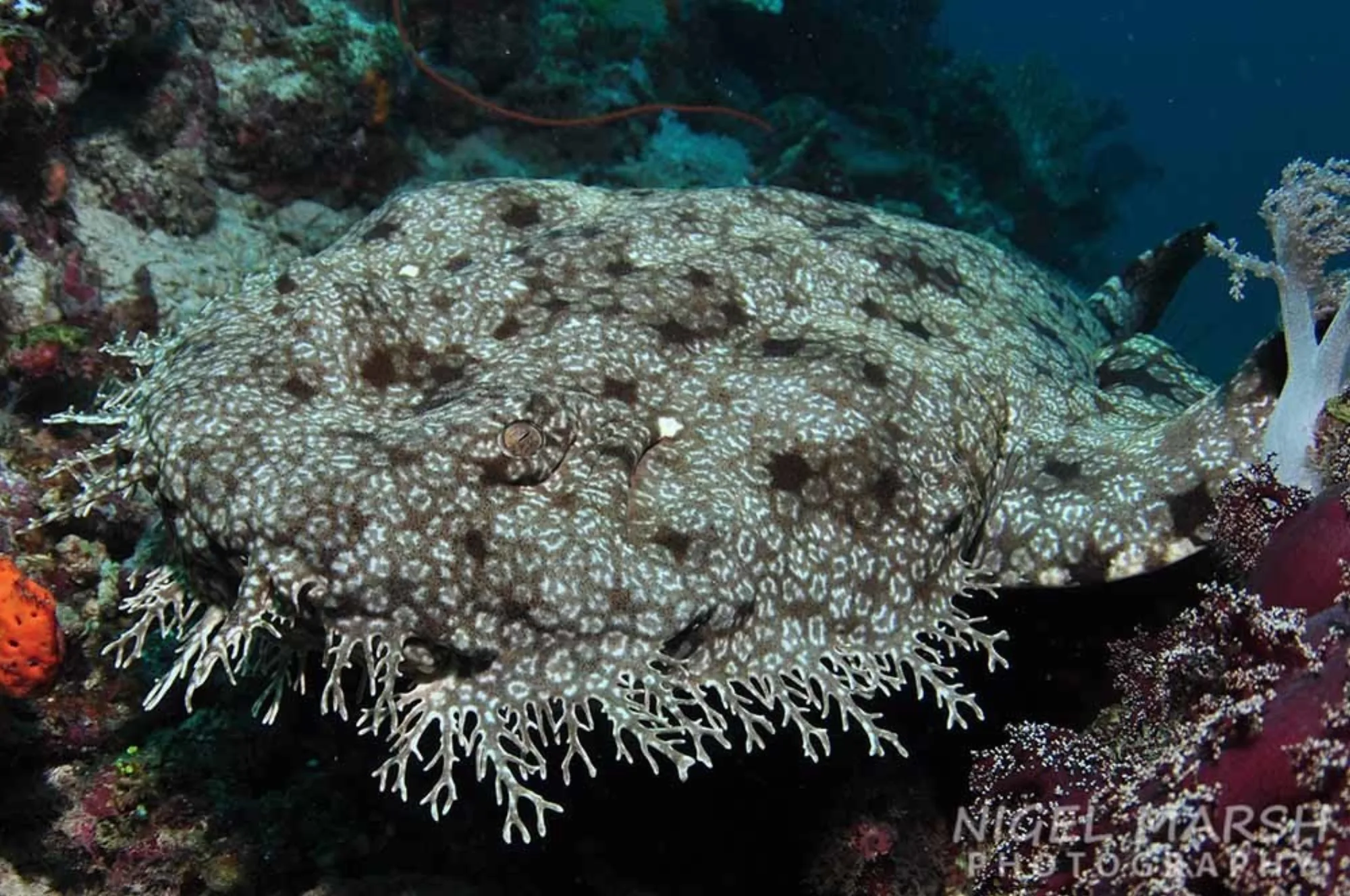
A fringe of branching flaps gives the Tasselled Wobbegong its distinctive outline, with a beard-like edge beneath its chin. This broad, flattened carpet shark can reach 1.8 m in length. Small dark blotches and lines form a mosaic over its grey- or yellow-brown back, sometimes with darker bands, helping it blend into the reef. Its large, rounded fins add to its broad shape, while its underside is mostly white.
Its range includes northern Australia, New Guinea and neighbouring islands, where it lives on coral reefs in water as deep as about 50 m and as shallow as the intertidal zone. Look for it on coral heads, along reef faces and in channels through the reef. Solitary by day, it usually lies still inside a cave or under a ledge, its tail curled up. Each shark keeps to a small home range and returns to preferred resting places. At night it becomes more active, swimming onto the reef to hunt. Its diet includes fish, crustaceans and cephalopods, and it also ambushes prey during the day. In captivity, sharks have been seen waving their tails when food is nearby, apparently drawing prey towards them with a fin that resembles a small fish.
Little is known about its breeding, but developing young are thought to be sustained by yolk, and newborns measure approximately 20 cm. Divers have approached the shark without incident, although it can inflict severe wounds and its camouflaged appearance makes accidental encounters a concern. It faces few threats in Australian waters, but elsewhere fishing activity and damage to its habitat may affect it. Pollution, blast fishing and coral removal all contribute to that habitat degradation.
Written from the English Wikipedia article Tasselled wobbegong (CC BY-SA 4.0).
- Records
- 50
- Countries
- 2
No atlas park has a record of the Tasselled Wobbegong in or around it yet.
These are open occurrence records, so they show where people looked for and recorded the Tasselled Wobbegong as much as where it lives. Cells are up to 25 km across, and every location is generalised to its cell.
Generalised encounter areas, not exact locations. Each shape is a grid cell coloured by how likely the species is there.
- Very likelyIndonesia25 km zone · medium confidence · 33 records · updated 80 days ago
- Very likelyAustralia25 km zone · medium confidence · 17 records · updated 80 days ago
Conservation status not assessed here yet, so every location is generalised to its grid cell.