Common Leopard Gecko
Eublepharis macularius
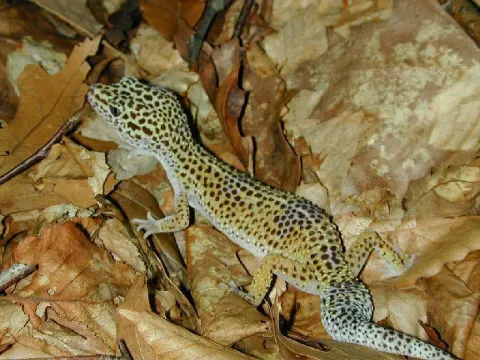
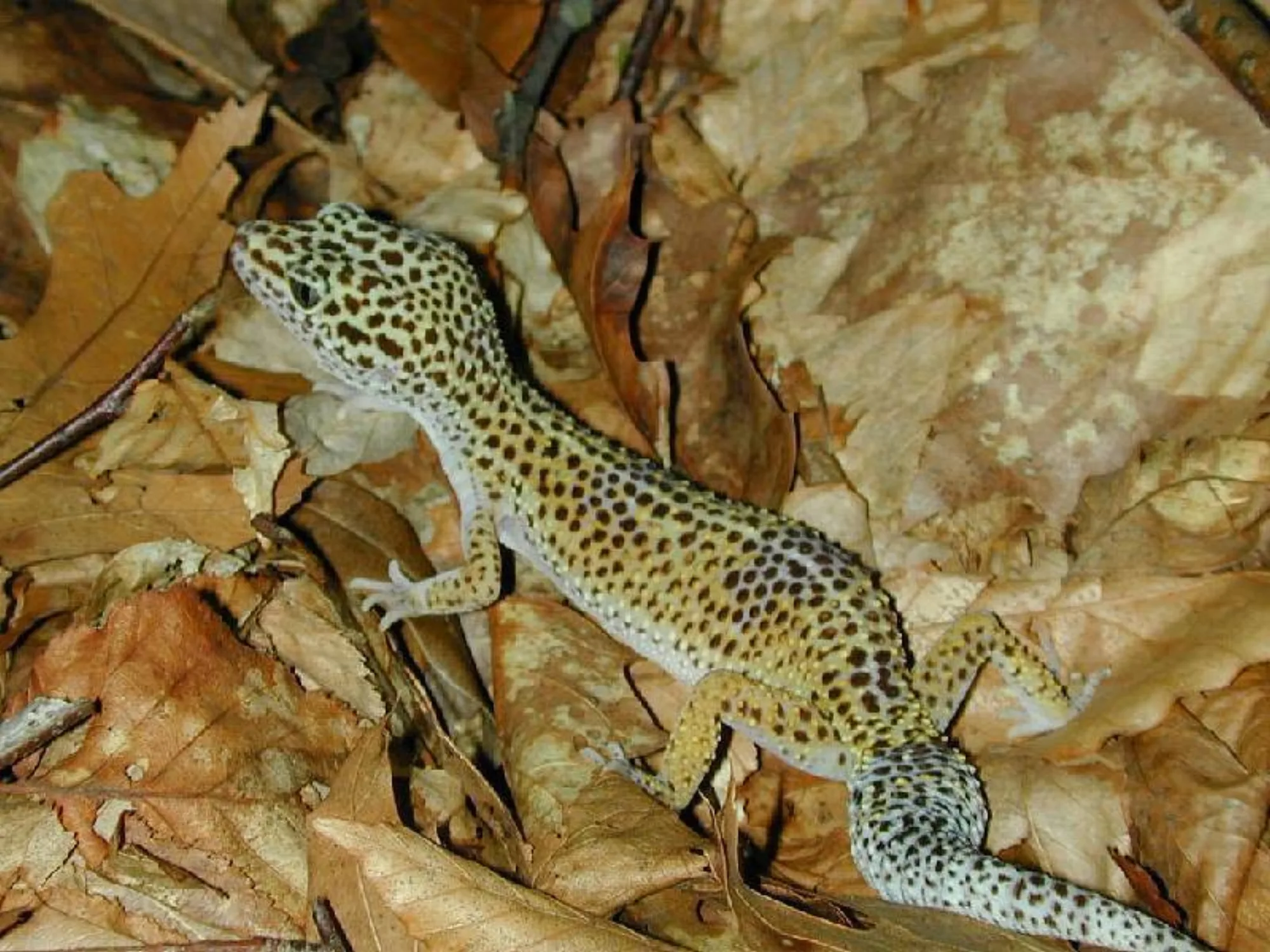
Spotted skin and a thick tail make the Common Leopard Gecko a distinctive small lizard of dry country. Its ground colour ranges from yellow to brownish-orange, with spots across all or much of its back. Adult females measure about 18 to 20 cm, while males are about 20 to 28 cm long. The tail stores fat, giving the gecko an energy reserve when food is scarce.
This ground-dwelling gecko occurs in parts of Iran and across Afghanistan and Pakistan, reaching northwest India and western Nepal. Look for its habitat in rocky, dry grassland and desert, where vegetation is sparse and the soil can be clay or sandy. Rock crevices offer shelter, though the gecko reportedly avoids places where sand is the main ground surface. It also occurs in dry forests in Nepal and Pakistan, where it may shelter beneath loose tree bark. During cold winters, it retreats underground and lives on stored fat.
Wild leopard geckos are generally considered nocturnal, hiding in burrows or other sheltered places by day and becoming active at dusk. They are opportunistic hunters, feeding mostly on invertebrates but also taking small vertebrates when the chance arises. Breeding usually takes place in summer, with females laying roughly six to eight clutches, each containing two eggs. Eggs take between 35 and 89 days to hatch, usually nearer the longer end of that range. Predators are a threat, and the gecko relies on camouflage and daytime hiding to avoid being found. If confronted, it may call out or drop its tail, which can keep twitching and distract a predator while the gecko escapes.
Written from the English Wikipedia article Leopard gecko (CC BY-SA 4.0).
- Records
- 4
- Countries
- 1
No atlas park has a record of the Common Leopard Gecko in or around it yet.
These are open occurrence records, so they show where people looked for and recorded the Common Leopard Gecko as much as where it lives. Cells are up to 25 km across, and every location is generalised to its cell.
Generalised encounter areas, not exact locations. Each shape is a grid cell coloured by how likely the species is there.
- Very likelyPakistan25 km zone · medium confidence · 4 records · updated 80 days ago
Conservation status not assessed here yet, so every location is generalised to its grid cell.