North Pacific Right Whale
Eubalaena japonica
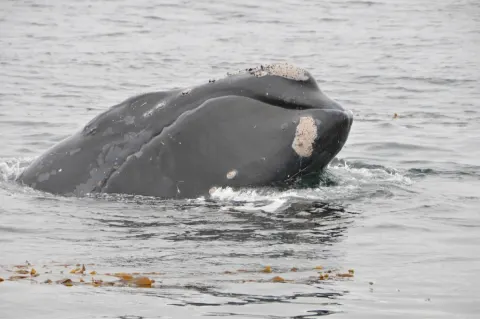
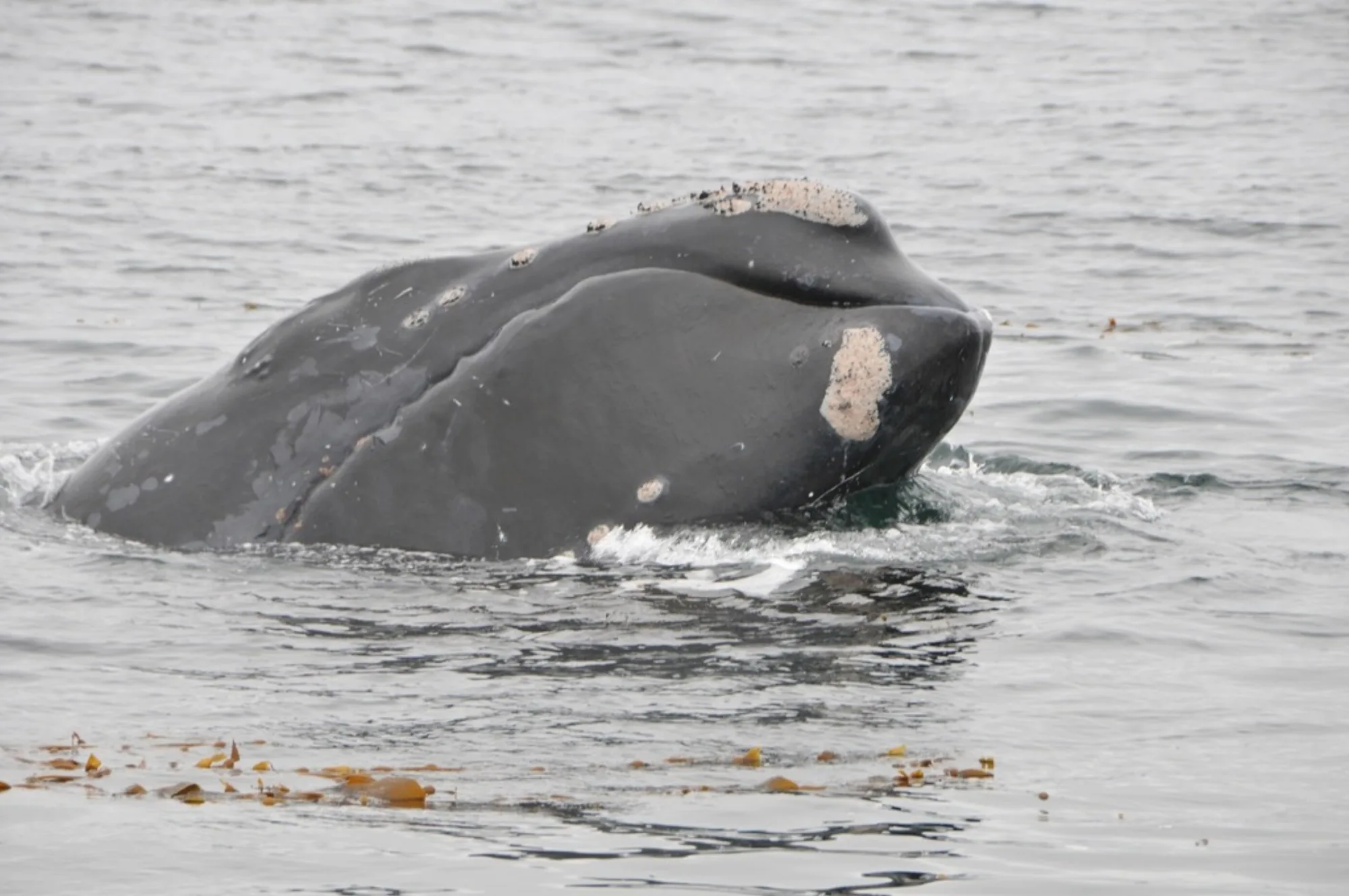
Spanning 15 to 19 m in length, these thickset baleen whales are distinguished by a broad black back and the absence of a dorsal fin. A traveller might recognize the North Pacific Right Whale by its distinctive V-shaped spout or the roughened, light-colored patches on its head called callosities. These giants can weigh between 50,000 and 90,000 kg, making them significantly larger than humpback whales. Today, they are divided into two main groups. A tiny eastern population spends its summers in the southeastern Bering Sea as well as the Gulf of Alaska. Meanwhile, a larger western group is found near the Kamchatka coast, the Kuril Islands, and within the Sea of Okhotsk. During the winter months, some individuals travel south to reach the Bonin Islands, occasionally appearing in shallow waters near the shore or even entering busy ports.
To sustain their massive bodies, these whales must find enormous concentrations of tiny copepods, often exceeding 3,000 per cubic meter. Unlike other species that lunge at prey, they feed by swimming continuously with their mouths open to skim the water. They are social animals that communicate using low-frequency sounds, including a percussive noise that resembles a gunshot. Females typically produce their first calf when they are 9 or 10 years old and may live for at least 70 years. However, their numbers remain precariously low. Historical commercial hunting before 1835 decimated a population once totaling over 20,000 animals. Later, illegal whaling operations in the 1960s killed hundreds more. Modern survivors face ongoing dangers from entanglement in fishing nets and are noted for being sensitive to the presence of ships, often submerging for long periods or fleeing their habitats when vessels approach.
Written from the English Wikipedia article North Pacific right whale (CC BY-SA 4.0).
- Atlas places
- 0
These are open occurrence records, so they show where people looked for and recorded the North Pacific Right Whale as much as where it lives. Cells are up to 25 km across, and every location is generalised to its cell.
No encounter zones yet
Where and when you can expect to see North Pacific Right Whale is calculated from observation density. No zones have been computed for this species yet.