North Atlantic Right Whale
Eubalaena glacialis
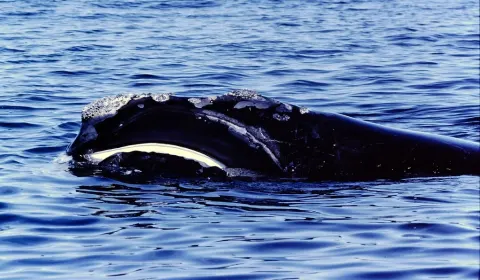
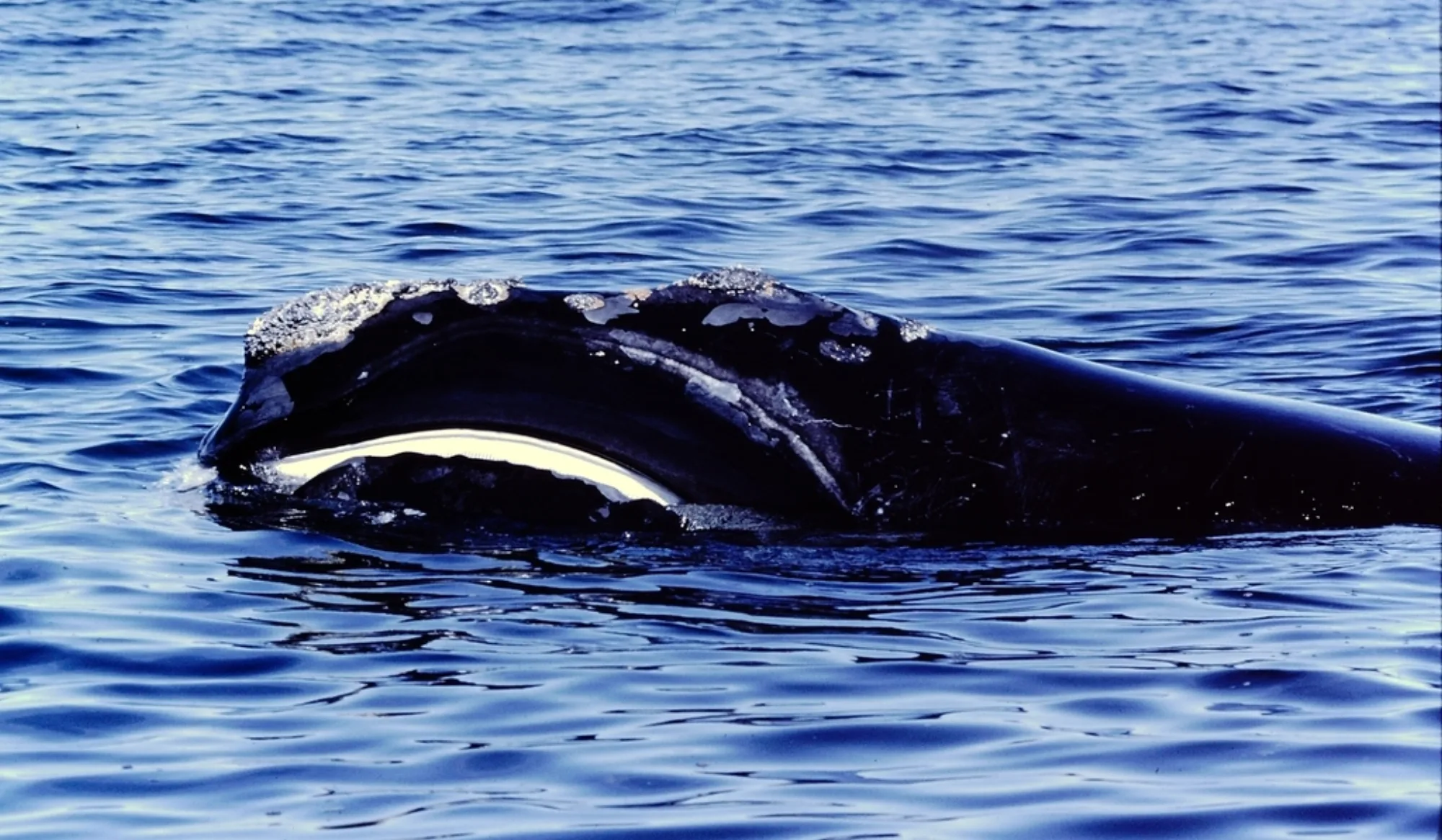
A broad, dark back without a dorsal fin is one clue to a North Atlantic Right Whale at the surface. This baleen whale ranges from dark grey to black, sometimes with white patches on its throat or belly. Rough white patches on its large head are another distinctive feature, while its blow can appear heart-shaped. Adults average 13 to 18 m in length, and females are larger than males.
These whales tend to stay close to the coast, travelling from the Labrador Sea, where they feed, to waters off Georgia and Florida to give birth in winter. From spring through autumn, the western population feeds across a range from Massachusetts to Newfoundland, including the Bay of Fundy, Gulf of Maine and Cape Cod Bay. The Gulf of St. Lawrence is also a regular destination for some migrating whales. Their diet consists largely of copepods, along with other small invertebrates, which they collect by moving slowly through dense prey patches at or just below the surface. Low-frequency sounds help them navigate, find food and communicate. Females first give birth at nine or ten years old, following a year-long pregnancy, and the interval between births now averages three to six years.
Whaling once heavily depleted the population, and collisions with vessels and entanglement in fixed fishing gear remain its greatest threats to recovery. A whale that survives entanglement may be weakened, have reduced fertility or suffer further injury. Noise from ships, oil exploration surveys and pile driving can disrupt communication, while ship noise may also be associated with chronic stress. Warming water reduces the abundance of an important prey species, affecting the whales' health and reproductive success. Changes in prey and ocean conditions have also shifted where and when whales feed, sometimes putting them outside areas and seasons covered by protective regulations.
Written from the English Wikipedia article North Atlantic right whale (CC BY-SA 4.0).
- Records
- 2,857
- Countries
- 3
- Atlas places
- 2
These are open occurrence records, so they show where people looked for and recorded the North Atlantic Right Whale as much as where it lives. Cells are up to 25 km across, and every location is generalised to its cell.
Generalised encounter areas, not exact locations. Each shape is a grid cell coloured by how likely the species is there.
- Very likelyCanada25 km zone · medium confidence · 2492 records · updated 80 days ago
- Very likelyUnited States25 km zone · medium confidence · 362 records · updated 80 days ago
- LikelyNetherlands25 km zone · medium confidence · 3 records · updated 80 days ago
Conservation status not assessed here yet, so every location is generalised to its grid cell.