Chain Pickerel
Esox niger
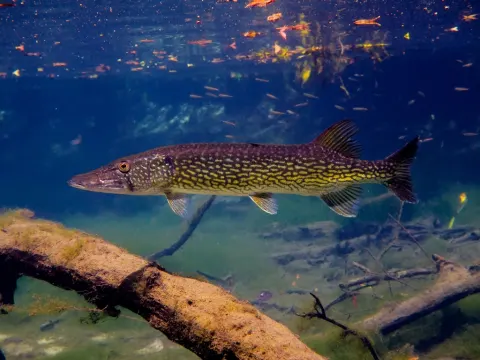
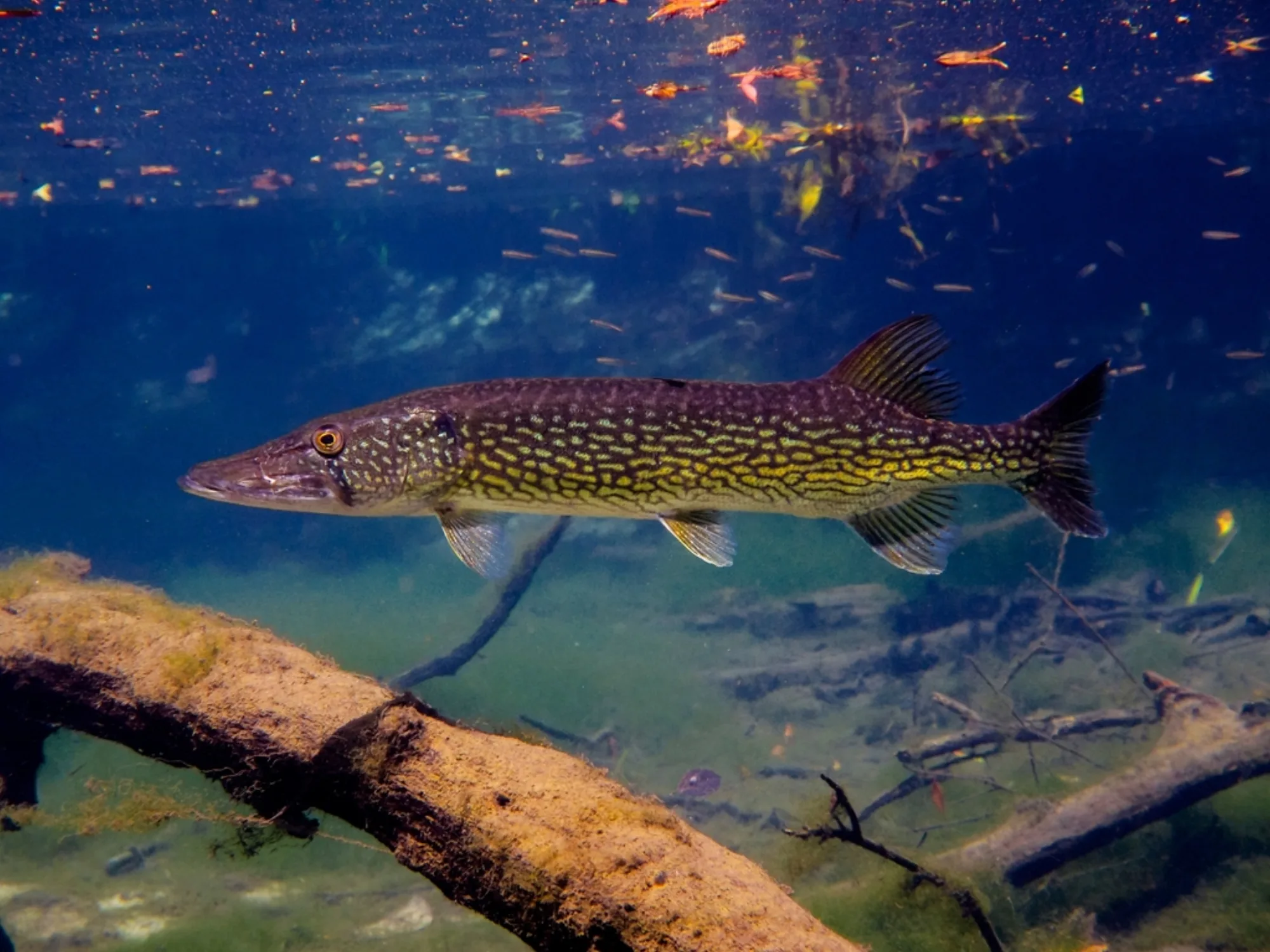
Dark markings form a chain-like pattern along the greenish sides of the Chain Pickerel, a freshwater member of the pike family. A dark vertical mark beneath each eye helps distinguish it from the redfin and grass pickerel, whose marks curve backwards. Its outline resembles that of the northern pike, and its skin has a characteristic coating of slime. An average fish measures 61 cm and weighs 1 1/2 kg, although it can rarely reach 78.7 centimetres in length. A blue colour form without the usual chain-like pattern has also been recorded in a New York population.
Along the eastern coast of North America, the species ranges between southern Canada and Florida, extending westwards to Texas. It also occurs in Lake Michigan and the lower Great Lakes, as well as New Brunswick and Nova Scotia. Look for it in pools in creeks and rivers, vegetated lakes, swamps and other wetlands. It tolerates both brackish and acidic water. In Nova Scotia, introduced chain pickerel have severely affected native fish populations through predation.
Smaller fish make up much of its diet, but a larger pickerel can wait under cover before lunging rapidly at sizeable prey. It also eats frogs, snakes, worms, mice, crayfish, insects and other small animals. Pickerel sometimes leap from the water after flying insects or dangling fishing lures. In late winter or early spring, it spawns among submerged plants, and a female may release up to 50,000 eggs. The adults provide no parental care, and the eggs hatch six to twelve days after laying. Chain pickerel are popular with anglers and can swallow an entire lure, leaving them deeply hooked.
Written from the English Wikipedia article Chain pickerel (CC BY-SA 4.0).
- Records
- 7,128
- Countries
- 2
No atlas park has a record of the Chain Pickerel in or around it yet.
These are open occurrence records, so they show where people looked for and recorded the Chain Pickerel as much as where it lives. Cells are up to 25 km across, and every location is generalised to its cell.
Generalised encounter areas, not exact locations. Each shape is a grid cell coloured by how likely the species is there.
- Very likelyUnited States25 km zone · medium confidence · 7089 records · updated 80 days ago
- LikelyCanada25 km zone · medium confidence · 39 records · updated 80 days ago
Conservation status not assessed here yet, so every location is generalised to its grid cell.