Muskellunge
Esox masquinongy
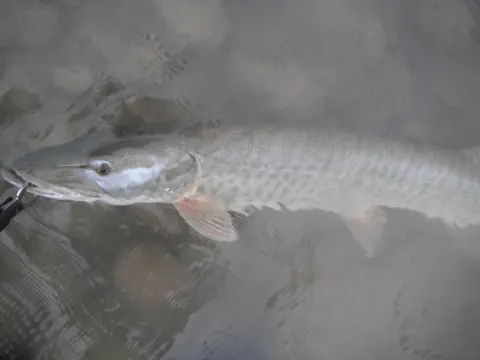
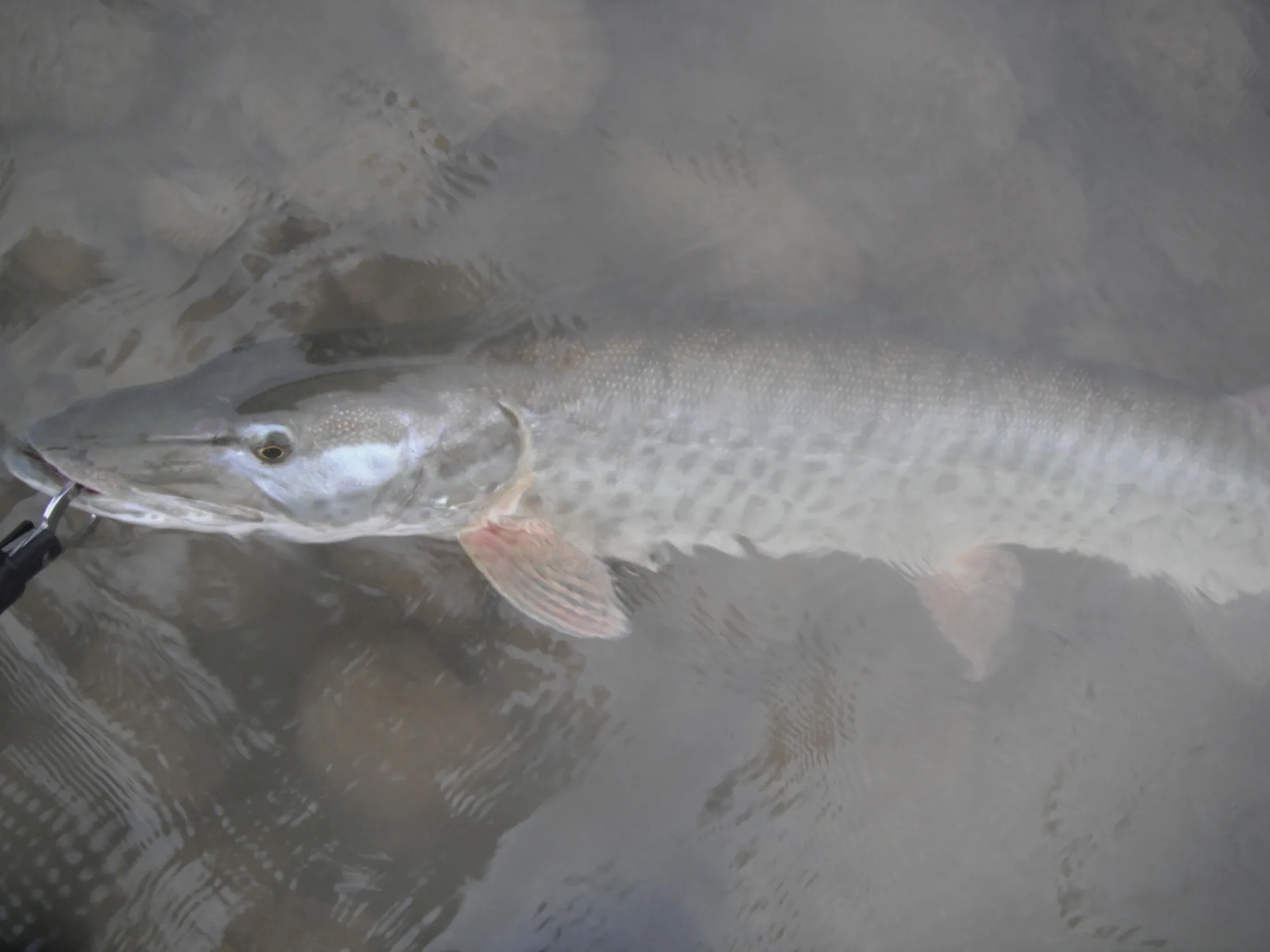
Long and built for ambush, the Muskellunge is a large freshwater predator native to North America and the largest member of the pike family. Its elongated body and flat head are typically light silver, brown or green, with dark bars that can break into spots. Some fish have no markings, especially in cloudy water, while their sharply pointed tail fins help distinguish them from northern pike. Muskellunge typically measure 70 to 120 cm and weigh 7 to 16.5 kg, though some reach 1.8 m and almost 30 kg.
The species lives in lakes and large rivers across the Great Lakes region and into Canada, with its range extending south to the Tennessee River valley and a small population in South Carolina's Broad River. It favours clear water, resting near weed edges, rock outcrops and other cover. In summer, each fish uses a shallow home range and a deeper one, patrolling both for food when water temperatures are suitable. Muskellunge sometimes gather in small schools and feed more actively around full and new moons. They seize prey quickly and swallow it head first, eating fish, including other muskellunge, as well as occasional frogs, small mammals, insects and ducks.
Spawning takes place from mid- to late spring in shallow, vegetated areas, often over rock or sand. Adults leave the eggs, which stick to plants and the lake bottom, and surviving embryos hatch within two weeks. Young muskellunge fall prey to fish such as bass and trout, as well as other muskellunge and northern pike; birds of prey occasionally take them too. Adults face threats from humans and, rarely, large birds of prey; slow growth and low reproductive rates make populations especially vulnerable to overfishing. Habitat destruction also puts pressure on the fish.
Written from the English Wikipedia article Muskellunge (CC BY-SA 4.0).
- Records
- 5,827
- Countries
- 2
No atlas park has a record of the Muskellunge in or around it yet.
These are open occurrence records, so they show where people looked for and recorded the Muskellunge as much as where it lives. Cells are up to 25 km across, and every location is generalised to its cell.
Generalised encounter areas, not exact locations. Each shape is a grid cell coloured by how likely the species is there.
- Very likelyUnited States25 km zone · high confidence · 5799 records · updated 80 days ago
- PossibleCanada25 km zone · medium confidence · 28 records · updated 80 days ago
Conservation status not assessed here yet, so every location is generalised to its grid cell.