Northern Pike
Esox lucius
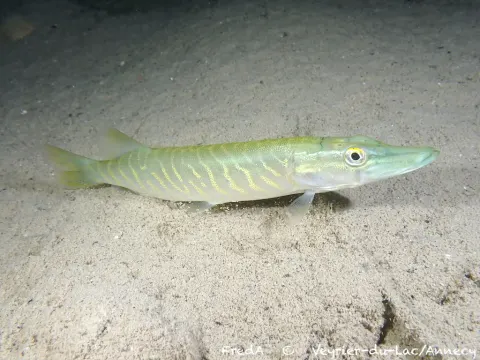
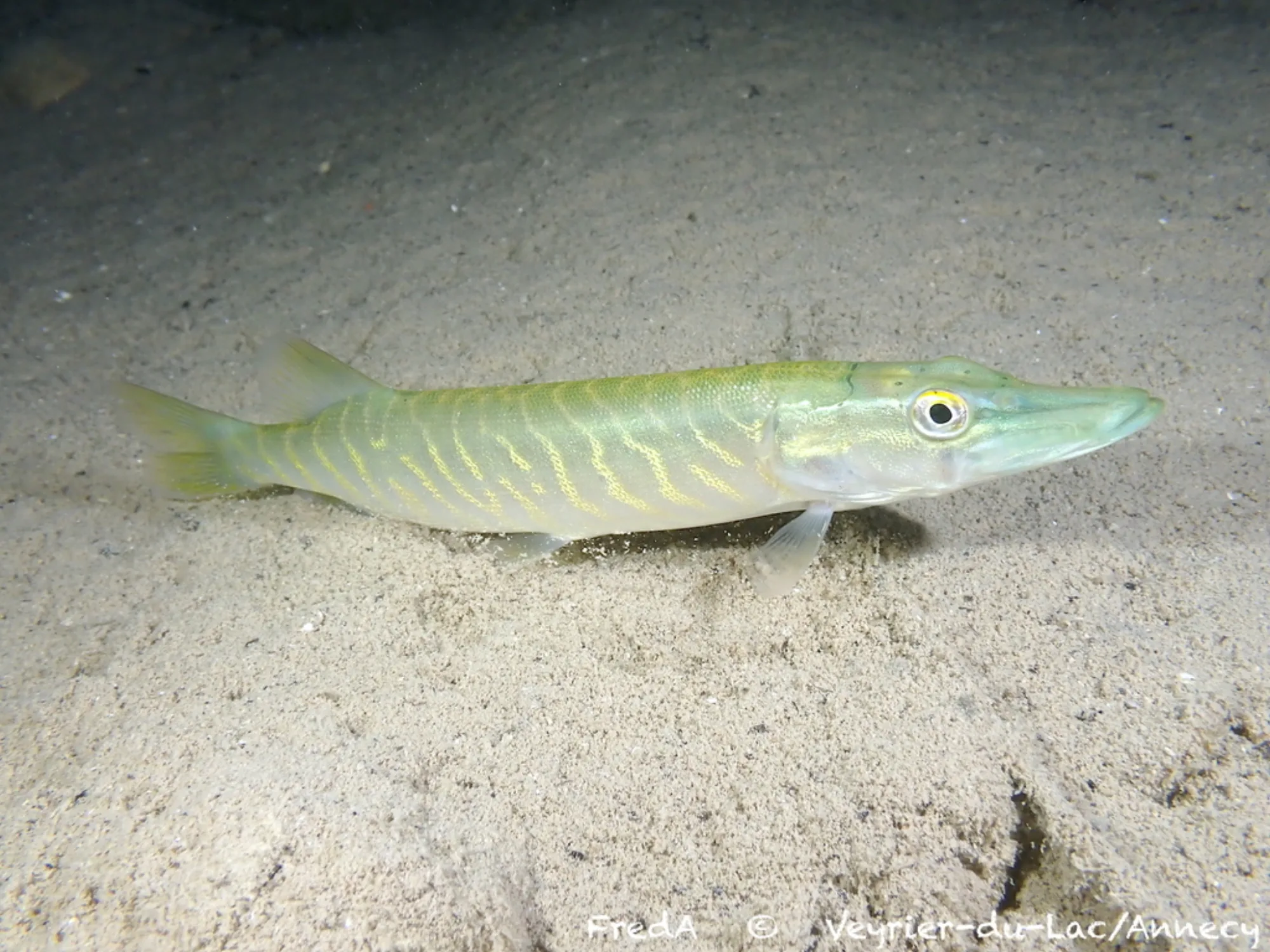
Look for an olive-green fish with pale, short bars along its sides and a belly shading from yellow to white: this is the Northern Pike, a freshwater predator. Its fins may have dark spots and can sometimes be reddish. Young fish look different, with yellow stripes on green bodies that later give way to pale spots. Pike average about 40 to 55 cm in length, although the largest recorded fish reached 150 cm.
Northern Pike live across fresh waters of the Northern Hemisphere, including Europe, Russia and North America. They occupy slow streams and shallow, weedy parts of lakes and reservoirs, but also occur in cold, clear, rocky waters. In the Baltic Sea, they can spend time in brackish water, both near river mouths and farther out, before returning to fresh water. On sunny days, pike tend to stay nearer the shallow shore, particularly where there is vegetation.
Usually solitary, pike often hunt by waiting motionless, then accelerating suddenly to seize prey. They eat mainly fish and frogs, but also take insects, crayfish, leeches, small mammals and birds. In spring, they move to breeding areas and lay large numbers of eggs; stable water conditions favour breeding success. Young pike shelter among submerged plants, where they are less exposed to larger pike that may eat them, especially when food is scarce. Toxic concentrations of iron and rapid temperature changes can cause mortality during early development. Fishing also poses risks: pike can be damaged during handling after capture, and skin damage may lead to fatal infections. In some places where pike have been introduced, agencies have tried to eliminate them by poisoning lakes to protect other fish.
Written from the English Wikipedia article Northern pike (CC BY-SA 4.0).
- Records
- 300,627
- Countries
- 7
No atlas park has a record of the Northern Pike in or around it yet.
These are open occurrence records, so they show where people looked for and recorded the Northern Pike as much as where it lives. Cells are up to 25 km across, and every location is generalised to its cell.
Generalised encounter areas, not exact locations. Each shape is a grid cell coloured by how likely the species is there.
- Very likelySweden25 km zone · high confidence · 281360 records · updated 80 days ago
- Very likelyNetherlands25 km zone · high confidence · 7508 records · updated 80 days ago
- Very likelyFrance25 km zone · high confidence · 3598 records · updated 80 days ago
- Very likelyNorway25 km zone · high confidence · 3577 records · updated 80 days ago
- Very likelyUnited States25 km zone · high confidence · 2373 records · updated 80 days ago
- Very likelyGermany25 km zone · high confidence · 1509 records · updated 80 days ago
- Very likelyUnited Kingdom25 km zone · high confidence · 702 records · updated 80 days ago
Conservation status not assessed here yet, so every location is generalised to its grid cell.