Gray Whale
Eschrichtius robustus
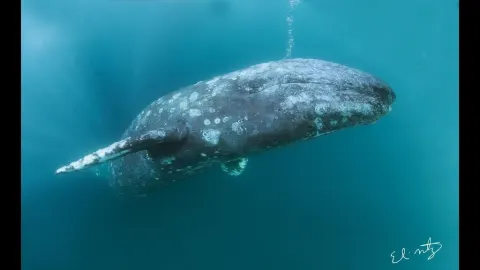
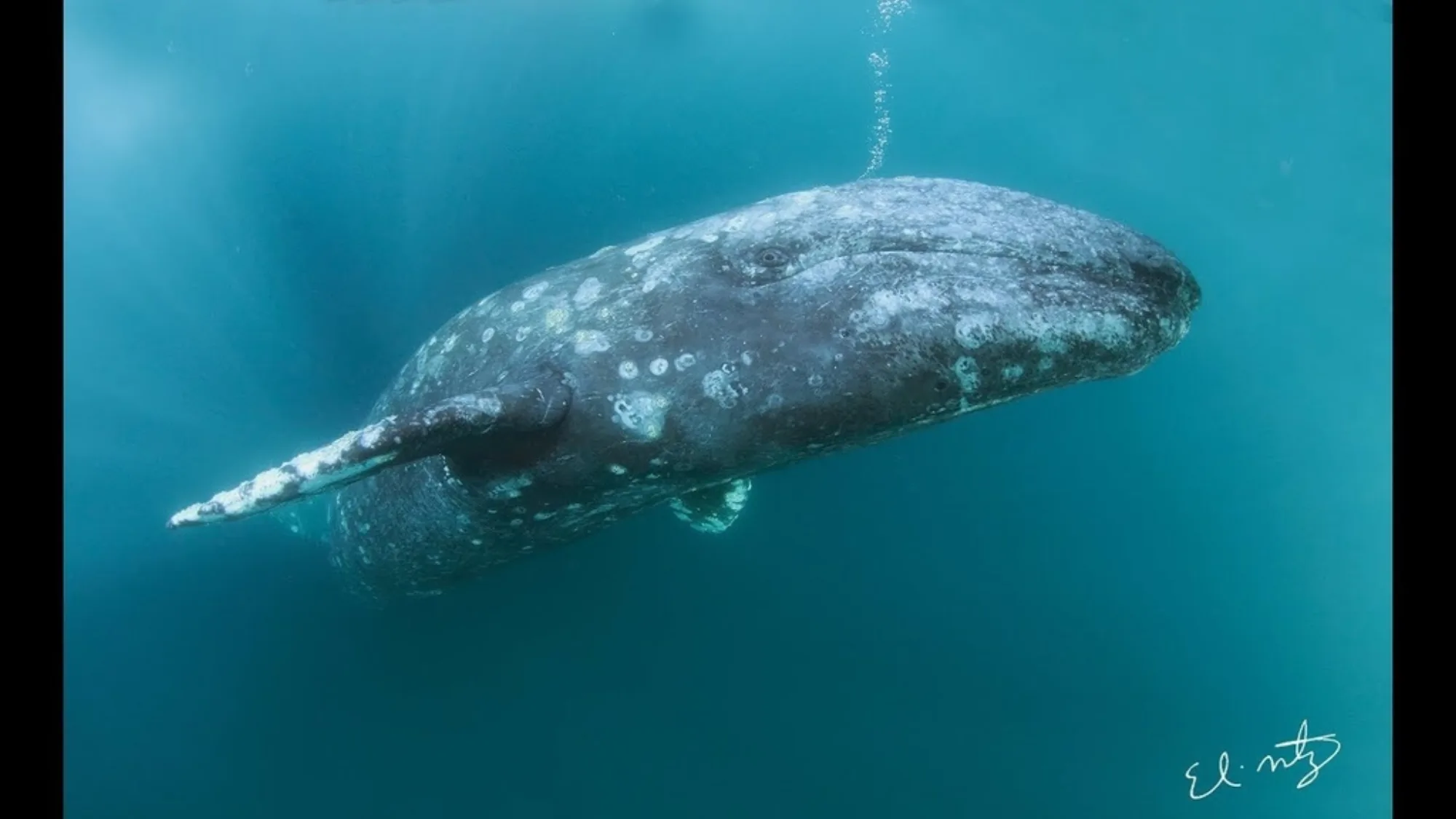
A dark body marked with grey patches and white mottling gives the Gray Whale its name. This baleen whale has no dorsal fin; instead, a row of raised bumps runs along the rear of its back towards the tail. In calm wind, its blow can form a distinctive heart shape at the surface. Adults measure 11 to 15.2 m long, and females tend to be slightly larger than males.
Gray Whales live in the Pacific, where they depend heavily on coastal waters. Each autumn, eastern whales travel south from the Bering and Chukchi seas to the warm lagoons of Mexico, passing the west coasts of Canada, the United States and Mexico. Between mid-December and early January, many are found between Monterey and San Diego, where they are often visible from shore. In Baja California Sur, pregnant females arrive at sheltered lagoons to give birth, and mothers with newborns are among the last to leave. The shallow water is thought to offer calves protection from sharks and orcas. Females nurse their calves for approximately seven months.
The whales feed mainly on small crustaceans living on the sea floor, turning onto their sides to scoop up sediment and using their baleen to strain out food. They also take other prey, including worms, fish eggs and small fish, and can skim at the surface for crab larvae. Most feeding takes place in northern waters during summer, though whales also feed opportunistically on migration. Collisions with ships, fishing gear that traps whales and climate-related shifts in sea-ice coverage all pose threats. The eastern population has also suffered mass starvation, malnutrition and calving failure associated with warming conditions in the Arctic.
Written from the English Wikipedia article Gray whale (CC BY-SA 4.0).
- Records
- 8,118
- Countries
- 5
- Atlas places
- 5
These are open occurrence records, so they show where people looked for and recorded the Gray Whale as much as where it lives. Cells are up to 25 km across, and every location is generalised to its cell.
Generalised encounter areas, not exact locations. Each shape is a grid cell coloured by how likely the species is there.
- Very likelyUnited States25 km zone · high confidence · 5569 records · updated 80 days ago
- Very likelyMexico25 km zone · high confidence · 2315 records · updated 80 days ago
- Very likelyCanada25 km zone · medium confidence · 178 records · updated 80 days ago
- LikelyRussia25 km zone · medium confidence · 51 records · updated 80 days ago
- LikelyNetherlands25 km zone · medium confidence · 5 records · updated 80 days ago
Conservation status not assessed here yet, so every location is generalised to its grid cell.