West European Hedgehog
Erinaceus europaeus
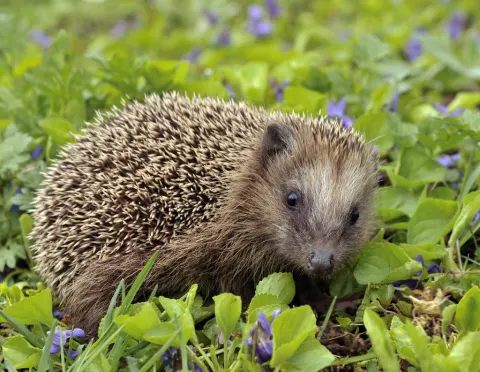
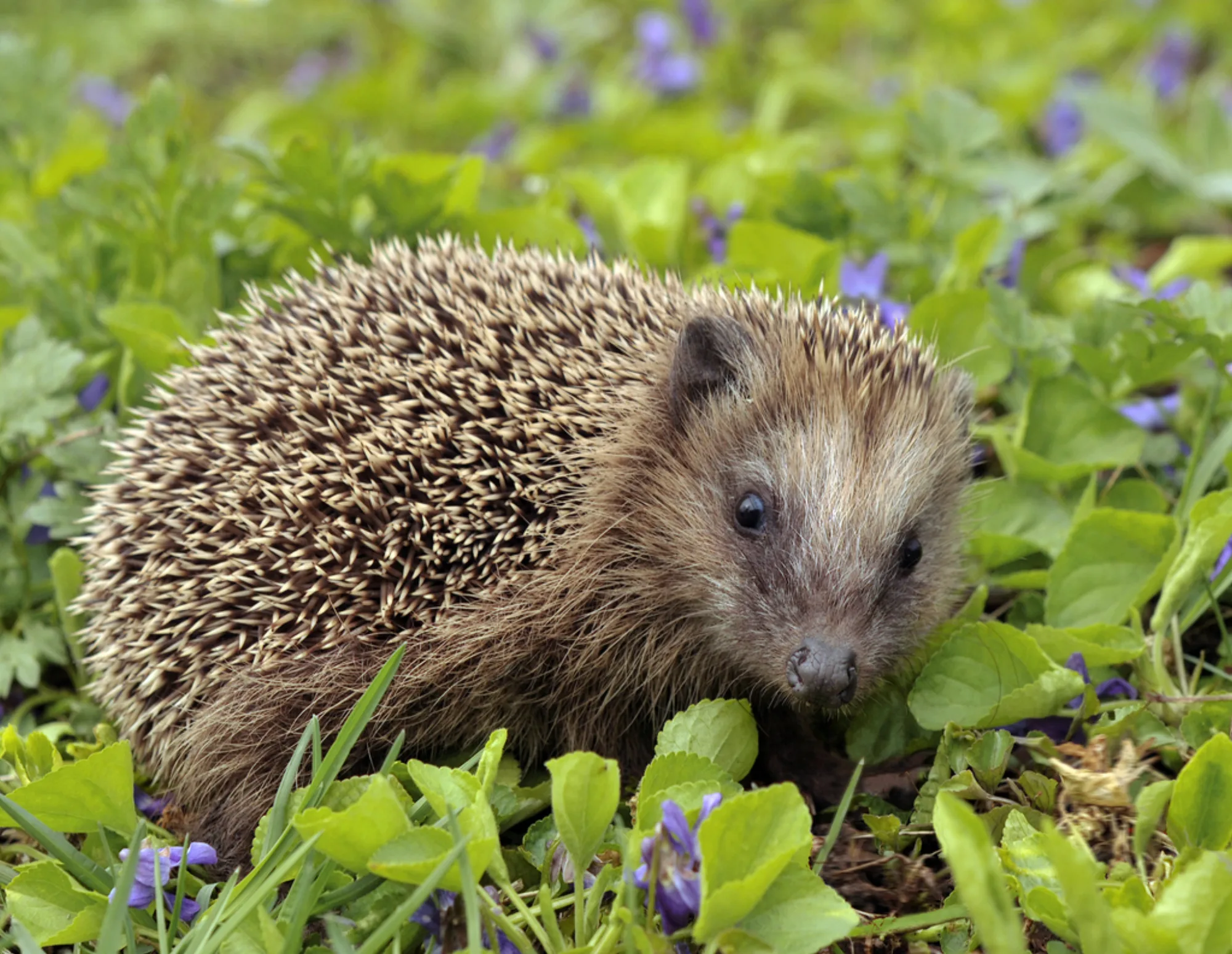
Brownish and covered over much of its body with brown and white spines, the West European Hedgehog is a familiar visitor to European gardens. Large adults can measure 260 mm or more from head to body, and their short tails are typically 20 to 30 mm long. If alarmed, a hedgehog rolls into a ball, using its spines for protection. Where it shares its range with the northern white-breasted hedgehog, the two can be difficult to tell apart in the field.
Its native range stretches from Ireland and the Iberian Peninsula through much of western and central Europe, reaching north-west Russia. It also occurs on Mediterranean islands and was introduced to New Zealand. Gardens, parks and other managed land near settlements can hold particularly large numbers, while woodland, meadows, pasture, orchards and vineyards also provide habitat. Outside cultivated areas, it favours forest margins with grass and scrub. Nests are often tucked beneath supporting structures such as roots or branches, with separate nests used for breeding, summer days and winter.
Mostly active at night, the hedgehog walks hesitantly, often pausing to sniff the air. It eats mainly earthworms, along with slugs, snails and a wide variety of insects, and may also feed on bird eggs and carcasses. It may hibernate in winter, although most individuals wake at least once to move nests. Breeding begins after hibernation; females raise litters alone, usually with four to six young. Starvation, often during hibernation, is the most common cause of death. Road traffic and predators also take hedgehogs, and populations have declined severely in Great Britain.
Written from the English Wikipedia article European hedgehog (CC BY-SA 4.0).
- Records
- 126,471
- Countries
- 27
No atlas park has a record of the West European Hedgehog in or around it yet.
These are open occurrence records, so they show where people looked for and recorded the West European Hedgehog as much as where it lives. Cells are up to 25 km across, and every location is generalised to its cell.
Generalised encounter areas, not exact locations. Each shape is a grid cell coloured by how likely the species is there.
- Very likelySwitzerland25 km zone · high confidence · 67812 records · updated 86 days ago
- Very likelyFrance25 km zone · high confidence · 33257 records · updated 86 days ago
- Very likelyUnited Kingdom25 km zone · high confidence · 10392 records · updated 86 days ago
- Very likelyGermany25 km zone · high confidence · 4857 records · updated 86 days ago
- Very likelyAustria25 km zone · high confidence · 2763 records · updated 86 days ago
- Very likelyNorway25 km zone · high confidence · 2303 records · updated 86 days ago
- Very likelyDenmark25 km zone · high confidence · 1284 records · updated 86 days ago
- Very likelyFinland25 km zone · high confidence · 1002 records · updated 86 days ago
- Very likelyItaly25 km zone · high confidence · 664 records · updated 86 days ago
- Very likelyNew Zealand25 km zone · high confidence · 507 records · updated 86 days ago
Conservation status not assessed here yet, so every location is generalised to its grid cell.