Bearded Seal
Erignathus barbatus
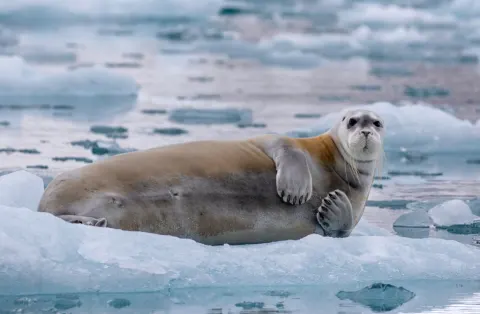
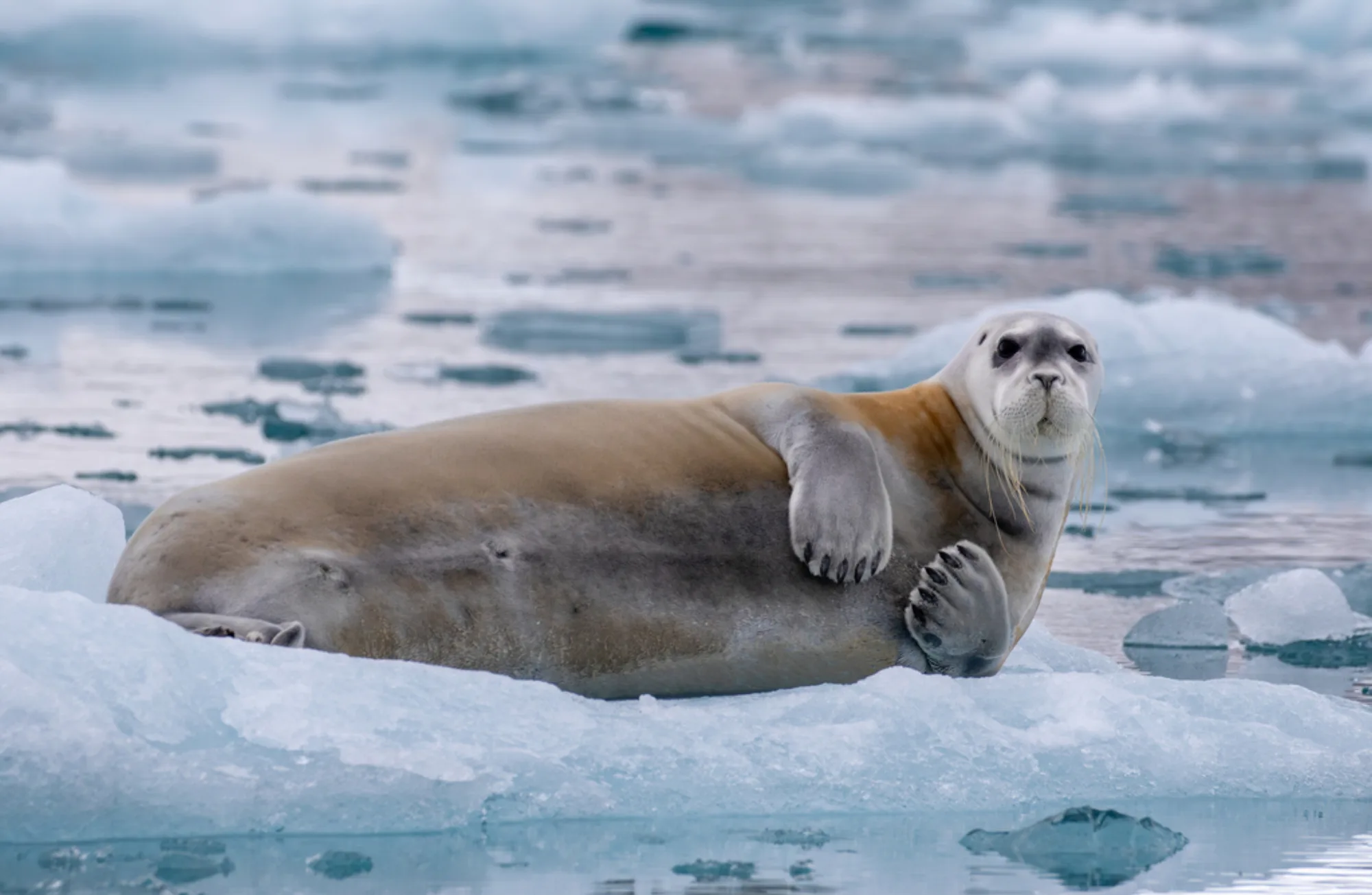
Long, abundant whiskers give the Bearded Seal its name and make it distinctive among the seals of the Arctic. Its broad, square front flippers and thick muzzle bristles are other useful features to look for. Adults are greyish-brown, with darker backs, and some have reddish-brown faces and necks. Females are larger than males, and the species measures roughly 2.1 to 2.7 m from nose to tail.
Bearded seals live in Arctic and Subarctic waters, including around Svalbard, Greenland and the Canadian Arctic Archipelago. Their range also stretches through the Bering Sea, from the Alaskan coast to the Russian coast. Adults favour shallow coastal waters, generally no deeper than 300 m, where they search the seabed for food. Their whiskers help them feel through soft sediment for clams, squid, crustaceans and fish. In summer they also eat animals such as anemones and sea cucumbers. During the breeding season, males make long, wavering calls that end in a moan or sigh; their trills can carry more than 30 km underwater. Pups are born in spring on small drifting ice floes in shallow water. They enter the water within hours, while their mothers care for them for 18 to 24 days.
Polar bears prey on bearded seals, especially young pups, and killer whales sometimes overturn ice floes to reach them. Walruses may also eat pups, although this is rare. Loss of sea ice threatens the places where these seals breed and raise their young. Other pressures include hunting and accidental capture in commercial fishing gear, while climate change could also reduce their prey.
Written from the English Wikipedia article Bearded seal (CC BY-SA 4.0).
- Records
- 430
- Countries
- 8
No atlas park has a record of the Bearded Seal in or around it yet.
These are open occurrence records, so they show where people looked for and recorded the Bearded Seal as much as where it lives. Cells are up to 25 km across, and every location is generalised to its cell.
Generalised encounter areas, not exact locations. Each shape is a grid cell coloured by how likely the species is there.
- Very likelySvalbard & Jan Mayen25 km zone · high confidence · 358 records · updated 80 days ago
- Very likelyUnited States25 km zone · medium confidence · 34 records · updated 80 days ago
- Very likelyRussia25 km zone · medium confidence · 24 records · updated 80 days ago
- Very likelyNorway25 km zone · medium confidence · 6 records · updated 80 days ago
- LikelyGreenland25 km zone · medium confidence · 5 records · updated 80 days ago
- LikelyFrance25 km zone · medium confidence · 2 records · updated 80 days ago
- LikelyCanada25 km zone · medium confidence · 1 record · updated 80 days ago
- RareUnited Kingdom25 km zone · low confidence · 0 records · updated 80 days ago
Conservation status not assessed here yet, so every location is generalised to its grid cell.