Horned Lark
Eremophila alpestris
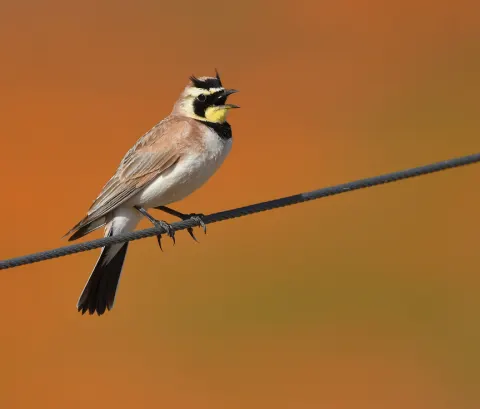
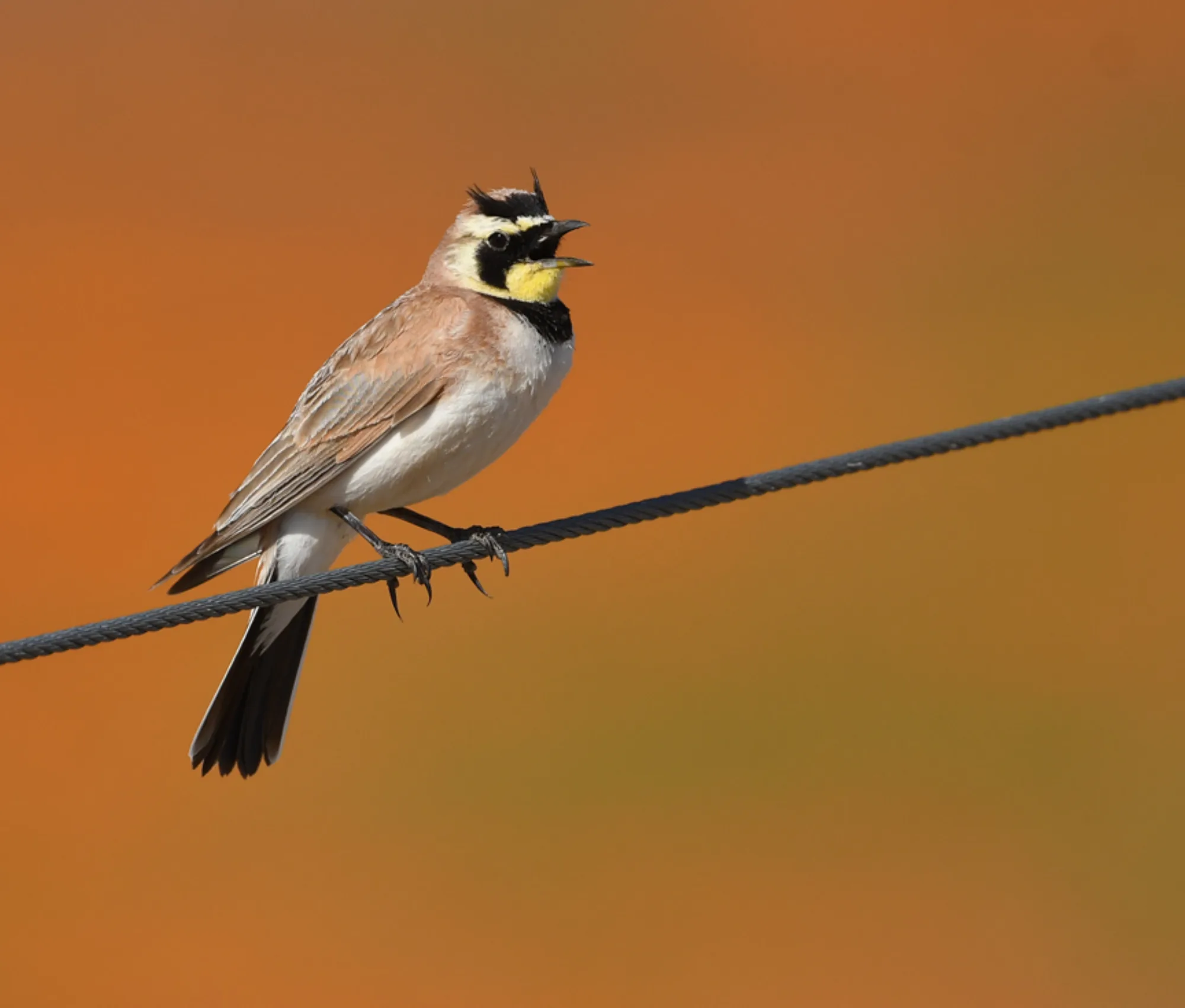
Across open ground in the northern hemisphere, the Horned Lark can be recognised by its brown-grey back, pale underside and black and yellow face. In summer, males have two black feather tufts on the head, giving them the appearance of horns. Its mostly black tail contrasts with the paler body, especially in flight. Listen for weak, high-pitched calls or a flight song that begins with a few chips and rises into a warbling trill.
The species breeds across much of North America, as well as the far north of Europe and Asia and the southeastern European mountains; an isolated population also lives on a Colombian plateau. In Eurasia, it breeds in the far north and in mountains above the tree line. Winter visitors to Europe are often seen on seashore flats, while in North America the bird also uses farmland, prairies, deserts, golf courses and airports. Northern populations move south for winter, while birds in the south of the range mainly stay put.
During the breeding season, males defend territories, and females sometimes chase away other females. The female chooses a hollow in bare ground or digs one, then builds a nest from plant material and lines it with soft materials. She lays 2 to 5 grey eggs with brown spots, and both parents feed and defend the chicks. In the south, a female can raise 2 to 3 broods a year, while one is more common in the north. North American populations are declining, with possible causes including habitat loss linked to pesticides, reforestation, urbanisation and human encroachment; collisions with structures at wind farms and airports may also contribute.
Written from the English Wikipedia article Horned lark (CC BY-SA 4.0).
- Records
- 543,455
- Countries
- 4
- Atlas places
- 1
These are open occurrence records, so they show where people looked for and recorded the Horned Lark as much as where it lives. Cells are up to 25 km across, and every location is generalised to its cell.
Generalised encounter areas, not exact locations. Each shape is a grid cell coloured by how likely the species is there.
- Very likelyUnited States25 km zone · high confidence · 473241 records · updated 80 days ago
- Very likelyCanada25 km zone · high confidence · 66921 records · updated 80 days ago
- Very likelyUnited Kingdom25 km zone · high confidence · 1830 records · updated 80 days ago
- Very likelyNorway25 km zone · high confidence · 1463 records · updated 80 days ago
Conservation status not assessed here yet, so every location is generalised to its grid cell.