Onager
Equus hemionus
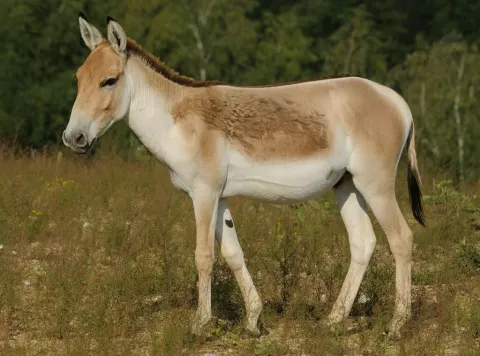
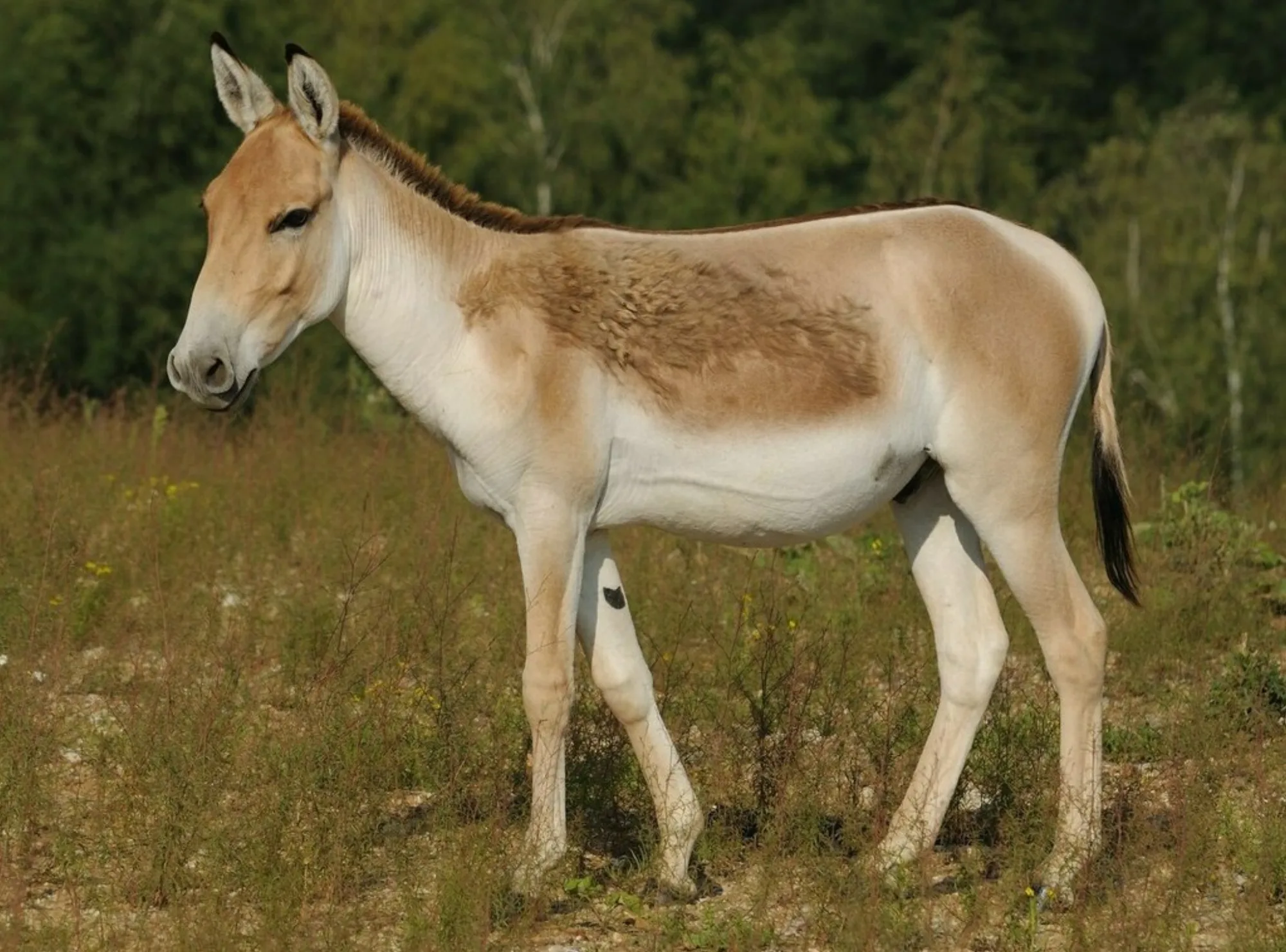
Across the dry landscapes of Asia, the Onager, or Asiatic wild ass, can be recognised by the dark stripe running along its back, edged in white. Its coat is generally reddish-brown in summer and turns yellowish-brown or greyish-brown in winter. It weighs about 200 to 260 kg and measures 2.1 to 2.5 m from head to body. Today its range includes Mongolia and China, as well as India, Iran, Kazakhstan, Turkmenistan and Uzbekistan; the Gobi Desert is its main stronghold. Its favoured terrain ranges from desert plains and oases to dry grasslands, steppes and mountains.
Onagers are social and most active around dawn and dusk, even in intense heat. Stallions may live alone or in small groups; some gather females, while others defend territories that attract them. Larger gatherings can form around food or water, then break up within a day. They eat grasses, herbs, leaves and fruit, as well as shrubs and trees in dry habitats. When natural water is unavailable, they dig into dry riverbeds to reach water below the surface. Breeding is seasonal, with mating and births occurring from April to September, especially in June and July. Mothers and their young may gather in groups of up to five females, and a mother stays close to her foal while rearing it.
Poaching for meat and hides is the greatest threat, with animals also taken for traditional medicine in some areas. Habitat loss and fragmentation add pressure, as do livestock grazing, reduced access to water and the cutting of shrubs. In Mongolia, roads, railways and fences serving mining activities are a particular concern. Isolated populations also face genetic problems caused by inbreeding.
Written from the English Wikipedia article Onager (CC BY-SA 4.0).
- Records
- 8
- Countries
- 2
No atlas park has a record of the Onager in or around it yet.
These are open occurrence records, so they show where people looked for and recorded the Onager as much as where it lives. Cells are up to 25 km across, and every location is generalised to its cell.
Generalised encounter areas, not exact locations. Each shape is a grid cell coloured by how likely the species is there.
- Very likelyIsrael25 km zone · medium confidence · 5 records · updated 80 days ago
- Very likelyIndia25 km zone · medium confidence · 3 records · updated 80 days ago
Conservation status not assessed here yet, so every location is generalised to its grid cell.