Asian Wild Horse
Equus ferus
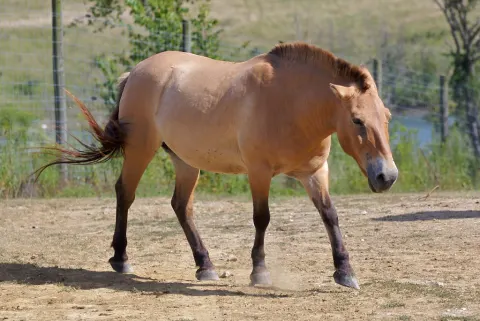
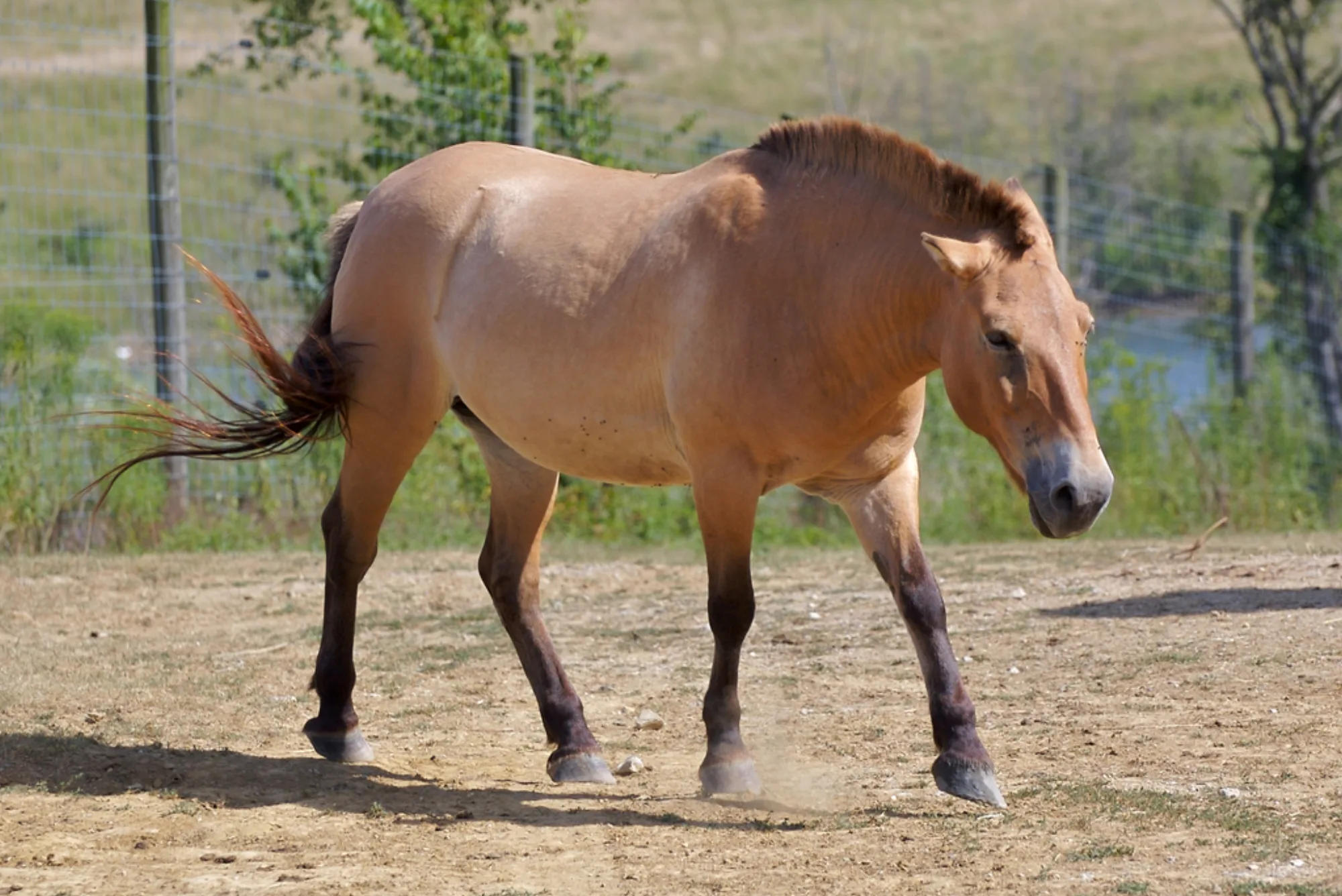
Known as Przewalski's horse or takhi, the Asian Wild Horse is the only living wild horse subspecies. Its estimated body mass is 250 to 360 kilograms, although its weight varies considerably through the year. Its homeland includes the Gobi Desert and other parts of Central Asia. Reintroduced populations now occupy small areas of Mongolia, Kazakhstan and northeast China, along with places beyond the horse's historical range, including Spain. Wild horses have occupied habitats from temperate forest to steppe and tundra, but generally favour open country.
A wild horse herd has a social order, usually with one dominant adult male, several mares and their young. The stallion defends the herd aggressively against rival males. As they reach adulthood, males and females leave for other herds, while young males may also gather in bachelor groups, where they play, display ritual behaviour and establish a hierarchy. Horses are generally grazers, although Przewalski's horses historically ate shrubs in winter when human pressure forced them into less suitable habitat. Mares tend to have their first foals at around 3 years old, after a pregnancy of around 12 months, with births mainly in spring or summer. Stallions usually start breeding at around 5 to 6 years old, when they leave their bachelor groups.
Human pressure has pushed Przewalski's horses into less suitable habitat, and their population once came close to disappearing. Wolves are the main modern predator of wild horses in Eurasia. Reintroduction has since brought Przewalski's horses back to the wild, including a small breeding population in Mongolia.
Written from the English Wikipedia article Wild horse (CC BY-SA 4.0).
- Records
- 616
- Countries
- 3
- Atlas places
- 1
These are open occurrence records, so they show where people looked for and recorded the Asian Wild Horse as much as where it lives. Cells are up to 25 km across, and every location is generalised to its cell.
Generalised encounter areas, not exact locations. Each shape is a grid cell coloured by how likely the species is there.
- Very likelyUnited Kingdom25 km zone · medium confidence · 616 records · updated 80 days ago
- PossibleUnited States25 km zone · low confidence · 0 records · updated 80 days ago
- RareFrance25 km zone · low confidence · 0 records · updated 80 days ago
Conservation status not assessed here yet, so every location is generalised to its grid cell.