African Wild Ass
Equus africanus
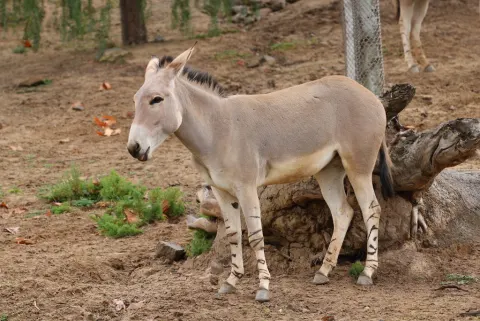
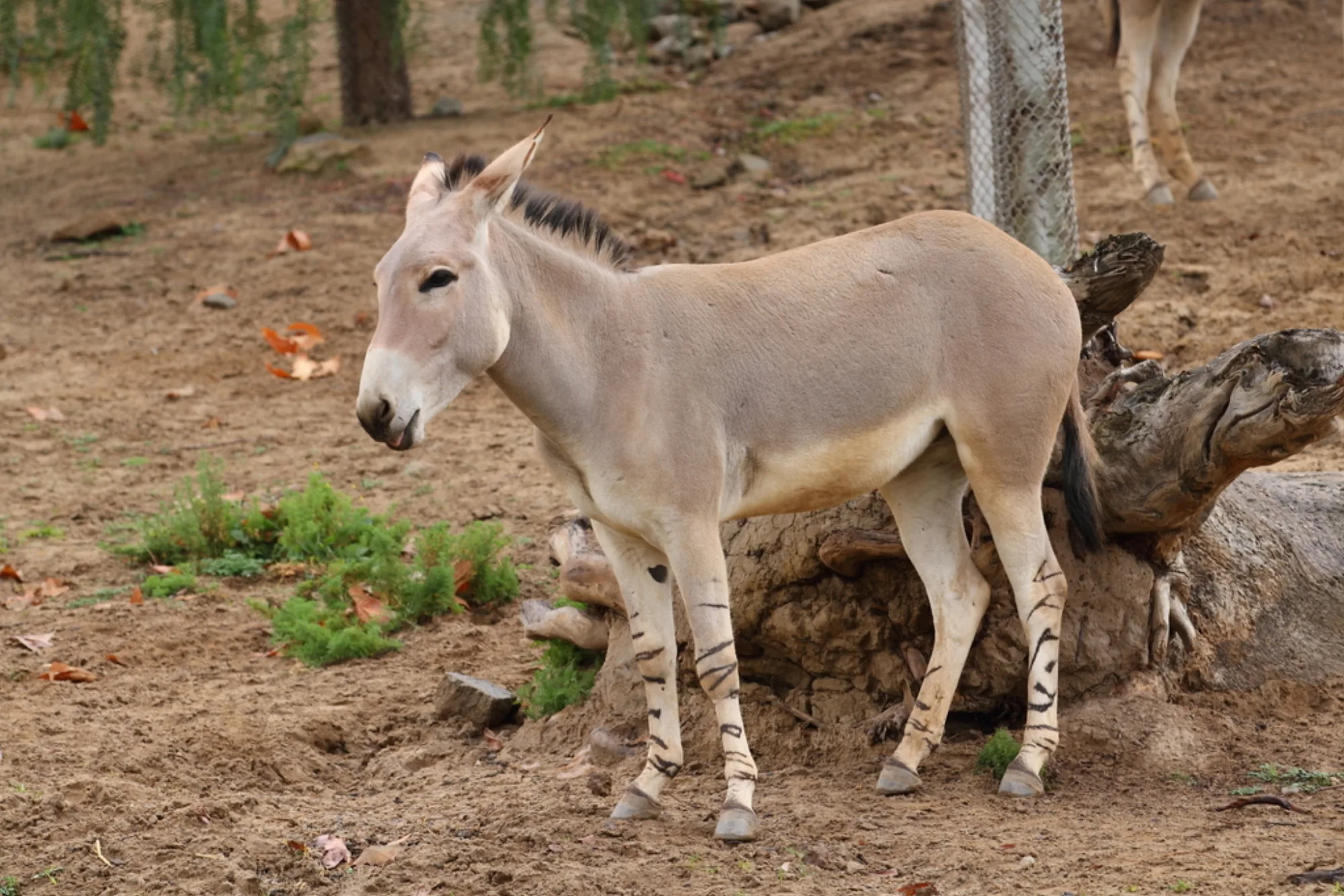
The African Wild Ass is a grey to fawn relative of the horse, standing about 1.2 metres tall. These animals are likely the ancestors of domestic donkeys and share several physical traits with them, including large ears with black edges and a stiff, upright mane. Visitors might notice a dark stripe along the back or horizontal black markings on the legs that look like those of a zebra. They are remarkably agile on rocky slopes and can reach speeds of 70 km/h on flat ground. Unlike many other mammals with hooves, they often pause to investigate a threat rather than fleeing immediately.
Today, these asses survive in the arid deserts of Ethiopia, Eritrea, and Somalia. They are well adapted to heat, using their ears for cooling and their tough digestive systems to process dry vegetation like bark and leaves. While they can endure long stretches with little water, they must drink at least every three days if their food is dry. Socially, they live in loose groups of up to fifty, though sparse food often keeps individuals apart. Breeding occurs during the wet season, with a single foal born after a gestation of 11 to 12 months.
With only a few hundred individuals remaining in the wild, the species faces several pressures. They are hunted for traditional medicine and food, and they must compete with livestock for limited grazing and water. Historically, they have been captured for domestication, and interbreeding with domestic donkeys has caused populations to decline. While legally protected in the countries where they live, these laws are hard to enforce.
Written from the English Wikipedia article African wild ass (CC BY-SA 4.0).
- Atlas places
- 0
These are open occurrence records, so they show where people looked for and recorded the African Wild Ass as much as where it lives. Cells are up to 25 km across, and every location is generalised to its cell.
No encounter zones yet
Where and when you can expect to see African Wild Ass is calculated from observation density. No zones have been computed for this species yet.