Big Brown Bat
Eptesicus fuscus
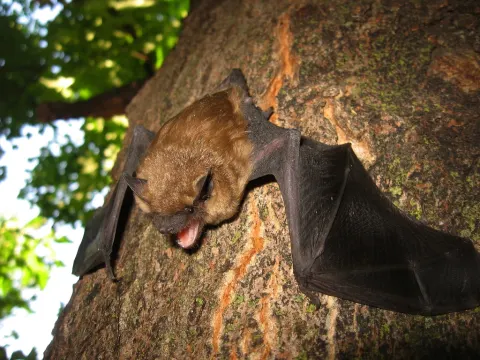
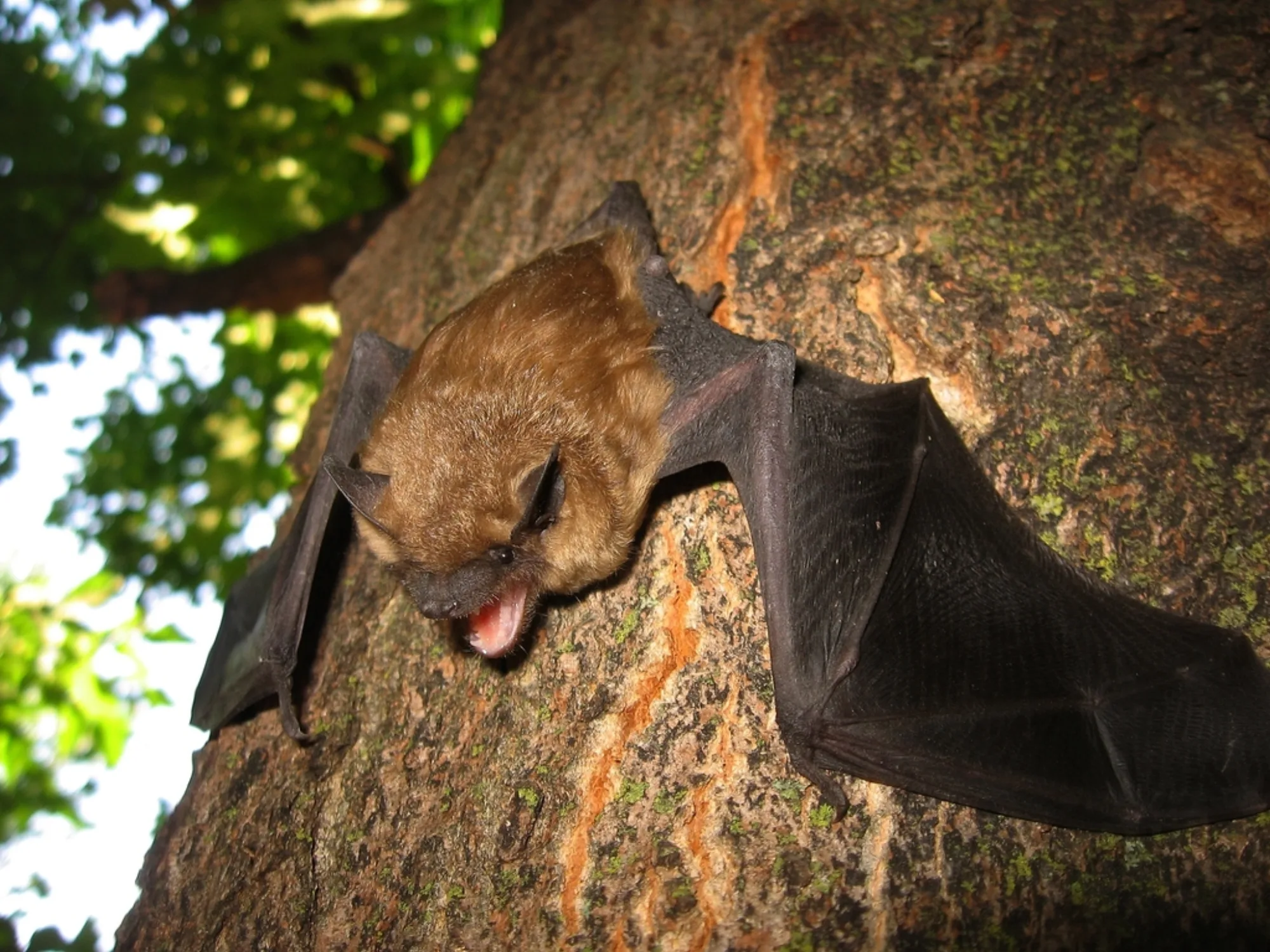
With glossy reddish-brown fur on its back, lighter fur underneath and short, rounded black ears, the Big Brown Bat is a relatively large microbat. Its black wings span 32.5 to 35 cm, and adults measure 110 to 130 mm in body length. Its range stretches from southern Canada and Alaska through Central America to Colombia and Venezuela, and includes Caribbean islands such as Cuba, Dominica and Barbados. Adaptable to urban, suburban and rural surroundings, it has also been recorded at elevations of 300 to 3,100 m.
By day, these bats shelter in places ranging from tree cavities and rock crevices to caves, tunnels and buildings. They hunt at night, sometimes around city street lamps, and use echoes to navigate and locate objects. Beetles are a favoured food, though the menu also includes flies, moths and caddisflies, with the mix varying by region. Some of their prey, including cucumber beetles, are agricultural pests. In summer, males usually roost alone, although some gather in small male colonies or share roosts with females. After breeding in autumn and hibernating through winter, females gather in maternity colonies in spring, often in buildings in human-dominated landscapes. Mothers leave their pups at the roost while they hunt, and the young begin to fly at three to five weeks old.
Predators include owls, American kestrels, long-tailed weasels and American bullfrogs. Rabies can affect Big Brown Bats, although some individuals have immunity and infections occur in a low proportion. The species is relatively resistant to white-nose syndrome, a fungal disease that has caused severe declines in other bats, and some populations have increased since its arrival in North America.
Written from the English Wikipedia article Big brown bat (CC BY-SA 4.0).
- Records
- 1,258
- Countries
- 5
- Atlas places
- 3
These are open occurrence records, so they show where people looked for and recorded the Big Brown Bat as much as where it lives. Cells are up to 25 km across, and every location is generalised to its cell.
Generalised encounter areas, not exact locations. Each shape is a grid cell coloured by how likely the species is there.
- Very likelyUnited States25 km zone · medium confidence · 662 records · updated 80 days ago
- Very likelyMexico25 km zone · medium confidence · 405 records · updated 80 days ago
- Very likelyColombia25 km zone · medium confidence · 95 records · updated 80 days ago
- Very likelyCanada25 km zone · medium confidence · 93 records · updated 80 days ago
- LikelyPuerto Rico25 km zone · medium confidence · 3 records · updated 80 days ago
Conservation status not assessed here yet, so every location is generalised to its grid cell.