Dusky Grouper
Epinephelus marginatus
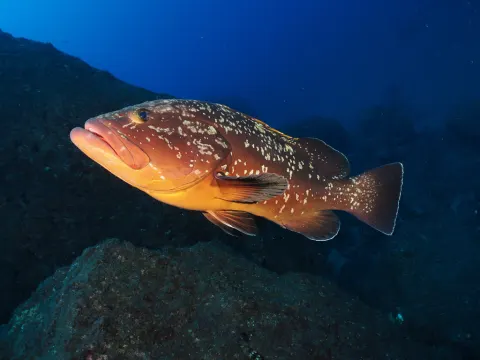
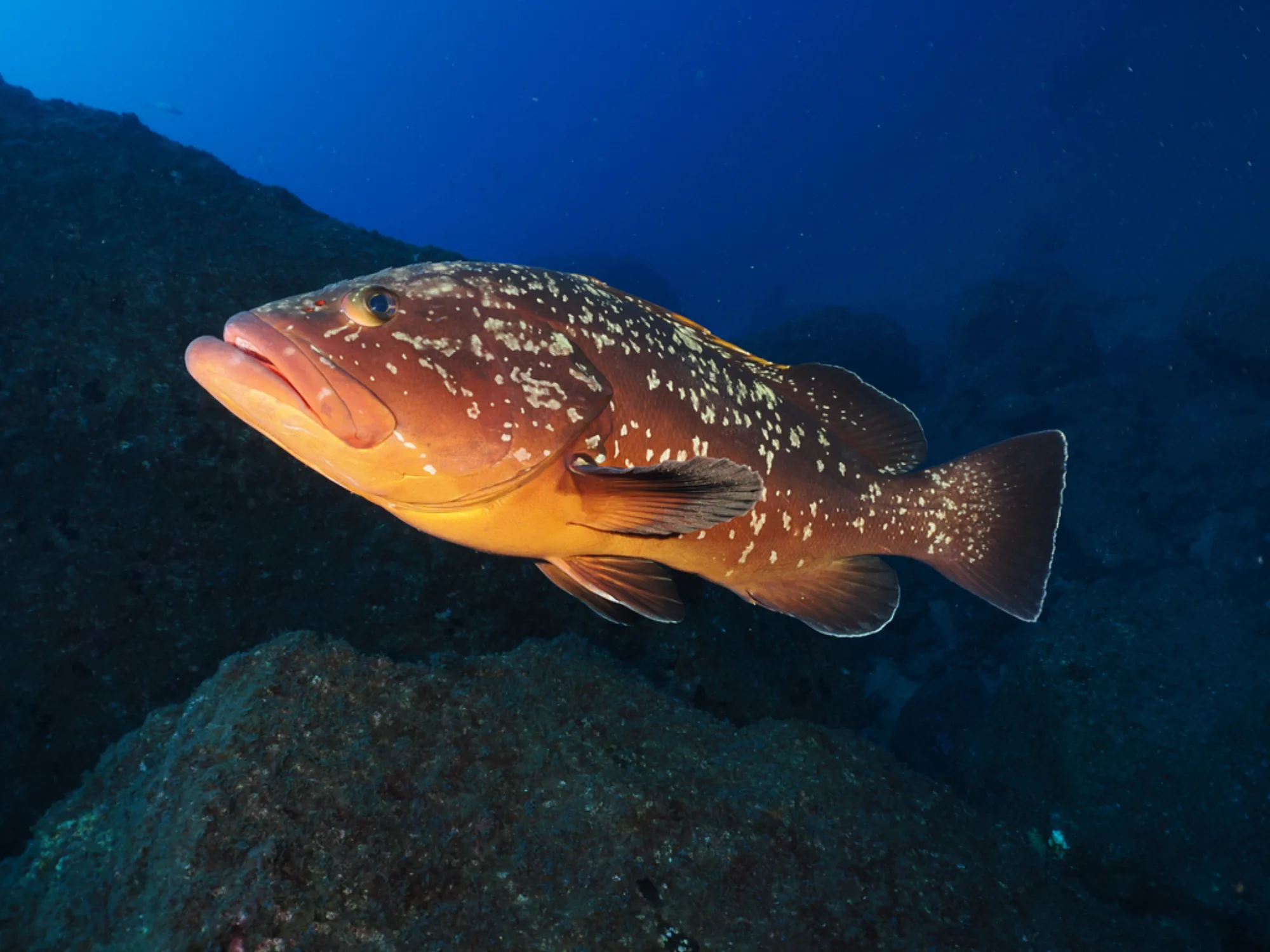
A broad head, wide mouth and oval body give the Dusky Grouper a distinctive shape. Its head and upper body are dark reddish brown or greyish, with conspicuous pale blotches, while the underside is often yellowish gold. It can reach 150 cm in length, although 90 cm is more usual.
This coastal fish occurs throughout the Mediterranean and along the eastern Atlantic from Iberia to the Cape of Good Hope, extending into the south-western Indian Ocean. Another population lives off southern Brazil, Uruguay and northern Argentina. Look for it around rocky reefs, sometimes near beds of Posidonia sea grass, from the surface down to 300 metres. Young fish tend to stay closer to shore than adults and can turn up in rock pools; in protected areas, both young and adults occur in shallow water. Adults usually live alone and defend territories, though fish of all ages also enter brackish estuaries. Molluscs, crustaceans and octopuses are mainstays of the diet, with reef fish becoming more important as a grouper grows.
Dusky Groupers begin adult life as females, and some later become males. Females start breeding at around five years old, and the change to male most commonly occurs at 12. During the breeding season, small groups gather at particular spawning sites, including the Medes Islands in Spain and Port-Cros National Park in France. Mediterranean spawning takes place from June to September, while off Brazil it occurs between November and December. Commercial fishing, angling and spearfishing all take this fish; its slow growth and reproductive pattern make it susceptible to overexploitation. Targeting large males can further distort the balance between the sexes and affect reproduction.
Written from the English Wikipedia article Epinephelus marginatus (CC BY-SA 4.0).
- Records
- 9,306
- Countries
- 17
- Atlas places
- 1
These are open occurrence records, so they show where people looked for and recorded the Dusky Grouper as much as where it lives. Cells are up to 25 km across, and every location is generalised to its cell.
Generalised encounter areas, not exact locations. Each shape is a grid cell coloured by how likely the species is there.
- Very likelyFrance25 km zone · high confidence · 5435 records · updated 80 days ago
- Very likelyBrazil25 km zone · medium confidence · 2295 records · updated 80 days ago
- Very likelySpain25 km zone · high confidence · 667 records · updated 80 days ago
- Very likelyItaly25 km zone · high confidence · 215 records · updated 80 days ago
- Very likelyMozambique25 km zone · medium confidence · 183 records · updated 80 days ago
- Very likelyMalta25 km zone · high confidence · 172 records · updated 80 days ago
- Very likelyMonaco25 km zone · medium confidence · 51 records · updated 80 days ago
- Very likelyMauritania25 km zone · medium confidence · 37 records · updated 80 days ago
- LikelyPortugal25 km zone · medium confidence · 79 records · updated 80 days ago
- LikelySouth Africa25 km zone · medium confidence · 76 records · updated 80 days ago
Conservation status not assessed here yet, so every location is generalised to its grid cell.