Giant Grouper
Epinephelus lanceolatus
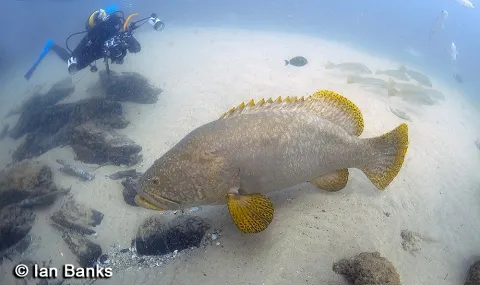
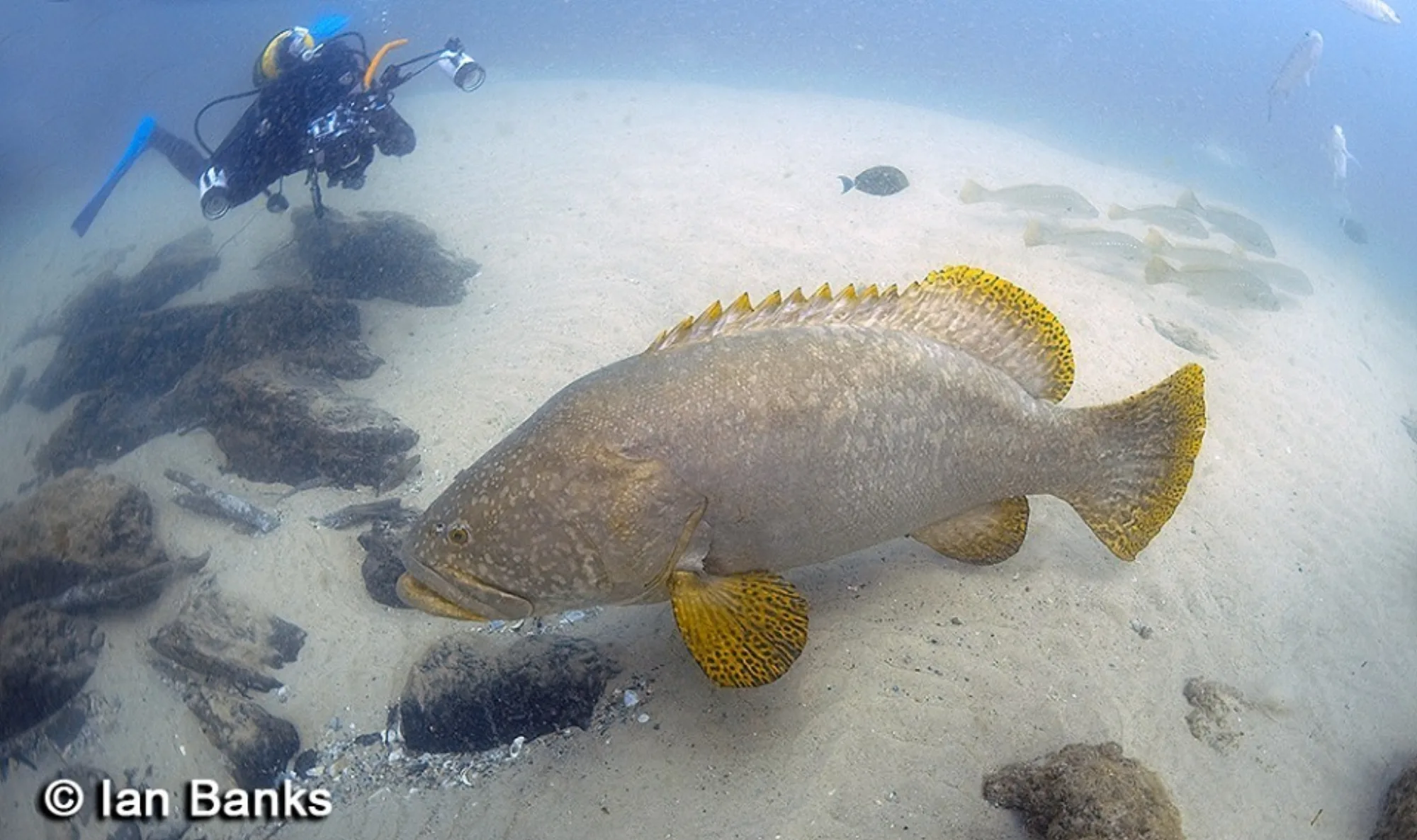
A heavy-bodied reef fish, the Giant Grouper ranks among the largest living bony fish. It can reach 270 centimetres in standard length and 400 kilograms in weight, though fish around 180 centimetres are more common. Adults are greyish-brown with mottled markings and darker fins, while small juveniles are yellow with broad, irregular dark bars and spotted fins.
Its range stretches from the Red Sea and eastern Africa across the Indian Ocean to the western Pacific, reaching Hawaii and the Pitcairn Islands. Its northern limit reaches southern Japan, and its southern range extends to Australia; it is absent from the Persian Gulf. Giant groupers inhabit shallow water at depths of 1 to 100 metres, around reefs, caves and wrecks. Adults hold territories on outer reefs and in lagoons, while secretive juveniles shelter among reefs and are seldom seen. Large fish have also been caught from shore, in harbours and over silty or muddy seabeds in turbid water.
Usually solitary and long-lived, the fish can be curious and often approaches divers closely. Divers are advised to treat large individuals with caution and avoid hand feeding them, following reports of attacks on humans. An ambush predator, it swallows fish, small sharks and rays, young sea turtles, crustaceans and molluscs whole. On coral reefs and in rocky areas, it favours spiny lobsters, while fish studied in South African estuaries ate almost exclusively crabs. Giant groupers gather to spawn on a lunar cycle, with spawning lasting about 7 days. They are caught by commercial and recreational fisheries and valued in the live reef food fish trade, particularly as smaller specimens.
Written from the English Wikipedia article Giant grouper (CC BY-SA 4.0).
- Records
- 49
- Countries
- 9
- Atlas places
- 1
These are open occurrence records, so they show where people looked for and recorded the Giant Grouper as much as where it lives. Cells are up to 25 km across, and every location is generalised to its cell.
Generalised encounter areas, not exact locations. Each shape is a grid cell coloured by how likely the species is there.
- Very likelyAustralia25 km zone · medium confidence · 27 records · updated 80 days ago
- Very likelyU.S. Outlying Islands25 km zone · medium confidence · 5 records · updated 80 days ago
- Very likelyBelize25 km zone · medium confidence · 4 records · updated 80 days ago
- Very likelyPhilippines25 km zone · medium confidence · 4 records · updated 80 days ago
- LikelySouth Africa25 km zone · medium confidence · 4 records · updated 80 days ago
- LikelyMayotte25 km zone · medium confidence · 3 records · updated 80 days ago
- PossibleNew Caledonia25 km zone · medium confidence · 2 records · updated 80 days ago
- PossibleKenya25 km zone · low confidence · 0 records · updated 80 days ago
- UncommonMalaysia25 km zone · low confidence · 0 records · updated 80 days ago
Conservation status not assessed here yet, so every location is generalised to its grid cell.