Red-and-blue Lory
Eos histrio
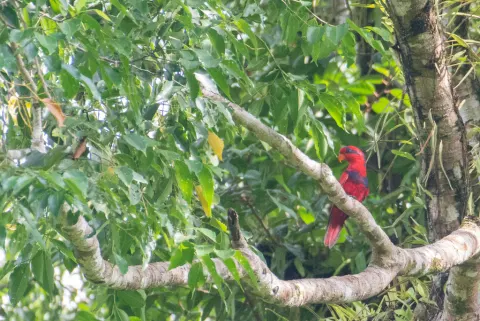
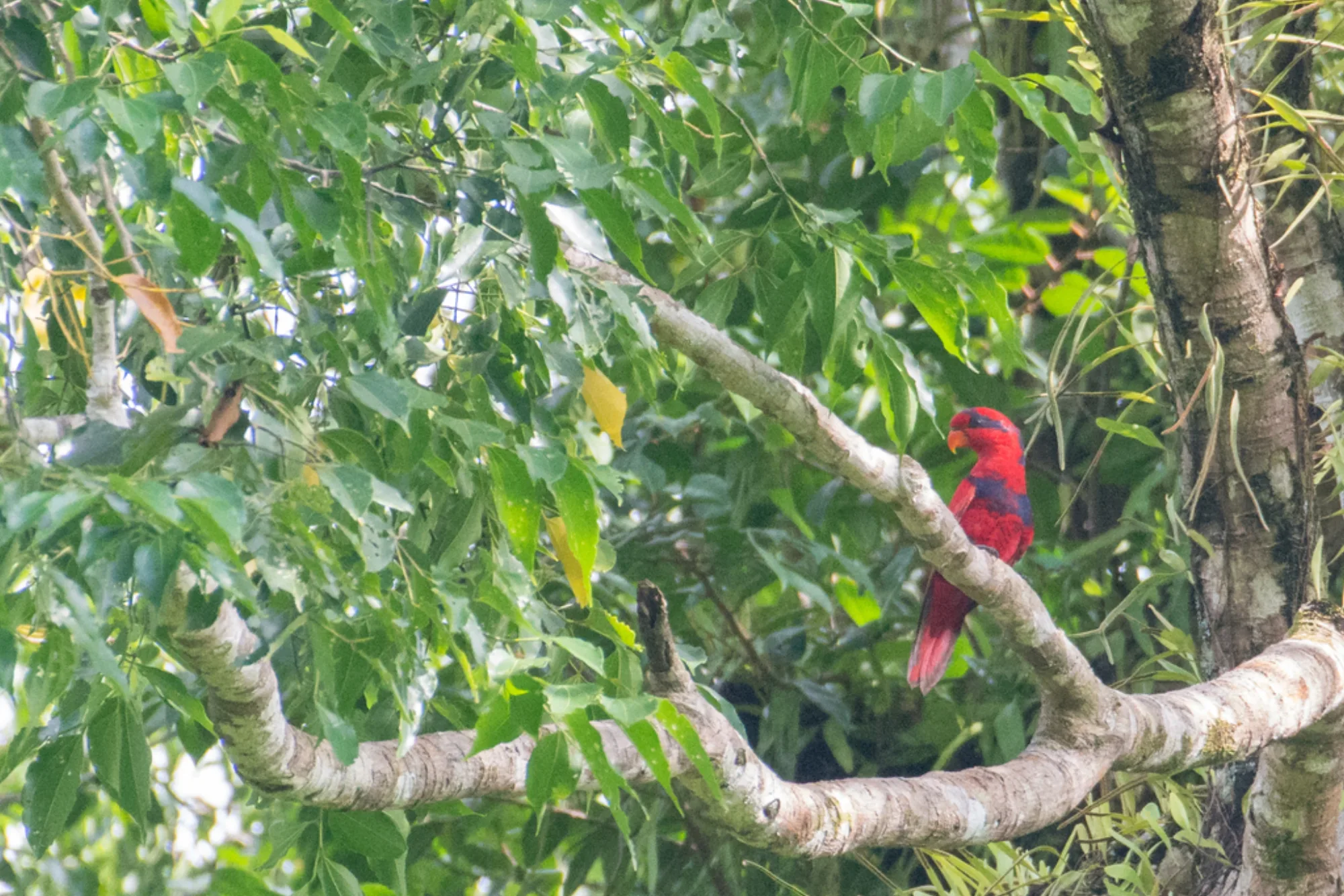
Endemic to the Indonesian archipelago, the Red-and-blue Lory is a small parrot measuring roughly 12 inches in length. Its plumage is mostly bright red, accented by an intense purple crown and an indigo-violet stripe running from the face to the nape of the neck. A broad band of deep blue marks the breast, while the back and legs show shades of violet and bluish-purple. These birds have short, bright orange beaks and move with a quick, straight flight.
Travellers will find this species almost exclusively on the island of Karakelong, where it lives in forests from sea level to 1,500 meters. These parrots are strictly arboreal and never forage on the ground, preferring a diet of nectar and pollen supplemented by fruit and insects. While they are known for being raucous and noisy, they typically fall silent when feeding. Outside of the breeding season, they form social flocks that gather in palm plantations and may fly between islands to find food.
Survival is difficult for this bird, with only 2,400 to 8,400 individuals estimated to remain in the wild. Logging is a major threat as the birds require mature trees for nesting. They also face risks from illegal trapping for the pet trade, with many poached specimens sent to the Philippines. Other dangers include insecticide spraying on coconut plantations and diseases spread by escaped domestic poultry. Although protected by law, the population continues to decline across its fragmented range.
Written from the English Wikipedia article Red-and-blue lory (CC BY-SA 4.0).
- Records
- 0
- Countries
- 1
- Atlas places
- 0
These are open occurrence records, so they show where people looked for and recorded the Red-and-blue Lory as much as where it lives. Cells are up to 25 km across, and every location is generalised to its cell.
Generalised encounter areas, not exact locations. Each shape is a grid cell coloured by how likely the species is there.
- Very likelyIndonesia50 km zone · low confidence · 0 records · updated 4 days ago